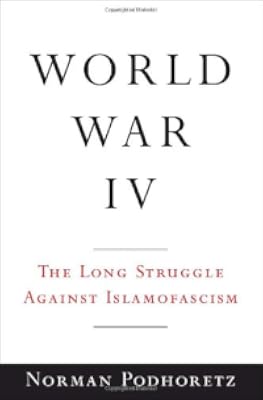
World War IV
by Norman Podhoretz
On This Page
Description
For almost half a century--as a magazine editor and as the author of numerous bestselling books and hundreds of articles--Norman Podhoretz has helped drive the central political and intellectual debates in this country. Now, in this provocative and powerfully argued book, he takes on the most controversial issue of our time--the war against the global network of terrorists that attacked us on 9/11.Tags
Recommendations







Member Reviews
I've read that neocons are optimists while paleocons are pessimists. That sentiment is certainly true of this short book. Podhoretz is certainly a Bush supporter in nearly every foreign policy decision, and is confident that the Bush Doctrine will survive. This is based on history's disproving of all other strategies (realpolitik, liberal internationalism).
While I was hoping for a treatise on how America needs to mobilize for what Podhoretz calls World War IV, this book is basically a rehash of how we got to where we are today (or better, where we were in late 2006). It's amazing to read the political comments made by both sides that showed the unity of opinion early on as compared to what the current situation. He also looks at the show more parallels to the domestic bickering in WWII and WWIII (the Cold War).
All in all, it's interesting and would be a good primer for those who've not paid too close attention the last 6 years. However, if you're looking for a book on suggested policies to win the war (something more Gingrich-esque) this is not it. show less
While I was hoping for a treatise on how America needs to mobilize for what Podhoretz calls World War IV, this book is basically a rehash of how we got to where we are today (or better, where we were in late 2006). It's amazing to read the political comments made by both sides that showed the unity of opinion early on as compared to what the current situation. He also looks at the show more parallels to the domestic bickering in WWII and WWIII (the Cold War).
All in all, it's interesting and would be a good primer for those who've not paid too close attention the last 6 years. However, if you're looking for a book on suggested policies to win the war (something more Gingrich-esque) this is not it. show less
This is a quick and easy read but one to stir up controversy if you follow his argument. There are not many people willing to take a positive view of the neocons, since currently they are regularly lampooned publicly, nor many who would dare say that Bush is right on foreign policy but Podhoretz is one such person who will. The closest analogy to Bush he argues is Truman in 1947 who unpopularly enunciated his Doctrine of containment against the Soviets. Eisenhower although differing in many ways did not alter the Truman Doctrine. Podhoretz argues that the Bush Doctrine of preemptive action against our enemies is correct and will be proven true historically.
The main elements of the Bush Doctrine were delineated in a National Security show more Council document, the National Security Strategy of the United States, published on September 20, 2002, as updated in 2006, it states:
“It is an enduring American principle that this duty obligates the government to anticipate and counter threats, using all elements of national power, before the threats can do grave damage. The greater the threat, the greater is the risk of inaction – and the more compelling the case for taking anticipatory action to defend ourselves, even if uncertainty remains as to the time and place of the enemy’s attack. There are few greater threats than a terrorist attack with WMD. To forestall or prevent such hostile acts by our adversaries, the United States will, if necessary, act preemptively in exercising our inherent right of self-defense."
There is another group categorized by Podhoretz as the Realists. Henry Kissinger is in this school of thought as an application of Wilsonism revisited. This school saw a balance of power as ideal, they emphasized stability, and the ideal state is that established in the Treaty of Westphalia. In contrast to the liberal internationalists, the realists have no problem with using power when it is needed.
Pre-911 Bush was a realist, a policy he abandoned with the demise of the towers. Bush stated:
"For decades, free nations tolerated repression in the Middle East for the stake of stability. In practice, this approach brought little stability and much oppression, so I have changed this policy (p. 133)."
Bush repudiated the realist school.
He went beyond what the internationalists thought possible. Not only did he retaliate against Afghanistan, they attacked us so we hit back, but Bush was committed to regime change as well, and he attacked Iraq also.
The hope of the internationalists and the realists then became the prospect of defeat in Iraq. Typical of this view is the realist, who when mixed with a bit of the internationalist, sees defeatism as welcomed as in Jimmy Carter's Secretary of State.
The Bush doctrine may be seen in direct contrast to the failed policies of Zbigniew Brzezinski. He considered Iraq a "hopeless battle" (p. 139); his policies "emboldened the Iranians to seize American hostages" (p. 139); then, his boss, the disastrous Jimmy Carter waited for over a year to attempt a hostage rescue, which led to an bungled attempt at rescue; and, Brzezinski was blind to the Soviet invasion of Afghanistan. show less
The main elements of the Bush Doctrine were delineated in a National Security show more Council document, the National Security Strategy of the United States, published on September 20, 2002, as updated in 2006, it states:
“It is an enduring American principle that this duty obligates the government to anticipate and counter threats, using all elements of national power, before the threats can do grave damage. The greater the threat, the greater is the risk of inaction – and the more compelling the case for taking anticipatory action to defend ourselves, even if uncertainty remains as to the time and place of the enemy’s attack. There are few greater threats than a terrorist attack with WMD. To forestall or prevent such hostile acts by our adversaries, the United States will, if necessary, act preemptively in exercising our inherent right of self-defense."
There is another group categorized by Podhoretz as the Realists. Henry Kissinger is in this school of thought as an application of Wilsonism revisited. This school saw a balance of power as ideal, they emphasized stability, and the ideal state is that established in the Treaty of Westphalia. In contrast to the liberal internationalists, the realists have no problem with using power when it is needed.
Pre-911 Bush was a realist, a policy he abandoned with the demise of the towers. Bush stated:
"For decades, free nations tolerated repression in the Middle East for the stake of stability. In practice, this approach brought little stability and much oppression, so I have changed this policy (p. 133)."
Bush repudiated the realist school.
He went beyond what the internationalists thought possible. Not only did he retaliate against Afghanistan, they attacked us so we hit back, but Bush was committed to regime change as well, and he attacked Iraq also.
The hope of the internationalists and the realists then became the prospect of defeat in Iraq. Typical of this view is the realist, who when mixed with a bit of the internationalist, sees defeatism as welcomed as in Jimmy Carter's Secretary of State.
The Bush doctrine may be seen in direct contrast to the failed policies of Zbigniew Brzezinski. He considered Iraq a "hopeless battle" (p. 139); his policies "emboldened the Iranians to seize American hostages" (p. 139); then, his boss, the disastrous Jimmy Carter waited for over a year to attempt a hostage rescue, which led to an bungled attempt at rescue; and, Brzezinski was blind to the Soviet invasion of Afghanistan. show less
A Strong Argument that the Cold war was WW III and ended with USSR breakup and that we have entered into WW IV ever since Islamic Terrorism Started and Its fully engaged since 9-11
Stopped reading.
Ratings
Members
- Recently Added By
Lists

Radical Islam/Islamism
75 works; 6 members
Author Information

23+ Works 1,012 Members
Norman Podhoretz is editor at large for Commentary magazine.
Awards and Honors
Distinctions
Common Knowledge
- Canonical title
- World War IV
Classifications
- Genres
- Nonfiction, General Nonfiction, History, Religion & Spirituality, Politics and Government
- DDC/MDS
- 973.931 — History & geography History of North America United States 1901- New Millennium, Post 9/11 (2001-Present) George W. Bush (2001-2009) Sept 11 Attacks, Iraq War, Patriot Act
- LCC
- HV6432 .P63 — Social sciences Social pathology. Social and public welfare. Criminology Social pathology. Social and public welfare. Criminology Crimes and offenses
- BISAC
Statistics
- Members
- 174
- Popularity
- 184,869
- Reviews
- 4
- Rating
- (3.37)
- Languages
- English
- Media
- Paper, Ebook
- ISBNs
- 3
- ASINs
- 2