On This Page
Description
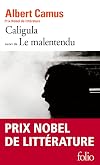
New translations of two plays by Nobel laureate Albert Camus that strip away decades of misinterpretation of the playwrights intentions. "The translations ably capture the menace and atmosphere of Camus writing"-Ruth Little, Literary Manager, Royal Court Theatre, London UK. "Spare, unforgiving and direct, much as Camus would want it I suspect"-Geordie Brookman, Artistic Director, State Theatre Company of South Australia.Tags
Recommendations































Member Reviews
Camus is the thinker of the absurd. That’s well known. But his absurd isn’t ours. We tend to forget that his was shaped by Nazism, Stalinism, La Résistance, the Algerian Question. Caligula is a drama not just of the absurd but the political absurd; The Misunderstanding a tragedy tied to the pointless cruelty exiles face returning home. The lesson of Scipio and Cherea, of Caligula himself, of Jan and Maria, is that if life is meaningless, that fact must be confronted while taking into account one’s time and place. Reading these plays, you realize that a moral realism foreign to most of us today girds Camus’s art, even as he questions everything.
Of the two plays in this book, I found Le malentendu (the misunderstood/the misunderstanding - usually translated as Cross Purpose) to be the more gripping. Indeed, it ranks among the finest plays I have ever read. The feeling one gets while reading the play is the same one finds in the archetypal Greek tragedies, a sense of relentless descent into ruin that is incredibly powerful, and at the same time deeply unsettling, yet beautiful. The play is not without its surreal moments too; the character of the servant, who never speaks, would doubtless be more effective on stage, but remains a powerful presence even in print.
Caligula is a historical play about the eponymous ex-Roman emperor, who descends into a series of cruel and depraved acts after the death of his sister and lover Drusilla. His realization that men die unhappy leads him to attempt to exercise autonomy and personal freedom to the greatest and purest extremes. Caligula repeatedly asks one of his subjects, Hélicon, to “bring him the moon,” believing that if the absolute were attained on at least one occasion, he would be satisfied and perhaps alter his actions. As the moon cannot be brought to him, he basically does the vilest, cruelest things he can imagine, convinced that all men are wicked and the sooner they die, the better really. His rebellion against mankind and his exercises of show more free will over the people that surround him isolate him further and further, although his basic idea that people can’t ever really understand each other anyways makes him not really care. This violent application of free will and his pursuit of absolutes are destined to never truly satisfy him, and he spirals onward with a mix of despair and disdain until the violent end of the play.
This play was most interesting to me in relation to Camus’ novels, especially L’Étranger, because of the seismic shift from an emperor in ancient Rome (Caligula) to an everyman in modern times (Meursault). While Camus in both books looks at the absurdity of life, Meursault and Caligula have different relationships with this absurdity, and vastly different possibilities with regard to their actions and interactions. Caligula attacks human life, which he has come to see as meaningless, and basically does whatever the hell he wants with the idea that if an unhappy death is our lot, the things that come before are meaningless. I liked seeing a different story of a person who finds life to be rather meaningless, and I liked just how different the time period, situation and driving force of Caligula were. If Camus was trying to develop a certain view on existence, I think it was a really cool choice to look at its possible individual ramifications by applying it to an emperor in Ancient Rome and then later doing so with a modern everyman.
Le Malentendu was fun to read because it gave me an immediate and persistent sense of déjà vu. I knew I had experienced the story before, but I couldn’t remember where, even though it was very clear in my mind. I explained it to my girlfriend and she felt the same way, and it kept bugging me, so rather than let it (eventually, hopefully) come to me, I looked it up and found out that, indeed, Le Malentendu is an expansion of the newspaper story that Meursault reads while in prison in L’Étranger. It’s about the homecoming of a man, Jan, who left his mother and sister behind many years ago, and who wants to reintroduce himself in their lives and use his good fortune in life toward their happiness. He doesn’t want to reveal himself to them immediately, or he doesn’t know how, and so he interacts with them as a stranger and decides to spend a night in their inn. His sister is the tragic center of the story, and her dreams of leaving the bleak countryside where she has spent her whole life fall in line with her anonymous brother’s means and desire to fulfill them, although the resolution of it all is not a happy one. It’s a short play, and the sister, Martha, is also convinced of the absurdity of life. I saw a lot in common between her, Caligula and Meursault, and her final interaction with Jan’s wife Maria reminded me a lot of Meursault’s final talk with the priest in L’Étranger. I enjoyed this short play, and like how Camus has fleshed out something only briefly mentioned in another one of his books, creating added connections in his fictional world. I know that a lot of authors make gestures to other works and build fictional connections between one book and another, and I feel like it’s a nice reward to the reader, who takes the time to read more and more books by the same person.
I think I’ll take a look at some basic summaries of Camus’ background and philosophical propositions now that I’ve gotten a few of his representations of individuals and the implications of feelings of meaninglessness and absurdity in life. show less
This play was most interesting to me in relation to Camus’ novels, especially L’Étranger, because of the seismic shift from an emperor in ancient Rome (Caligula) to an everyman in modern times (Meursault). While Camus in both books looks at the absurdity of life, Meursault and Caligula have different relationships with this absurdity, and vastly different possibilities with regard to their actions and interactions. Caligula attacks human life, which he has come to see as meaningless, and basically does whatever the hell he wants with the idea that if an unhappy death is our lot, the things that come before are meaningless. I liked seeing a different story of a person who finds life to be rather meaningless, and I liked just how different the time period, situation and driving force of Caligula were. If Camus was trying to develop a certain view on existence, I think it was a really cool choice to look at its possible individual ramifications by applying it to an emperor in Ancient Rome and then later doing so with a modern everyman.
Le Malentendu was fun to read because it gave me an immediate and persistent sense of déjà vu. I knew I had experienced the story before, but I couldn’t remember where, even though it was very clear in my mind. I explained it to my girlfriend and she felt the same way, and it kept bugging me, so rather than let it (eventually, hopefully) come to me, I looked it up and found out that, indeed, Le Malentendu is an expansion of the newspaper story that Meursault reads while in prison in L’Étranger. It’s about the homecoming of a man, Jan, who left his mother and sister behind many years ago, and who wants to reintroduce himself in their lives and use his good fortune in life toward their happiness. He doesn’t want to reveal himself to them immediately, or he doesn’t know how, and so he interacts with them as a stranger and decides to spend a night in their inn. His sister is the tragic center of the story, and her dreams of leaving the bleak countryside where she has spent her whole life fall in line with her anonymous brother’s means and desire to fulfill them, although the resolution of it all is not a happy one. It’s a short play, and the sister, Martha, is also convinced of the absurdity of life. I saw a lot in common between her, Caligula and Meursault, and her final interaction with Jan’s wife Maria reminded me a lot of Meursault’s final talk with the priest in L’Étranger. I enjoyed this short play, and like how Camus has fleshed out something only briefly mentioned in another one of his books, creating added connections in his fictional world. I know that a lot of authors make gestures to other works and build fictional connections between one book and another, and I feel like it’s a nice reward to the reader, who takes the time to read more and more books by the same person.
I think I’ll take a look at some basic summaries of Camus’ background and philosophical propositions now that I’ve gotten a few of his representations of individuals and the implications of feelings of meaninglessness and absurdity in life. show less
Caligula : C'est une vérité toute simple et toute claire, un peu bête, mais difficile à découvrir et lourde à porter.
Hélicon : Et qu'est-ce donc que cette vérité, Caïus ?
Caligula : Les hommes meurent et ils ne sont pas heureux.
Hélicon : Allons, Caïus, c'est une vérité dont on s'arrange très bien. Regarde autour de toi. Ce n'est pas cela qui les empêche de déjeuner.
Caligula : Alors, c'est que tout, autour de moi, est mensonge, et moi, je veux qu'on vive dans la vérité !
Hélicon : Et qu'est-ce donc que cette vérité, Caïus ?
Caligula : Les hommes meurent et ils ne sont pas heureux.
Hélicon : Allons, Caïus, c'est une vérité dont on s'arrange très bien. Regarde autour de toi. Ce n'est pas cela qui les empêche de déjeuner.
Caligula : Alors, c'est que tout, autour de moi, est mensonge, et moi, je veux qu'on vive dans la vérité !
קראתי כנער ואהבתי מאוד
9788420636962
Members
- Recently Added By
Author Information

359+ Works 108,173 Members
Born in 1913 in Algeria, Albert Camus was a French novelist, dramatist, and essayist. He was deeply affected by the plight of the French during the Nazi occupation of World War II, who were subject to the military's arbitrary whims. He explored the existential human condition in such works as L'Etranger (The Outsider, 1942) and Le Mythe de Sisyphe show more (The Myth of Sisyphus, 1942), which propagated the philosophical notion of the "absurd" that was being given dramatic expression by other Theatre of the Absurd dramatists of the 1950s and 1960s. Camus also wrote a number of plays, including Caligula (1944). Much of his work was translated into English. He was awarded the Nobel Prize for Literature in 1957. Camus died in an automobile accident in 1960. (Bowker Author Biography) show less
Series

Belongs to Publisher Series
Work Relationships
Is contained in
Contains
Common Knowledge
- Canonical title
- Caligula / Cross Purpose
- Original title
- Caligula suivi de Le malentendu
- Alternate titles*
- Caligula / Le malentendu
- Original publication date
- 1944
- People/Characters
- Caligula; Milonia Caesonia
- Dedication*
- À mes amis du théâtre de l'Équipe
- Original language
- French
*Some information comes from Common Knowledge in other languages. Click "Edit" for more information.
Classifications
Statistics
- Members
- 613
- Popularity
- 47,501
- Reviews
- 9
- Rating
- (3.82)
- Languages
- 7 — Dutch, English, Finnish, French, Portuguese, Spanish, Swedish
- Media
- Paper, Audiobook, Ebook
- ISBNs
- 9
- UPCs
- 1
- ASINs
- 38