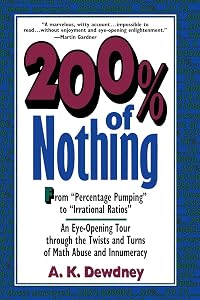
200% of Nothing: An Eye Opening Tour Through the Twists and Turns of Math Abuse and Innumeracy
by A. K. Dewdney
On This Page
Description
"In this delightfully witty excursion into the world of mathematical manipulation, popular columnist and math whiz A.K. Dewdney unveils the vast array of ways in which numbers are twisted and statistics are turned in order to fool the unsuspecting public. From the case of the "Incredible Expanding Toyota" to that of the "National Security Googol," Dewdney exposes the slick tricks and subtle schemes used by advertisers, politicians, special interest lobbyists, stockbrokers, car dealers, and show more just about anybody who tries to impress us with numbers, charts, and graphs." "At turns funny and infuriating, Two Hundred Percent of Nothing is packed with real-life examples from the worlds of advertising, government, business, and media that demonstrate all types of math abuses. Dewdney identifies them by name, from "number bludgeoning to occult sampling," and shows us exactly how they play upon our innumeracy - the common inability to understand the rules of percentages, ratios, statistics, and basic math logic. You may want to buy the halogen light bulbs that an ad claims will save you 200% on energy costs, until Dewdney points out that it's impossible to save any more than 100% of something. And you may never want to play the lottery again when you learn that your chances of winning are mathematically equivalent whether you play or not." "Why should we be skeptical of 4 out of 5 dentists surveyed?" "What's the bull behind the bull market?" "Do statistics really prove it's safer to fly than drive across country?" "When would financing a car through a dealer be a bad deal?" "With the wry wit and professorial wisdom that made his math column a favorite among Scientific American readers for nearly a decade, Dewdney gives the answers. Furthermore, he explains the basic math behind the answers so that the next time you see mathematical chicanery, you'll recognize it." "Though you may be shocked at how pervasive math abuse is, you may be even more astonished to discover how rapidly you can learn the simple tricks and basic logic of defending yourself against it. As Dewdney writes in his Introduction: "It is far easier to calculate a percentage than it is to drive a car." Math abusers are everywhere, but with Dewdney's shrewd pointers, you can easily catch them at their own game."--Jacket. show lessTags
Recommendations
















Member Reviews
I normally enjoy books like 200% of Nothing. The book claims to show the importance of being numerate but the examples used are simplistic, obvious and humorless. At least the book is a short and quick read, coming in shy of 200 pages.
There isn't much in terms of new examples with in 200% of Nothing. Anyone with even the minimum of interest will have heard of these examples and their solutions. A perfect example is the "Monty Hall" puzzle. Another chapter languishes over tossing coins. Coin toss odds are about the most basic of examples, twenty pages really don't need to be spent on the subject!
The book might be more interesting for less numerate readers. My husband and I have both read 200% of Nothing and agree that the examples are show more basic and the author's attitude towards his audience is rather condescending. A better book on the subject is How to Lie with Statistics by Darrell Huff. show less
There isn't much in terms of new examples with in 200% of Nothing. Anyone with even the minimum of interest will have heard of these examples and their solutions. A perfect example is the "Monty Hall" puzzle. Another chapter languishes over tossing coins. Coin toss odds are about the most basic of examples, twenty pages really don't need to be spent on the subject!
The book might be more interesting for less numerate readers. My husband and I have both read 200% of Nothing and agree that the examples are show more basic and the author's attitude towards his audience is rather condescending. A better book on the subject is How to Lie with Statistics by Darrell Huff. show less
The vast majority of these examples and pitfalls will be obvious and easy to avoid for people who paid attention during grade 10 math - and people who didn't, sadly, are unlikely to pick up the book. Its first chapters attempt to pique the reader's interest by covering ways in which advertisers deceive and utility companies defraud by misuse of math (whether deliberate or inadvertent.) That topic and some others in the book would probably catch the interest of high school students; if I was teaching high school math I would find it a useful reference book and use it as a basis for creating a few lessons - I'm sure that skeptical 15 years olds could probably find some badly misused or misleading math in the wild.
Innumeracy is a more widespread plague than is illiteracy, yet we don't seem to pay it any attention or mind. This is a mistake, as Dewdney handily points out. Reading this book, I was proud that the examples cited therein are things I no longer fall for, having read enough books on the subject to protect me heartily against such misinformation. Prouder still was that I had read several books in the bibliography. Where this work stands out a bit from the others is that the author shows how easy it is NOT to be innumerate, and patiently shows the reader how. Works like these are of paramount importance, but an entire movement will need to be created to move innumeracy front and center.
Great fun to read, even for non-math-geeks. And useful, too,
Indeholder "Preface", "Introduction", "1. Innumeracy and Math Abuse", " Light Bulbs that Generate Power", " Death by Aftermath", " Death by Filtering", " Instant Wealth and Rebounding Grades", " Drunk, Drugged, Depressed and Dangerous!", " The Irrelevant Fund", " A Million Drops in the Bucket", " The National Security Googol", " The Incredible Expanding Toyota", " Chart Abuse", " Graphic Distortion", "2. Statistics and Damned Lies", " The Great Pepsi Challenge", " Lotteries and Lightning", " Death Threats", " What Happens When You Toss Seven Coins 128 Times", " The Naked Fund Manager", " Numerical Terrorism at the Nuclear Plant", " Hitting the Hites", " Occult Samples", "3. The Mathematics of Advertising", " A Game for the Numerate", " show more Ivory Liquid Goes to Camp", " One-Page Wonders", " Will Life Jackets Kill You?", " For Sale: High-Price/Low-Performance Computers", " The 226.8 Gram Canary", "4. Intelligent Dice", " Dr. Lotto Dies Under the Knife", " Winning Ways?", " Winning Big", " Revenge of the Dice", " The World's Smartest Human Screws Up - or Does She?", " Her Answer? 'Switch'", "5. The Law of Zero Return", " Shortchanged!", " Portrait of the Bull", " Following the Herd", " Charts and Chicken Entrails", " Self-Fulfilling Prophets", " Dividend Spin", " The Money Forest", " The Law of Zero Return", "6. Caveat Emptor", " Casting Out Nines", " Hidden Costs", " Putting Your Best Foot into Your Mouth", "7. The Government Figures", " Getting Elected", " Staying Elected: Cooking the Stats", " Canadians Get the Picture", " Inflated Remarks", " More Money = Less Brains", " Cooking by Radar", " Number Numbness in the Think Tank", " Penny Larceny", "8. Living with Risk", " Testing the Waters", " The Plutonium Scare", " Numerically Enhanced Drugs", " Nightlining Oat Bran", " Testing Positive", " Planes (Trains) and Automobiles", "9. Gee-Whiz Media Math", " Sex and the Single Statistic", " Environmental Blunders", " The Unexpected Expectancy", " Inflating Inflation", " Sports Reports", "10. The Tip of the Iceberg", " The Educational Crisis", " Invasion of the Nerds", " What Do Mathematicians Do?", " Junk Science", "11. Everybody is a Mathematician", " The World of Games", " The World of Sherlock Holmes", " Mathematics in Life", " Jockeying for Position", " Mathematics Is Too Simple", "12. Street Math", " Numbers, Growth, and Decay", " When Numbers Combine", " Working with Probability", " Morbidity, Mortality, and Worse", " Combinatorics Counts", "Annotated Bibliography", "Acknowledgments: The Abuse Detectives", " Be a Math Abuse Detective", " Further Acknowledgments".
Nogle kedelige eksempler på journalist- eller reklame-matematik. Spar 200% på din elregning. Blah, blah, blah. Omkring side 68 er der en gennemgang af Monty Hall problemet, som er svagt mindre uinteressant end resten.
Forfatteren dokumenterer uforvarende at en forkert påstand fanger opmærksomheden og derfor er en god reklame. show less
Nogle kedelige eksempler på journalist- eller reklame-matematik. Spar 200% på din elregning. Blah, blah, blah. Omkring side 68 er der en gennemgang af Monty Hall problemet, som er svagt mindre uinteressant end resten.
Forfatteren dokumenterer uforvarende at en forkert påstand fanger opmærksomheden og derfor er en god reklame. show less
Oct 4, 2020 (Edited)Danish
Ratings
Members
- Recently Added By
Lists

The Great Courses: Your Deceptive Mind
60 works; 1 member
Author Information

27+ Works 1,944 Members
Recreations, his column which appeared in Scientific American for more than eight years. He has been an Associate Professor of Computer Science at the University of Western Ontario in Canada since 1968, and is president of Turing Omnibus, Inc. Among his many books on computer science, science and mathematics are Two Hundred Percent of Nothing show more (1993), an effort to expose abuses of math and statistics in everyday life and its companion work, Yes, We Have No Neutrons (1997). Dewdney is also interested in growing and distributing rare native trees, as manifested in his book, Hungry Hollow: The Story of a Natural Place (1998). Hungry Hollow examines the elements of a natural habitat in both time and space. (Bowker Author Biography) show less
Common Knowledge
- Original publication date
- 1993
- Dedication
- Dedicated with affection & respect
to
William H. (Pop) Adamson
The urgency of X
outweighed 33 teenagers. - First words
- What if you are already a mathematician and don't know it?
- Quotations
- "None of us really understands what's going on with all these numbers." -- David Stockman, Reagan's Budget Director, 1981.
"Now I think we are trying to get unemployment to go up [sic], and I think we are going to succeed." -- Ronald Reagan, during 1982 Republican fund-raiser. - Original language
- English
Classifications
Statistics
- Members
- 189
- Popularity
- 173,105
- Reviews
- 5
- Rating
- (3.39)
- Languages
- English, French, German
- Media
- Paper, Ebook
- ISBNs
- 3
- ASINs
- 2