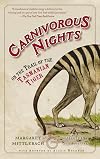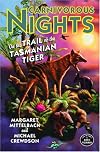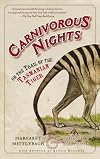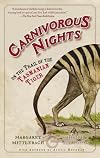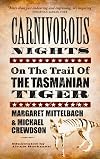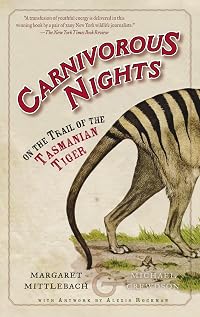
Carnivorous Nights: On the Trail of the Tasmanian Tiger
by Margaret Mittelbach, Michael Crewdson
On This Page
Description
"Packing an off-kilter sense of humor and keen scientific minds, authors Margaret Mittelbach and Michael Crewdson take off with renowned artist Alexis Rockman on a postmodern safari. Their mission? Tracking down the elusive Tasmanian tiger. This mysterious, striped predator was once the world's largest carnivorous marsupial. It had a pouch like a kangaroo and a jaw that opened impossibly wide to reveal terrifying choppers. Tragically, this rare and powerful animal was hunted into extinction show more in the early part of the twentieth century. Or was it?" "Journeying first to the Australian mainland and then south to the wild island of Tasmania, these young naturalists brave a series of bizarre misadventures and uproarious wildlife encounters in their obsessive search for this long-lost beast." "Filled with Alexis Rockman's drawings of flora and fauna - originally made from soil, wombat scat, and a drop or two of the artist's own blood - Carnivorous Nights is a hip and hilarious account of an unhinged safari, as well as a portrayal of a wildly unique part of the world."--BOOK JACKET. show lessTags
Recommendations



















Member Reviews
A kind of gonzo nature book, with a group of New Yorkers traipsing around Tassie getting high and trying to track down the Tasmanian tiger. It's filled with great characters, fun anecdotes and plenty of fascinating facts. The writing is clear and funny at times, but the collective first person pronoun style of narration ('we almost fell', 'we dreamed about Tassie devils' etc) grated a bit. It's ultimately a sad story, about the ways in which humans destroy the environment - the sections at the end really drive home the point that we've barely learned any lessons from the disasters like the extinction of the thylacine.
I'm a sucker for books about quests for hidden animals. It doesn't matter if the animal is real (a giant squid or coelacanth) or likely imaginary (Bigfoot or Ogopogo), I'm compelled by stories of people devoting their lives to search for them. In Carnivorous Nights, Margaret Mittelbach and Michael Crewdson tell the story of their own obsession with the Tasmanian tiger, an animal that scientists say has been extinct since the 1930s, yet some Tasmanians still believe otherwise. The two authors, along with artist friend Alexis Rockman and other occasional hangers-on, traveled to Tasmania to search for tigers and tiger experts. The resulting account is a funny, engaging foray into Tasmania's unique wildlife and culture.
The Tasmanian tiger, show more which is also commonly called the thylacine, looks like a skinny wolf with stripes on its hindquarters. The resemblance is misleading because it's a marsupial -- more closely related to a kangaroo than a dog. Because the thylacine walks on all fours, the female's pouch faces toward the rear so that her young won't fall out. The thylacine is a carnivore, like its cousin the Tasmanian devil. Thylacines once thrived in the unique ecosystem of Australia's southeastern island state, Tasmania, but their existence became threatened after Europeans started colonizing. People brought along their pets and livestock, which the thylacines promptly started eating. With government support, farmers then hunted the thylacine "pests" to extinction.
Sightings are still reported often, and though most are easily debunked, many hope the thylacine still hides in Tasmania's dense old-growth forests. The government records the sightings, but it's really only private citizens who take them seriously and do follow-up investigations. In the book we meet several of these passionate searchers and experts and follow them on night-time expeditions. Along the way they pick up roadkill to feed to Tasmanian devils, and similarly nasty materials for the artist Rockman to paint with. He mixes up pigment out of local substances like dirt, feces, and blood.
It's not all blood and gore, though. There are plenty of cute episodes with pademelons, which are like small kangaroos, and wombats, platypuses, and little blue penguins. Tasmanians clearly are in love with their wildlife, which adorn all manner of advertising and art. The thylacine tops them all in this respect. One of the most vivid episodes in the book is a visit to the "Tiger's Lair Café Bar," packed with paintings, cartoons, and every other artistic representation of thylacines you can imagine.
In the end, what emerges from the book is an appreciation of the special yet endangered ecosystem of Tasmania. Many fascinating and bizarre plants and animals evolved here. The forests are filled with prehistoric ferns and immense Eucalyptus regnans trees -- second only to the California redwood in height. The authors encounter marsupials like wombats, devils, quolls and potoroos, and other exotic creatures such as land leeches and bats the size of cats. An early explorer wrote of Tasmania's strange wildlife, "This land is cursed… the animals hop, not run, the birds run, not fly, and the swans are black, not white." Remarkably, Charles Darwin visited the island just a few months after his voyage to Galapagos, yet seemed not to notice or appreciate the evolutionary richness. The sad fact is that dozens of Tasmanian species are set to follow the thylacine into extinction, endangered by clearcutting of forests and the continued import of feral cats, dogs, foxes, and rabbits.
My only quibbles with the book are, first, that despite Rockman's wonderful art, some photographs would save the reader from frequent Googling for more realistic depictions, and, second, the narrative voice is a little distracting. The two authors use "we" for themselves, which becomes odd in recorded conversations between "we" and other, named, people -- it reads like a horror movie script with creepy twins speaking in a single voice. Speaking of horror movies, did you know that there was a movie called Howling III: The Marsupials? Marsupials rule -- this book will convince you.
(Reviewed for bookslut: http://www.bookslut.com/nonfiction/2006_06_009083.php) show less
The Tasmanian tiger, show more which is also commonly called the thylacine, looks like a skinny wolf with stripes on its hindquarters. The resemblance is misleading because it's a marsupial -- more closely related to a kangaroo than a dog. Because the thylacine walks on all fours, the female's pouch faces toward the rear so that her young won't fall out. The thylacine is a carnivore, like its cousin the Tasmanian devil. Thylacines once thrived in the unique ecosystem of Australia's southeastern island state, Tasmania, but their existence became threatened after Europeans started colonizing. People brought along their pets and livestock, which the thylacines promptly started eating. With government support, farmers then hunted the thylacine "pests" to extinction.
Sightings are still reported often, and though most are easily debunked, many hope the thylacine still hides in Tasmania's dense old-growth forests. The government records the sightings, but it's really only private citizens who take them seriously and do follow-up investigations. In the book we meet several of these passionate searchers and experts and follow them on night-time expeditions. Along the way they pick up roadkill to feed to Tasmanian devils, and similarly nasty materials for the artist Rockman to paint with. He mixes up pigment out of local substances like dirt, feces, and blood.
It's not all blood and gore, though. There are plenty of cute episodes with pademelons, which are like small kangaroos, and wombats, platypuses, and little blue penguins. Tasmanians clearly are in love with their wildlife, which adorn all manner of advertising and art. The thylacine tops them all in this respect. One of the most vivid episodes in the book is a visit to the "Tiger's Lair Café Bar," packed with paintings, cartoons, and every other artistic representation of thylacines you can imagine.
In the end, what emerges from the book is an appreciation of the special yet endangered ecosystem of Tasmania. Many fascinating and bizarre plants and animals evolved here. The forests are filled with prehistoric ferns and immense Eucalyptus regnans trees -- second only to the California redwood in height. The authors encounter marsupials like wombats, devils, quolls and potoroos, and other exotic creatures such as land leeches and bats the size of cats. An early explorer wrote of Tasmania's strange wildlife, "This land is cursed… the animals hop, not run, the birds run, not fly, and the swans are black, not white." Remarkably, Charles Darwin visited the island just a few months after his voyage to Galapagos, yet seemed not to notice or appreciate the evolutionary richness. The sad fact is that dozens of Tasmanian species are set to follow the thylacine into extinction, endangered by clearcutting of forests and the continued import of feral cats, dogs, foxes, and rabbits.
My only quibbles with the book are, first, that despite Rockman's wonderful art, some photographs would save the reader from frequent Googling for more realistic depictions, and, second, the narrative voice is a little distracting. The two authors use "we" for themselves, which becomes odd in recorded conversations between "we" and other, named, people -- it reads like a horror movie script with creepy twins speaking in a single voice. Speaking of horror movies, did you know that there was a movie called Howling III: The Marsupials? Marsupials rule -- this book will convince you.
(Reviewed for bookslut: http://www.bookslut.com/nonfiction/2006_06_009083.php) show less
Feeling like a travelogue mixed with natural history, this fantastic book was created out of a trip two naturalists and one artist made to Australia and Tasmania with one main purpose in mind- to find the Tasmanian tiger, or thylacine. Traveling across the island in search of a carnivorous marsupial long believed extinct, the adventurous threesome hiked through rainforests, up mountains, crept into caves and visited pubs and museums dedicated to the Tasmanian tiger. They interviewed many people of different sorts who still search for the thylacine, and enthusiasts including wildlife experts working to save endangered marsupials and scientists hoping to one day clone the thylacine from tissue of preserved specimens.
Just as fascinating as show more the lore about thylacines and the history of their demise presented in these pages are the descriptions of the astonishing and curious Tasmanian wildlife. There's lots of interesting information and humorous incidents in these pages, and I marked a dozen pages that mentioned animals or incidents I want to read more about. One odd thing about the book is that it's written entirely in the "we" form- which felt awkward at first, but eventually I was able to ignore it.
from the DogEar Diary show less
Just as fascinating as show more the lore about thylacines and the history of their demise presented in these pages are the descriptions of the astonishing and curious Tasmanian wildlife. There's lots of interesting information and humorous incidents in these pages, and I marked a dozen pages that mentioned animals or incidents I want to read more about. One odd thing about the book is that it's written entirely in the "we" form- which felt awkward at first, but eventually I was able to ignore it.
from the DogEar Diary show less
I enjoyed this one despite the narrative choice of using the second person plural. It made the authors sound like conjoined twins - or was it the royal "we"? - it was a consistent irritant throughout the book. Luckily the trek around Tasmania was interesting as an introduction to some of the nifty places and critters of that island. We've planned it as part of our trip to Oz next month (me and my conjoined twin) and I made notes and got ideas on where to go when we get there. Wombats - Old growth forest - Quolls - The Nut - Here I come!
I really liked it. I'm a bit straight laced so the occassinal drug use bugged me, but all in all a great look at Tasmania and the search for the devil. Loved the artwork.
Marget Mittelbach, Michel Crewdson, Alex Rockman set out on a safari to track the most probably extinct Tasmanian tiger, the largest carnivorous marsupial. Mittelbach and Crewdson's fascination began at the American Museum of Natural History in Manhattan but spread into a road trip that takes them to the Austrialian mainland as well as Tasmania. Their frequently side tracked adventure mixes a humorous travelogue with a scientific expedition and a dash of micro history. Rockman's interesting illustrations add a unique dimension to the tale.
The travel books of travel books for an up-close zany adventure through the wilds of the Tasmanian island bush where a band of odd human travelers meet animals face-t-face in their overall search for the elusive, thought by some to be extinct, Tasmanian Tiger--some call it the Tasmanian Marsupial Wolf.
Members
- Recently Added By
Author Information
2 Works 252 Members
3 Works 209 Members
All Editions
Common Knowledge
- Important places
- Australia; Tasmania, Australia
Classifications
Statistics
- Members
- 207
- Popularity
- 158,791
- Reviews
- 9
- Rating
- (3.73)
- Languages
- English
- Media
- Paper, Ebook
- ISBNs
- 5
- ASINs
- 1