
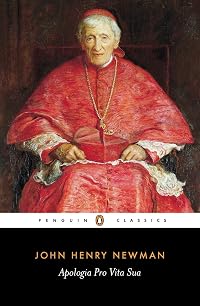
Apologia pro Vita Sua
by John Henry Newman
On This Page
Description
Even before the publication of his masterwork, John Henry Newman had been regarded as one of the most important religious thinkers on the 19th Century. His decision in 1845 to leave his Anglicanism behind and convert to the Roman Catholic faith was one that rocked the Victorian establishment at a time when virulent anti-Catholic feeling ran high. It was in response to one particularly vicious attack - by the Reverend Charles Kingsley - that Newman wrote his Apologia Pro Vita Sua. A humane show more and vivid account of the development of his ideas and his faith and a passionate defence of both, the book remains a landmark work of Victorian literature and autobiography and one that continues to resonate to this day. show lessTags
Recommendations










Member Recommendations
Member Reviews
This book belongs to that small subset of the memoir genre, spiritual autobiography. How does one make drama of one’s personal faith and change of allegiance? Although Newman writes at length in an orotund, full-blown Victorian style, the book held my interest in all but the driest passages.
The occasion for this book was a gratuitous attack on Newman by Charles Kingsley in an unrelated book review, followed by an unsatisfactory public exchange of letter and pamphlet. Newman felt the misrepresentation of what he believed severe enough to warrant this lengthy defense. However, he avers that his purpose is not to defend himself as much as the Roman church’s priesthood, membership, and teachings.
I write “Roman” church on purpose. show more Newman, with few exceptions, distinguishes in his book between the terms Catholic and Roman. “Catholic” means for him the universal church, of which Roman Catholicism was a part, as was the Eastern Orthodox tradition. He also long held the belief that the Anglican church (though not continental Protestants) was as well, though he abandoned this conviction.
One hundred and fifty years later, it seems to this reader that Kingsley came off the worse in this exchange. He is blind to the degree to which his anti-Roman bias causes him to misunderstand. Bon mots such as “While [Newman] tried to destroy others’ reason, he was at least fair enough to destroy his own” miss the mark. He doesn’t help his case by being so intemperate.
While he has the better of this controversy, Newman is also a problematic figure to me. His is a profoundly conservative, reticent nature. His turn to Rome came because he lost confidence that the Anglican church could successfully oppose what he calls Liberalism (aka, so Newman, “the spirit of Antichrist”). By this, he not only means the political program that went under that name in the nineteenth century but also developments in theology such as higher criticism. The inevitable result, Newman is convinced, is atheism, and Rome is the only bulwark against it. In his mind, he converted in the interest of Truth (written, as he did, with a capital T). From the perspective of a time when even conservative Bible scholars accept many of the results of higher criticism as true (small “t”), it seems tragic that such a fine mind should adopt, as Newman did, this bunker mentality. show less
The occasion for this book was a gratuitous attack on Newman by Charles Kingsley in an unrelated book review, followed by an unsatisfactory public exchange of letter and pamphlet. Newman felt the misrepresentation of what he believed severe enough to warrant this lengthy defense. However, he avers that his purpose is not to defend himself as much as the Roman church’s priesthood, membership, and teachings.
I write “Roman” church on purpose. show more Newman, with few exceptions, distinguishes in his book between the terms Catholic and Roman. “Catholic” means for him the universal church, of which Roman Catholicism was a part, as was the Eastern Orthodox tradition. He also long held the belief that the Anglican church (though not continental Protestants) was as well, though he abandoned this conviction.
One hundred and fifty years later, it seems to this reader that Kingsley came off the worse in this exchange. He is blind to the degree to which his anti-Roman bias causes him to misunderstand. Bon mots such as “While [Newman] tried to destroy others’ reason, he was at least fair enough to destroy his own” miss the mark. He doesn’t help his case by being so intemperate.
While he has the better of this controversy, Newman is also a problematic figure to me. His is a profoundly conservative, reticent nature. His turn to Rome came because he lost confidence that the Anglican church could successfully oppose what he calls Liberalism (aka, so Newman, “the spirit of Antichrist”). By this, he not only means the political program that went under that name in the nineteenth century but also developments in theology such as higher criticism. The inevitable result, Newman is convinced, is atheism, and Rome is the only bulwark against it. In his mind, he converted in the interest of Truth (written, as he did, with a capital T). From the perspective of a time when even conservative Bible scholars accept many of the results of higher criticism as true (small “t”), it seems tragic that such a fine mind should adopt, as Newman did, this bunker mentality. show less
I suspect I would have been better served reading about Newman than reading him, though his prose is quite lovely (by eighteenth century standards, at least, which are rather low). This is an excellent edition, though.
This seemed like an important work when I was in college, and still a Roman Catholic. It tells how cardinal Newman decided Anglicism was not the true religion for him.
Boy, did I not really get much out of this book. I was a bit curious, having also been one who sort of unexpectedly went Catholic one day, to some persons' surprise. To me the book is just rather locked in its timely position in 19th century English church life, and more universal aspects of faith and religion were passed aside. Fine, okay, no one says an autobiography has to be generational, but I expected more by this book's repuation.
Important read for anyone who is Anglican but finds themselves drawn to Rome. I'm not really qualified to give a good review of this book, but will say this: know your church history and Anglican documents well before you read--for instance it's important to know the 39 Articles, or at least have access to them, so you understand what Newman was wrestling with before he wrote Tract 90 and later went to Rome.
563. Apologia Pro Vita Sua: Being A History of his Religious Opinions, by John Henry Cardinal Newman (read 7 Dec 1958) This is a classic of its genre, and I suitably appreciated it as such, though I did no post-reading note, regrettably.
A highly influential figure in the Church of England, John Henry Newman stunned the Anglican community in 1843, when he left his position as vicar of St. Mary's, Oxford, to join the Roman Catholic church. Perhaps no one took greater offense than Protestant clergyman Charles Kingsley, whose scathing attacks against Newman's faith and honor inspired this brilliant response. Apologia Pro Vita Sua, Newman's spiritual autobiography, explores the depths and nature of Christianity with flowing prose and a conversational style that has ensured its status as a classic.
"False ideas may be refuted by argument, but by true ideas alone are they expelled. I will vanquish," Newman promised, "not my accuser, but my judges." His honest and passionate show more defense consists of a personal history of his religious convictions, from earliest memory through the Oxford movement and his ultimate conversion. His concluding point-by-point refutation of Kingsley's charges features thought-provoking contentions that strike at the very roots of the principles underlying Protestantism. Newman won respect and admiration with his Apologia, a work that has helped clarify perceptions of Roman Catholicism among readers of every faith. show less
"False ideas may be refuted by argument, but by true ideas alone are they expelled. I will vanquish," Newman promised, "not my accuser, but my judges." His honest and passionate show more defense consists of a personal history of his religious convictions, from earliest memory through the Oxford movement and his ultimate conversion. His concluding point-by-point refutation of Kingsley's charges features thought-provoking contentions that strike at the very roots of the principles underlying Protestantism. Newman won respect and admiration with his Apologia, a work that has helped clarify perceptions of Roman Catholicism among readers of every faith. show less
Members
- Recently Added By
Lists

Church Times 100 Best Christian Books
106 works; 26 members

Saints and Blesseds
74 works; 4 members

Books I Own But Haven't Read
144 works; 2 members

CCE 100 Great Books List
145 works; 8 members

Harold Bloom - The Western Canon: C. The Democratic Age
336 works; 15 members
Author Information

580+ Works 10,620 Members
English clergyman John Henry Newman was born on February 21, 1801. He was educated at Trinity College, University of Oxford. He was the leader of the Oxford movement and cardinal after his conversion to the Roman Catholic Church. In 1822, he received an Oriel College fellowship, which was then the highest distinction of Oxford scholarship, and was show more appointed a tutor at Oriel. Two years later, he became vicar of St. Mary's, the Anglican church of the University of Oxford, and exerted influence on the religious thought through his sermons. When Newman resigned his tutorship in 1832, he made a tour of the Mediterranean region and wrote the hymn "Lead Kindly Light." He was also one of the chief contributors to "Tracts for the Times" (1833-1841), writing 29 papers including "Tract 90", which terminated the series. The final tract was met with opposition because of its claim that the Thirty-nine Articles of the Church of England are aimed primarily at the abuses of Roman Catholicism. Newman retired from Oxford in 1842 to the village of Littlemore. He spent three years in seclusion and resigned his post as vicar of St. Mary's on October 9, 1845. During this time, he wrote a retraction of his criticisms of the Roman Catholic Church and after writing his "Essay on the Development of Christian Doctrine," he became a Roman Catholic. The following year, he went to Rome and was ordained a priest and entered the Congregation of the Oratory. The remainder of Newman's life was spent in the house of the Oratory that he established near Birmingham. He also served as rector of a Roman Catholic university that the bishops of Ireland were trying to establish in Dublin from 1854-1858. While there, he delivered a series of lectures that were later published as "The Idea of a University Defined" (1873), which says the function of a university is the training of the mind instead of the giving of practical information. In 1864, Newman published "Apologia pro Vita Sua (Apology for His Life)" in response to the charge that Roman Catholicism was indifferent to the truth. It is an account of his spiritual development and regarded as both a religious autobiography and English prose. Newman also wrote "An Essay in Aid of a Grammar of Assent" (1870), and the novels "Loss and Gain" (1848), Callista" (1856) and "The Dream of Gerontius" (1865). Newman was elected an honorary fellow of Trinity College, Oxford, in 1877 and was made cardinal by Pope Leo XIII in 1879. He died on August 11, 1890. (Bowker Author Biography) show less
Some Editions
Awards and Honors
Series
Belongs to Publisher Series
Modern Library (113)
Riverside Editions (B10)
Project Gutenberg EBook (19690, 22088)
Image Books (D37)
The World's Classics (601)
Everyman's Library (636)
Work Relationships
Common Knowledge
- Canonical title
- Apologia pro Vita Sua
- Original title
- Apologia pro vita sua
- Original publication date
- 1864; 1994 [this edition only]
- People/Characters
- Charles Kingsley; John Henry Newman
- Important places
- Oxford, Oxfordshire, England, UK; Littlemore, Oxford, Oxfordshire, England, UK
- First words
- It may easily be conceived how great a trial it is to me to write the following history of myself; but I must not shrink from the task. (Revised version, 1886)
- Original language
- English
Classifications
- Genres
- Religion & Spirituality, Nonfiction, Biography & Memoir, General Nonfiction, Philosophy, History
- DDC/MDS
- 282.092 — Religion Christian denominations Roman Catholic Church Catholic Biography And History Biography
- LCC
- BX4705 .N5 .A3 — Philosophy, Psychology and Religion Christian Denominations Christian Denominations Catholic Church Biography and portraits Individual
- BISAC
Statistics
- Members
- 1,672
- Popularity
- 13,330
- Reviews
- 17
- Rating
- (4.06)
- Languages
- 9 — Catalan, Dutch, English, French, German, Italian, Latin, Spanish, Swedish
- Media
- Paper, Audiobook, Ebook
- ISBNs
- 93
- UPCs
- 1
- ASINs
- 74