The Star Maiden: An Ojibway Tale
by Barbara Juster Esbensen
On This Page
Description
Tired of wandering in the sky, the star maiden searches for the perfect home on earth.Tags
Recommendations

Member Reviews
"The Star Maiden" is a native american legend about the origin of the water lily flower. In this tale, a maiden in the stars speaks to a member of the tribe through his dreams and these conversations lead to a connection between the maiden and the tribe, with whom she creates a new home for herself. The language is old-fashioned, almost as if someone wrote it down as someone was telling it to them. "The Star Maiden" is a very lovely tale about where water lilies come from and why we have them.
This book has a very engaging plot for the reader. It introduces the star maiden at first just as a bright light that no one knows what it is. Then the character is revealed in a dream, and then the star maiden goes on a quest to find a resting place on earth. The reader keeps reading to first find out what the bright mysterious light is, and then to find out where the star maiden will choose to live on earth. This is an excellent example of a myth. It tells a story that is told by the Ojibway tribe and is passed down from generation to generation. It explains the origin of water lilies and how they came to be on this earth.
Art Media: water colors
Appropriate Age: Primary
Art Media: water colors
Appropriate Age: Primary
This is a tale about a star that came down from the sky, and became a waterlily to be with the people on Earth. It was a cute, and sweet tale. Something that I found interesting is how they described the star people. It really ties in with what I have seen on the History channel about aliens visiting and connecting with people on Earth. Now, I may not say this to my class (or I would seem crazy). I would definitely keep this book, and read it when learning about North American Indians.
It's so typical that nothing pleases the Star Maiden. It's a common problem among we humans- we aren't pleased with anything we have. I'm glad that she found solace, though.
This story is about a tribe who has this interest in a star. As this star comes down to Earth, known as the Star Maiden, she tries to find a place to stay but everywhere she goes she is bothered by things on Earth. Then water lilies are created for her to reside and this is how the flower comes about. I would read this book to my students to further their education on folktales and Native American culture.
Sally M. Hunter (The Five Owls, July/August 1988 (Vol. 2, No. 6))
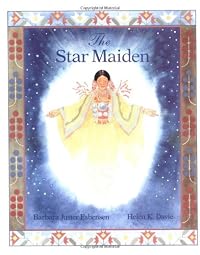
At last we have a beautiful children's book about the Indian culture of the Great Lakes Region. This Ojibwe legend, rewritten for children, is complemented by beautiful and refreshingly accurate watercolors. Esbensen's source is Kah ge ga gah bowh, also known as George Copway, a convert to the Christian religion who in 1850 wrote this oral traditional tale in a book of history, customs, and legends. As Esbensen notes, "He was afraid this valuable information would one day disappear." Kah ge ga gah bowh, an Ojibwe whose name translated means Stand Forever, wanted his work forever in print and accepted by his romantic white readers. He wrote carefully in the style of the show more times. The story takes place in a mythical time so long ago that there were neither wars nor winters and only American Indians populated the land. A star appears to the Ojibwe asking to live among the tribe. The star, a young woman, has tired of wandering the skies and would rather be near the people whose children play so happily. The young star woman appears to a young man in his dream to petition his help. He in turn asks the elders, respected for their wisdom in Ojibwe society, for advice and guidance. The tribe has a religious welcoming ceremony, dancing and praying to welcome the star visitor to earth. The star is given a choice of earthly forms, and her final choice brings her close to the canoe people, the Ojibwe. Legends entertain, but they also educate because they contain the culture in the oral tradition. In this legend we see the values of strong family and tribal ties and the willingness of the people to help one another and to welcome strangers while allowing individual choices. The terms "maiden" and "brave," used throughout the story, belong to the 1850s (Copley's time) and the dual worldview of Indian people as either savages or pristine innocents. Indian people did not use such romanticized words to discuss their own people, and Indians today don't need this way of thinking reinforced. Society is already full of Indian stereotypes. When reading the legend to children, one can easily replace "maiden" and "brave" with "young woman" and "young man," more appropriate terms. The illustrator, Helen K. Davie, paints incredibly detailed and exquisite pictures and borders. The stylization of floral and geometric border designs appear to be copies of authentic Ojibwe beadwork and Great Lakes tribal ribbon work. Her research shows the attention given historical traditions. For example, the girl wears the shoulder strap dress with a jacket cape copied from the earliest known drawings of an Ojibwe women's dress. Each illustration is bursting with details of Indian life. Bordering each page are authentic designs from old porcupine quillwork, ribbon applique patterns, and woodland scenes. The drawings incorporate such details as the birch trees and Ojibwe birch bark canoes. Davie uses softer colors and some softened shapes, such as the star woman fading out when enveloped in starlight. The integration of the colors and the blending of tones are effective for the mood of this romantic tale. The effect created is that of the natural world--the use of natural dyes and the real beauty of Mother Earth in the northern woodlands. Ojibwe stories contain the culture of the people. They are rich in history, knowledge of plants, animals, and human nature. Many stories contain valuable information on how we must learn to live. Esbensen and Davie have done their homework well, presenting us with a gentle and loving work to be relished by both children and adults. 1988, Little Brown, $14.95. Ages 4 to 8. show less
At last we have a beautiful children's book about the Indian culture of the Great Lakes Region. This Ojibwe legend, rewritten for children, is complemented by beautiful and refreshingly accurate watercolors. Esbensen's source is Kah ge ga gah bowh, also known as George Copway, a convert to the Christian religion who in 1850 wrote this oral traditional tale in a book of history, customs, and legends. As Esbensen notes, "He was afraid this valuable information would one day disappear." Kah ge ga gah bowh, an Ojibwe whose name translated means Stand Forever, wanted his work forever in print and accepted by his romantic white readers. He wrote carefully in the style of the show more times. The story takes place in a mythical time so long ago that there were neither wars nor winters and only American Indians populated the land. A star appears to the Ojibwe asking to live among the tribe. The star, a young woman, has tired of wandering the skies and would rather be near the people whose children play so happily. The young star woman appears to a young man in his dream to petition his help. He in turn asks the elders, respected for their wisdom in Ojibwe society, for advice and guidance. The tribe has a religious welcoming ceremony, dancing and praying to welcome the star visitor to earth. The star is given a choice of earthly forms, and her final choice brings her close to the canoe people, the Ojibwe. Legends entertain, but they also educate because they contain the culture in the oral tradition. In this legend we see the values of strong family and tribal ties and the willingness of the people to help one another and to welcome strangers while allowing individual choices. The terms "maiden" and "brave," used throughout the story, belong to the 1850s (Copley's time) and the dual worldview of Indian people as either savages or pristine innocents. Indian people did not use such romanticized words to discuss their own people, and Indians today don't need this way of thinking reinforced. Society is already full of Indian stereotypes. When reading the legend to children, one can easily replace "maiden" and "brave" with "young woman" and "young man," more appropriate terms. The illustrator, Helen K. Davie, paints incredibly detailed and exquisite pictures and borders. The stylization of floral and geometric border designs appear to be copies of authentic Ojibwe beadwork and Great Lakes tribal ribbon work. Her research shows the attention given historical traditions. For example, the girl wears the shoulder strap dress with a jacket cape copied from the earliest known drawings of an Ojibwe women's dress. Each illustration is bursting with details of Indian life. Bordering each page are authentic designs from old porcupine quillwork, ribbon applique patterns, and woodland scenes. The drawings incorporate such details as the birch trees and Ojibwe birch bark canoes. Davie uses softer colors and some softened shapes, such as the star woman fading out when enveloped in starlight. The integration of the colors and the blending of tones are effective for the mood of this romantic tale. The effect created is that of the natural world--the use of natural dyes and the real beauty of Mother Earth in the northern woodlands. Ojibwe stories contain the culture of the people. They are rich in history, knowledge of plants, animals, and human nature. Many stories contain valuable information on how we must learn to live. Esbensen and Davie have done their homework well, presenting us with a gentle and loving work to be relished by both children and adults. 1988, Little Brown, $14.95. Ages 4 to 8. show less
Ratings
Members
- Recently Added By
Author Information

23+ Works 1,695 Members
Some Editions
Awards and Honors
Awards
Notable Lists
Common Knowledge
- Original publication date
- 1987
Classifications
Statistics
- Members
- 205
- Popularity
- 158,902
- Reviews
- 6
- Rating
- (3.85)
- Languages
- English, Finnish, Swedish
- Media
- Paper
- ISBNs
- 9
- ASINs
- 1