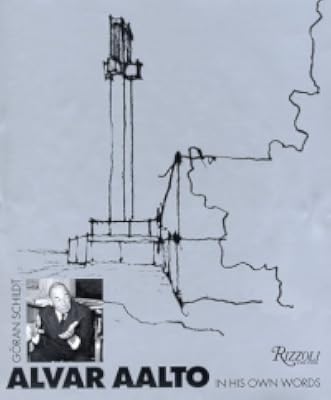
Alvar Aalto In His Own Words
by Alvar Aalto
26 Members (3.50)
On This Page
Description
To celebrate the centennial of the birth of the great Finnish architect, Alvar Aalto, Alvar Aalto in His Own Words presents, for the first time, an illuminating collection of over 75 of his visionary lectures, speeches, articles, and other writings, and 100 archival illustrations. These fascinating texts illustrate important aspects of Aalto's outlook and career. They begin with a charming piece, dictated by Aalto near the end of his life, about growing up beneath his father's two-tiered show more white table where the surveyor's apprentices worked - and his gradual ascent to the top tier. From Aalto's early writings (which he signed with the pseudonym 'Ping') there is a satirical sketch about Christmas festivities at Benvenuto Cellini's place, attended by an unlikely mix of characters including Eliel Saarinen, Andre Le Notre, and Katshusika Hokusai. Aalto's often-idealistic reform projects - his Renaissance revival, his rationalistic utopia - his writings as a propagandist during the war years; his comments on his own crucial travels to Italy, the 1939 New York World's Fair, and the "decadence of public buildings"; critiques of building and furniture design - all reveal the progression of ideas and convictions that grew and changed throughout Aalto's life, both reflecting and influencing the course of architecture in the twentieth century. Other influences are also revealed in Aalto's contact with the Bauhaus in Germany, De Stijl in the Netherlands, Le Corbusier in France, and such important friends as Sven Markelius, Gunnar Asplund, Laszlo Moholy-Nagy, Siegried Giedion, Lewis Mumford, Walter Gropius, and Frank Lloyd Wright, some of whom Aalto eulogizes in the chapter 'In Memoriam' show lessTags
Recommendations

















Member Reviews
Members
- Recently Added By
Author Information

63+ Works 519 Members
Alvar Aalto is considered the father of modernism in Scandinavia. He was born in Kuortane, Finland. His reputation as an architect has spread far beyond the bounds of his native country, where he built the major part of his work. He is perhaps Finland's greatest architect and certainly one of the major figures of twentieth-century architecture. As show more early as 1923, Aalto built in a typical Scandinavian style, relying heavily on native materials-timber in Finland's case-and produced such masterworks as the Library at Viipuri (1927-35), the Paimio Sanitarium, and the Villa Mairea. In 1932 he invented the process for making bent wood furniture. After World War II, his work began to be noticed internationally as he developed his own singular style, and he built some of his finest works-the Finlandia Concert Hall, in Helsinki, and the Baker Dorms at the Massachusetts Institute of Technology, his only building in the United States, (1947-49). His style is based on irregular and asymmetric forms with many curved walls and single-pitched roofs and with a highly imaginative use of natural materials. Aalto is also known for the design of several classic styles of chairs, tables, and glassware. (Bowker Author Biography) show less
Common Knowledge
- People/Characters
- Alvar Aalto
Classifications
Statistics
- Members
- 26
- Popularity
- 1,038,841
- Rating
- (3.50)
- Languages
- English, Finnish
- Media
- Paper
- ISBNs
- 3