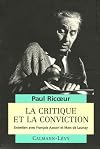
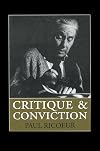
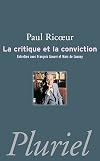
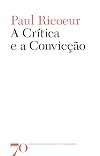
Critique and Conviction
by Paul Ricœur
On This Page
Description
In this new book Paul Ricoeur - one of the greatest contemporaryphilosophers - offers a personal reflection on his life and on thethemes which have preoccupied him over the course of his career. Ranging across topics in ethics and metaphysics, psychoanalysisand hermeneutics, history, politics and religion, Critique andConviction provides unique insight into the ideas and sourcesof influence which have shaped Ricoeur's philosophical approach anddefined his core concerns. Ricoeur also show more discusses in detail anumber of topics about which he has not written extensively before,including questions of aesthetics and current affairs. This remarkable testimony by one of the leading philosophers ofthe twentieth century will be of great interest to students ofphilosophy, theology, literary theory and social and politicaltheory. show lessTags
Recommendations











Member Reviews
Do not be fooled by the meager two and a half stars that I have given to this booklet. Ricoeur is not just anyone, but one of the most interesting philosophers of the 20th century. But the interviews in this book are slightly dated (they are more than 20 years old). And I had hoped to learn a lot more about Ricoeur's own philosophy, and especially his hermeneutical reading of the world and look on history. But the latter remains limited, hence the lesser rating. Yet, again, there are quite interesting things to read about man and society, philosophy and religion. Perhaps it’s better to take on his own work first.
Ratings
Members
- Recently Added By
Author Information

197+ Works 6,401 Members
Professor of philosophy at the University of Paris and the University of Chicago, Paul Ricoeur has been described as "possibly the only younger philosopher in Europe whose reputation is of the magnitude of that of the old men of Existentialism---Marcel, Jaspers, Heidegger and Sartre . . . ." His work has been characterized as "the most massive show more accomplishment of any philosopher of Christian faith since the appearance of Gabriel Marcel." A practitioner of the phenomenology of Edmund Husserl mediated by a return to Immanuel Kant---in that things in themselves, though unknowable, are not excluded by bracketing existence but are acknowledged as the necessary conditions for the possibility of human experience---Ricoeur has examined those parts of experience---faulty, fallible, and susceptible to error and evil---that other phenomenologists, interested primarily in the cognitional, have neglected. In this respect he follows in the footsteps of Heidegger and Sartre, but he goes beyond them in his discovery of principles transcending human subjectivity that are amenable to spiritual interpretation. Here Ricoeur steps within the contemporary hermeneutic circle of Heidegger and Hans-Georg Gadamer, on whom he has written. Ricoeur's hermeneutical method, however, has much in common with the methods of biblical exegesis, and in this respect his works should be especially appealing to seminarians and the clergy. (Bowker Author Biography) show less
All Editions
Classifications
Statistics
- Members
- 70
- Popularity
- 449,704
- Reviews
- 1
- Rating
- (3.75)
- Languages
- 7 — English, French, Polish, Portuguese, Slovenian, Spanish, Turkish
- Media
- Paper
- ISBNs
- 12
- ASINs
- 1