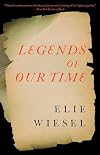
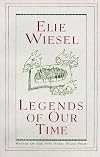
Legends of Our Time
by Elie Wiesel
On This Page
Description
A collection of tales immortalizing the heroic deeds and visions of people Wiesel knew during and after World War II.Tags
Recommendations































Member Reviews
update 28/8/18 And even as we write and read, here on the internet, Naziism continues to come out of its hiding place to take its preferred place on the stage. And no great surprise to see that even (or especially?) Hitler salutes are ignored by the police, despite being illegal. The reason? Appeasement. '...a desire not to escalate an already tense situation had forced them to hold back.' The police are the grand-children of Nazis too. https://www.theguardian.com/world/2018/aug/28/german-police-criticised-as-countr...
-----------------------------
I discovered after reading this, that Wiesel is a controversial figure. I'm not talking about the anti-Semitic loons or the woman who wanted to join the 'me too' campaign. Rather, within the show more body of work that stands as 'Lest We Forget', there is much debate as to what his testament means, whether he has betrayed those he writes of, himself included, how his work fits into what others have done. He was the rockstar of the Holocaust preservation, the first to force non-Jewish people to acknowledge the horror. Yet he only managed to do that by watering down what he had to say, a process that started with The Night, his French and then English version of a much longer work written in Yiddish for an entirely different audience.
As has been noted by scholars in the field, the watering down process wasn't only about making something that was palatable to the world that was complicit in the murder of millions of Jews. It made sense that a different audience would be presented with a differently written, more culturally accessible work.
However, there is also the issue of memory, what a memoir is, at which point it becomes a lie. Much has been written about this too in reference to Wiesel, and in particular his juxtaposition with James Frey on the Oprah Bookshow (whatever that is).
For my part, I can understand the impossibility of saying the same thing to the people you are accusing as to the people to whom wrong is done. It is so easy to understand the humiliation as well as the rage. Even the idea of silence, as a major theme. What I find hard to relate to is the mysticism that is fundamental to his interpretations of the world. His rage feels as genuine as his talk of forgiveness feels forced. I can believe whole-heartedly in the one, not at all in the other.
This may be entirely my failing. I've never been religiously inclined and the notion of 'forgive and forget' does not sit easily with me. Eventually one sort of forgets. With that comes something which isn't forgiveness, more like a moving on, I suppose, which takes the place of that more noble sentiment.
In any case, can one have it both ways? Forget in some personal way, and never forget in some social way which we believe is vital to the prevention of such events in the future? I had the misfortune to go to Berlin's memorial for murdered Jews a few years ago. Full of people taking selfies and having fun. It could scarcely have been more offensive to point of the place. Richard Brody wrote of it:
Why no names, he asks? The victims are shrouded in abstract concrete anonymity, as are the murderers.
rest here: https://alittleteaalittlechat.wordpress.com/2018/08/25/legends-of-our-time-by-el... show less
-----------------------------
I discovered after reading this, that Wiesel is a controversial figure. I'm not talking about the anti-Semitic loons or the woman who wanted to join the 'me too' campaign. Rather, within the show more body of work that stands as 'Lest We Forget', there is much debate as to what his testament means, whether he has betrayed those he writes of, himself included, how his work fits into what others have done. He was the rockstar of the Holocaust preservation, the first to force non-Jewish people to acknowledge the horror. Yet he only managed to do that by watering down what he had to say, a process that started with The Night, his French and then English version of a much longer work written in Yiddish for an entirely different audience.
As has been noted by scholars in the field, the watering down process wasn't only about making something that was palatable to the world that was complicit in the murder of millions of Jews. It made sense that a different audience would be presented with a differently written, more culturally accessible work.
However, there is also the issue of memory, what a memoir is, at which point it becomes a lie. Much has been written about this too in reference to Wiesel, and in particular his juxtaposition with James Frey on the Oprah Bookshow (whatever that is).
For my part, I can understand the impossibility of saying the same thing to the people you are accusing as to the people to whom wrong is done. It is so easy to understand the humiliation as well as the rage. Even the idea of silence, as a major theme. What I find hard to relate to is the mysticism that is fundamental to his interpretations of the world. His rage feels as genuine as his talk of forgiveness feels forced. I can believe whole-heartedly in the one, not at all in the other.
This may be entirely my failing. I've never been religiously inclined and the notion of 'forgive and forget' does not sit easily with me. Eventually one sort of forgets. With that comes something which isn't forgiveness, more like a moving on, I suppose, which takes the place of that more noble sentiment.
In any case, can one have it both ways? Forget in some personal way, and never forget in some social way which we believe is vital to the prevention of such events in the future? I had the misfortune to go to Berlin's memorial for murdered Jews a few years ago. Full of people taking selfies and having fun. It could scarcely have been more offensive to point of the place. Richard Brody wrote of it:
The title doesn’t say “Holocaust” or “Shoah”; in other words, it doesn’t say anything about who did the murdering or why—there’s nothing along the lines of “by Germany under Hitler’s regime,” and the vagueness is disturbing. Of course, the information is familiar, and few visitors would be unaware of it, but the assumption of this familiarity—the failure to mention it at the country’s main memorial for the Jews killed in the Holocaust—separates the victims from their killers and leaches the moral element from the historical event, shunting it to the category of a natural catastrophe. The reduction of responsibility to an embarrassing, tacit fact that “everybody knows” is the first step on the road to forgetting.
Why no names, he asks? The victims are shrouded in abstract concrete anonymity, as are the murderers.
rest here: https://alittleteaalittlechat.wordpress.com/2018/08/25/legends-of-our-time-by-el... show less
update 28/8/18 And even as we write and read, here on the internet, Naziism continues to come out of its hiding place to take its preferred place on the stage. And no great surprise to see that even (or especially?) Hitler salutes are ignored by the police, despite being illegal. The reason? Appeasement. '...a desire not to escalate an already tense situation had forced them to hold back.' The police are the grand-children of Nazis too. https://www.theguardian.com/world/2018/aug/28/german-police-criticised-as-countr...
-----------------------------
I discovered after reading this, that Wiesel is a controversial figure. I'm not talking about the anti-Semitic loons or the woman who wanted to join the 'me too' campaign. Rather, within the show more body of work that stands as 'Lest We Forget', there is much debate as to what his testament means, whether he has betrayed those he writes of, himself included, how his work fits into what others have done. He was the rockstar of the Holocaust preservation, the first to force non-Jewish people to acknowledge the horror. Yet he only managed to do that by watering down what he had to say, a process that started with The Night, his French and then English version of a much longer work written in Yiddish for an entirely different audience.
As has been noted by scholars in the field, the watering down process wasn't only about making something that was palatable to the world that was complicit in the murder of millions of Jews. It made sense that a different audience would be presented with a differently written, more culturally accessible work.
However, there is also the issue of memory, what a memoir is, at which point it becomes a lie. Much has been written about this too in reference to Wiesel, and in particular his juxtaposition with James Frey on the Oprah Bookshow (whatever that is).
For my part, I can understand the impossibility of saying the same thing to the people you are accusing as to the people to whom wrong is done. It is so easy to understand the humiliation as well as the rage. Even the idea of silence, as a major theme. What I find hard to relate to is the mysticism that is fundamental to his interpretations of the world. His rage feels as genuine as his talk of forgiveness feels forced. I can believe whole-heartedly in the one, not at all in the other.
This may be entirely my failing. I've never been religiously inclined and the notion of 'forgive and forget' does not sit easily with me. Eventually one sort of forgets. With that comes something which isn't forgiveness, more like a moving on, I suppose, which takes the place of that more noble sentiment.
In any case, can one have it both ways? Forget in some personal way, and never forget in some social way which we believe is vital to the prevention of such events in the future? I had the misfortune to go to Berlin's memorial for murdered Jews a few years ago. Full of people taking selfies and having fun. It could scarcely have been more offensive to point of the place. Richard Brody wrote of it:
Why no names, he asks? The victims are shrouded in abstract concrete anonymity, as are the murderers.
rest here: https://alittleteaalittlechat.wordpress.com/2018/08/25/legends-of-our-time-by-el... show less
-----------------------------
I discovered after reading this, that Wiesel is a controversial figure. I'm not talking about the anti-Semitic loons or the woman who wanted to join the 'me too' campaign. Rather, within the show more body of work that stands as 'Lest We Forget', there is much debate as to what his testament means, whether he has betrayed those he writes of, himself included, how his work fits into what others have done. He was the rockstar of the Holocaust preservation, the first to force non-Jewish people to acknowledge the horror. Yet he only managed to do that by watering down what he had to say, a process that started with The Night, his French and then English version of a much longer work written in Yiddish for an entirely different audience.
As has been noted by scholars in the field, the watering down process wasn't only about making something that was palatable to the world that was complicit in the murder of millions of Jews. It made sense that a different audience would be presented with a differently written, more culturally accessible work.
However, there is also the issue of memory, what a memoir is, at which point it becomes a lie. Much has been written about this too in reference to Wiesel, and in particular his juxtaposition with James Frey on the Oprah Bookshow (whatever that is).
For my part, I can understand the impossibility of saying the same thing to the people you are accusing as to the people to whom wrong is done. It is so easy to understand the humiliation as well as the rage. Even the idea of silence, as a major theme. What I find hard to relate to is the mysticism that is fundamental to his interpretations of the world. His rage feels as genuine as his talk of forgiveness feels forced. I can believe whole-heartedly in the one, not at all in the other.
This may be entirely my failing. I've never been religiously inclined and the notion of 'forgive and forget' does not sit easily with me. Eventually one sort of forgets. With that comes something which isn't forgiveness, more like a moving on, I suppose, which takes the place of that more noble sentiment.
In any case, can one have it both ways? Forget in some personal way, and never forget in some social way which we believe is vital to the prevention of such events in the future? I had the misfortune to go to Berlin's memorial for murdered Jews a few years ago. Full of people taking selfies and having fun. It could scarcely have been more offensive to point of the place. Richard Brody wrote of it:
The title doesn’t say “Holocaust” or “Shoah”; in other words, it doesn’t say anything about who did the murdering or why—there’s nothing along the lines of “by Germany under Hitler’s regime,” and the vagueness is disturbing. Of course, the information is familiar, and few visitors would be unaware of it, but the assumption of this familiarity—the failure to mention it at the country’s main memorial for the Jews killed in the Holocaust—separates the victims from their killers and leaches the moral element from the historical event, shunting it to the category of a natural catastrophe. The reduction of responsibility to an embarrassing, tacit fact that “everybody knows” is the first step on the road to forgetting.
Why no names, he asks? The victims are shrouded in abstract concrete anonymity, as are the murderers.
rest here: https://alittleteaalittlechat.wordpress.com/2018/08/25/legends-of-our-time-by-el... show less
update 28/8/18 And even as we write and read, here on the internet, Naziism continues to come out of its hiding place to take its preferred place on the stage. And no great surprise to see that even (or especially?) Hitler salutes are ignored by the police, despite being illegal. The reason? Appeasement. '...a desire not to escalate an already tense situation had forced them to hold back.' The police are the grand-children of Nazis too. https://www.theguardian.com/world/2018/aug/28/german-police-criticised-as-countr...
-----------------------------
I discovered after reading this, that Wiesel is a controversial figure. I'm not talking about the anti-Semitic loons or the woman who wanted to join the 'me too' campaign. Rather, within the show more body of work that stands as 'Lest We Forget', there is much debate as to what his testament means, whether he has betrayed those he writes of, himself included, how his work fits into what others have done. He was the rockstar of the Holocaust preservation, the first to force non-Jewish people to acknowledge the horror. Yet he only managed to do that by watering down what he had to say, a process that started with The Night, his French and then English version of a much longer work written in Yiddish for an entirely different audience.
As has been noted by scholars in the field, the watering down process wasn't only about making something that was palatable to the world that was complicit in the murder of millions of Jews. It made sense that a different audience would be presented with a differently written, more culturally accessible work.
However, there is also the issue of memory, what a memoir is, at which point it becomes a lie. Much has been written about this too in reference to Wiesel, and in particular his juxtaposition with James Frey on the Oprah Bookshow (whatever that is).
For my part, I can understand the impossibility of saying the same thing to the people you are accusing as to the people to whom wrong is done. It is so easy to understand the humiliation as well as the rage. Even the idea of silence, as a major theme. What I find hard to relate to is the mysticism that is fundamental to his interpretations of the world. His rage feels as genuine as his talk of forgiveness feels forced. I can believe whole-heartedly in the one, not at all in the other.
This may be entirely my failing. I've never been religiously inclined and the notion of 'forgive and forget' does not sit easily with me. Eventually one sort of forgets. With that comes something which isn't forgiveness, more like a moving on, I suppose, which takes the place of that more noble sentiment.
In any case, can one have it both ways? Forget in some personal way, and never forget in some social way which we believe is vital to the prevention of such events in the future? I had the misfortune to go to Berlin's memorial for murdered Jews a few years ago. Full of people taking selfies and having fun. It could scarcely have been more offensive to point of the place. Richard Brody wrote of it:
Why no names, he asks? The victims are shrouded in abstract concrete anonymity, as are the murderers.
rest here: https://alittleteaalittlechat.wordpress.com/2018/08/25/legends-of-our-time-by-el... show less
-----------------------------
I discovered after reading this, that Wiesel is a controversial figure. I'm not talking about the anti-Semitic loons or the woman who wanted to join the 'me too' campaign. Rather, within the show more body of work that stands as 'Lest We Forget', there is much debate as to what his testament means, whether he has betrayed those he writes of, himself included, how his work fits into what others have done. He was the rockstar of the Holocaust preservation, the first to force non-Jewish people to acknowledge the horror. Yet he only managed to do that by watering down what he had to say, a process that started with The Night, his French and then English version of a much longer work written in Yiddish for an entirely different audience.
As has been noted by scholars in the field, the watering down process wasn't only about making something that was palatable to the world that was complicit in the murder of millions of Jews. It made sense that a different audience would be presented with a differently written, more culturally accessible work.
However, there is also the issue of memory, what a memoir is, at which point it becomes a lie. Much has been written about this too in reference to Wiesel, and in particular his juxtaposition with James Frey on the Oprah Bookshow (whatever that is).
For my part, I can understand the impossibility of saying the same thing to the people you are accusing as to the people to whom wrong is done. It is so easy to understand the humiliation as well as the rage. Even the idea of silence, as a major theme. What I find hard to relate to is the mysticism that is fundamental to his interpretations of the world. His rage feels as genuine as his talk of forgiveness feels forced. I can believe whole-heartedly in the one, not at all in the other.
This may be entirely my failing. I've never been religiously inclined and the notion of 'forgive and forget' does not sit easily with me. Eventually one sort of forgets. With that comes something which isn't forgiveness, more like a moving on, I suppose, which takes the place of that more noble sentiment.
In any case, can one have it both ways? Forget in some personal way, and never forget in some social way which we believe is vital to the prevention of such events in the future? I had the misfortune to go to Berlin's memorial for murdered Jews a few years ago. Full of people taking selfies and having fun. It could scarcely have been more offensive to point of the place. Richard Brody wrote of it:
The title doesn’t say “Holocaust” or “Shoah”; in other words, it doesn’t say anything about who did the murdering or why—there’s nothing along the lines of “by Germany under Hitler’s regime,” and the vagueness is disturbing. Of course, the information is familiar, and few visitors would be unaware of it, but the assumption of this familiarity—the failure to mention it at the country’s main memorial for the Jews killed in the Holocaust—separates the victims from their killers and leaches the moral element from the historical event, shunting it to the category of a natural catastrophe. The reduction of responsibility to an embarrassing, tacit fact that “everybody knows” is the first step on the road to forgetting.
Why no names, he asks? The victims are shrouded in abstract concrete anonymity, as are the murderers.
rest here: https://alittleteaalittlechat.wordpress.com/2018/08/25/legends-of-our-time-by-el... show less
This book, like Souls on Fire, disappointed me. It is a series of vignettes about Wiesel's postwar travels and his ruminations on the death camps. I think the book is pretty lightweight and could have been better. The subject matter is dark and Wiesel's writing tends to be mystic, too much for my taste. But that's me. Perhaps the subject matter simply requires that.
Judaism
Ratings
Members
- Recently Added By
Author Information

Eliezer "Elie" Wiesel was born in Sighet, Romania on September 30, 1928. In 1944, he and his family were deported along with other Jews to the Nazi death camp Auschwitz. His mother and his younger sister died there. He loaded stones onto railway cars in a labor camp called Buna before being sent to Buchenwald, where his father died. He was show more liberated by the United States Third Army on April 11, 1945. After the war ended, he learned that his two older sisters had also survived. He was placed on a train of 400 orphans that was headed to France, where he was assigned to a home in Normandy under the care of a Jewish organization. He was educated at the Sorbonne and supported himself as a tutor, a Hebrew teacher and a translator. He started writing for the French newspaper L'Arche. In 1948, L'Arche sent him to Israel to report on that newly founded state. He also became the Paris correspondent for the daily Yediot Ahronot. In this capacity, he interviewed the novelist Francois Mauriac, who urged him to write about his war experiences. The result was La Nuit (Night). After the publication of Night, Wiesel became a writer, literary critic, and journalist. His other books include Dawn, The Accident, The Gates of the Forest, The Jews of Silence: A Personal Report on Soviet Jewry, and Twilight. He received a numerous awards and honors for his literary work including the William and Janice Epstein Fiction Award in 1965, the Jewish Heritage Award in 1966, the Prix Medicis in 1969, and the Prix Livre-International in 1980. He received the Nobel Peace Prize in 1986 for his work in combating human cruelty and in advocating justice. He had a leading role in the creation of the United States Holocaust Memorial Museum in Washington, D. C. He died on July 2, 2016 at the age of 87. (Bowker Author Biography) show less
Some Editions
Common Knowledge
- Canonical title*
- Gesang der Toten : Erinnerungen und Zeugnis
- Original title
- Le chant des morts
- Original publication date
- 1968
*Some information comes from Common Knowledge in other languages. Click "Edit" for more information.
Classifications
Statistics
- Members
- 331
- Popularity
- 95,585
- Reviews
- 5
- Rating
- (4.31)
- Languages
- 5 — Dutch, English, French, German, Italian
- Media
- Paper, Ebook
- ISBNs
- 12
- ASINs
- 11