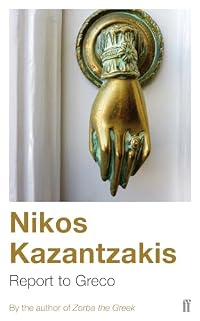
Report to Greco
by Níkos Kazantzákis
On This Page
Description
The Greek writer reviews his life, his art, and his quest for spiritual truth.Tags
Recommendations

























Member Reviews
Nikos Kazantzakis acknowledges at the beginning of his autobiographical novel Report to Greco that the idea for the book was inspired by Francesco Petrarch’s Letters to Cicero. This deliberate analogy is not a literary game, but rather a moral and spiritual dialogue with a dead teacher. Kazantzakis chooses the figure of El Greco as his “father,” “judge,” and “witness,” before whom he decides to give an account of his life.
And Kazantzakis indeed has much to say—entirely understandable for one of the major literary landmarks of the twentieth century. Yet although what he says is genuinely valuable and compelling, I personally did not respond to the way in which he chooses to say it. The emphasis on his own exceptional show more nature and erudition, veiled behind the modest origins of his mother’s family and the lack of education on his father’s side, and lavishly bathed in Orthodox faith, reads to me as pomposity and a desire for self-display, leaving a bitter aftertaste after the writer’s verbal bacchanalia.
Kazantzakis presents himself in two mise-en-scènes: as a Greek in Greece, and as a Greek abroad (primarily in France). In the first, we encounter an Old Testament Kazantzakis, retelling biblical parables and legends of wandering souls and monks devoted to fasting and self-sacrifice in the name of a terrifying and ferocious God, hungry for human blood and sacrifice in the service of His own grandeur. We also hear the thoughts of Jehovah and Buddha, spoken through the mouth of an orthodox author, seasoned with Greek pathos and placed within a Balkan context.
On foreign soil, we hear the author conversing with himself; we sense his perceptions of the birth of Übermenschen, his terror of shadows that stubbornly linger beside him, Joycean philosophizing, an endless procession of quotations from thinkers, an unceasing mill of words and high-flown figures, dialogues with himself in the second and third person, the exaltation and simultaneous pitying of his own heart. An endlessly sophisticated and highly intellectual logorrhea.
A master at constructing literary figures whose perfection I have long admired, Kazantzakis here, in my reading, remains hardest to accept precisely when he speaks about himself. show less
And Kazantzakis indeed has much to say—entirely understandable for one of the major literary landmarks of the twentieth century. Yet although what he says is genuinely valuable and compelling, I personally did not respond to the way in which he chooses to say it. The emphasis on his own exceptional show more nature and erudition, veiled behind the modest origins of his mother’s family and the lack of education on his father’s side, and lavishly bathed in Orthodox faith, reads to me as pomposity and a desire for self-display, leaving a bitter aftertaste after the writer’s verbal bacchanalia.
Kazantzakis presents himself in two mise-en-scènes: as a Greek in Greece, and as a Greek abroad (primarily in France). In the first, we encounter an Old Testament Kazantzakis, retelling biblical parables and legends of wandering souls and monks devoted to fasting and self-sacrifice in the name of a terrifying and ferocious God, hungry for human blood and sacrifice in the service of His own grandeur. We also hear the thoughts of Jehovah and Buddha, spoken through the mouth of an orthodox author, seasoned with Greek pathos and placed within a Balkan context.
On foreign soil, we hear the author conversing with himself; we sense his perceptions of the birth of Übermenschen, his terror of shadows that stubbornly linger beside him, Joycean philosophizing, an endless procession of quotations from thinkers, an unceasing mill of words and high-flown figures, dialogues with himself in the second and third person, the exaltation and simultaneous pitying of his own heart. An endlessly sophisticated and highly intellectual logorrhea.
A master at constructing literary figures whose perfection I have long admired, Kazantzakis here, in my reading, remains hardest to accept precisely when he speaks about himself. show less
Report to Greco is a poet’s view of his life, a life that in his imagination rises forth with the mystic clods of Cretan earth he carries in spirit and body across the globe. Nikos Kazantzakis mixes reminiscence, fictional re-telling and re-imagining, and intimate confessions.
His father was a hard-minded fighter in the war for Crete’s liberation from Turkey. That man’s autobiography, if such could possibly exist, would be literal in word and spirit. The son was a different sort of man. As an example, on Sparta NK finds himself descending a mountain in a thunderstorm. For most of us, an experience involving fear or exhilaration and also an exercise in safe conduct. NK, instead, describes it as the “violent descent of the Holy show more Ghost.” In this we see the sensibility with which his “life story” is told.
There is hardly a page that does not immerse the reader in a reality or personal history heightened or even altered by imagination. Olive groves, convents, gargoyles, temples, puddles, stone, surf, orange trees, saints, martyrs, parents, children, art, political slaughter, a woman’s body, a woman’s soul, the wind, philosophy—in his memory NK sustains what he has seen and whom he has known so that, he believes, as long as he lives these people and these places, events, and days will continue to live. That is his book’s ambition. It’s quite a personality to accompany through his world and time.
NK can be wonderful when evoking that world, with nature as an active personality:
“I began to go for strolls in the fields. The world had become a paradise; the snows of Olympus sparkled in the sunlight while the fields below shone bright green and the returning swallows, like shuttles of a loom, wove spring into the air. Small white and yellow wildflowers, pushing up the soil with their tiny heads, began to emerge into the sunlight to see the world above. Someone must have rolled back the earthen tombstones above them: they were being resurrected.”
And yet he describes himself as taciturn—the last word one would use after reading his Report. Even in NK’s most ascetic moods the exuberance of living is always ready to whirl forth in mimicry of the dervishes he visits who believe that dance is one of the archangels come to ready us to appear before God.
The past (not any past, the Greek past) is seen by him as a parade of dramas rather than as a document of sober history. At times NK composes history in terms that do not apply. He imagines that by means of their struggles the Greeks sanctified each region, subordinated each to an exalted meaning that formed from each region’s physical nature something metaphysical. The more bitter truth: Greece was torn by jealousies, hatreds, civil wars. Democracies, aristocracies, and tyrannies exterminated one another.
This is part of his method. By such contrasts NK invokes his own peculiar romantic process to explain how such an event as the ancient Olympics, such an idea, could arise. His conclusion is “Civilization begins at the moment sport begins.” Remember that next time you watch the Super Bowl or World Cup! But remember also this caution: “When Greece began to decline, the athlete’s body began at the same time to hypertrophy and kill his mind. Euripides was among the first to protest: he proclaimed what risks the spirit was running at the hands of athleticism.”
A serious life but sometimes silly too, as when NK buys shoes that are too narrow in order to cause himself pain as penance for so enjoying Italy.
Matters of the spirit, and of religion, are more prominent than anything else in the Report. NK is restless, relentlessly curious, with a drive that creates personal drama in all his encounters with holy places and the persons who live in them. He spends a lot of time visiting monasteries but as much as he likes their “anachronistic life” none seem to him satisfactory or address his needs. He recalls Francis of Assisi asking “How can I enjoy heaven, Lord, when I know hell exists.” But given the fictional aspects of his memoir, it’s possible the quote is NK’s rather than the Saint’s.
His visits, if anything, inspire combative reactions. On one page he writes, “The world is a trap laid by Satan, laid by God,” and on another comes the thought that “God is not man’s ancestor but his descendent.” His concern is always with spiritual and intellectual freedom: “the man who either hopes for heaven or fears hell cannot be free.” Words such as these remind us that NK’s destiny was to be anathematized by the Church, in line with the notion that only a man gravely concerned with God, Satan, and salvation of the soul shall end as saint or outcast.
Even NK’s study of Buddha spurs a kind of combativeness: “…this is my form of freedom. I have been saved from salvation…every other form of freedom is a form of slavery…If I were to be born again, I would fight for this great freedom, for salvation from salvation…Salvation means deliverance from all saviors...the perfect savior…is the Savior who shall deliver mankind from salvation.”
Take that in.
A big issue in evaluating the book is its semi-fictional nature. How are we to assess the stories related by Kazantzakis? How much can we trust what he tells us about others? He writes that “The great artist considers realistic representation a disfigurement and caricature of the eternal” and that all great artists relocate history “in the elevated and symbolic atmosphere of myth.”
Nikos, I have my doubts. But you seem, if we can believe your Report, to have shown greatness in the intensity of your quest. show less
His father was a hard-minded fighter in the war for Crete’s liberation from Turkey. That man’s autobiography, if such could possibly exist, would be literal in word and spirit. The son was a different sort of man. As an example, on Sparta NK finds himself descending a mountain in a thunderstorm. For most of us, an experience involving fear or exhilaration and also an exercise in safe conduct. NK, instead, describes it as the “violent descent of the Holy show more Ghost.” In this we see the sensibility with which his “life story” is told.
There is hardly a page that does not immerse the reader in a reality or personal history heightened or even altered by imagination. Olive groves, convents, gargoyles, temples, puddles, stone, surf, orange trees, saints, martyrs, parents, children, art, political slaughter, a woman’s body, a woman’s soul, the wind, philosophy—in his memory NK sustains what he has seen and whom he has known so that, he believes, as long as he lives these people and these places, events, and days will continue to live. That is his book’s ambition. It’s quite a personality to accompany through his world and time.
NK can be wonderful when evoking that world, with nature as an active personality:
“I began to go for strolls in the fields. The world had become a paradise; the snows of Olympus sparkled in the sunlight while the fields below shone bright green and the returning swallows, like shuttles of a loom, wove spring into the air. Small white and yellow wildflowers, pushing up the soil with their tiny heads, began to emerge into the sunlight to see the world above. Someone must have rolled back the earthen tombstones above them: they were being resurrected.”
And yet he describes himself as taciturn—the last word one would use after reading his Report. Even in NK’s most ascetic moods the exuberance of living is always ready to whirl forth in mimicry of the dervishes he visits who believe that dance is one of the archangels come to ready us to appear before God.
The past (not any past, the Greek past) is seen by him as a parade of dramas rather than as a document of sober history. At times NK composes history in terms that do not apply. He imagines that by means of their struggles the Greeks sanctified each region, subordinated each to an exalted meaning that formed from each region’s physical nature something metaphysical. The more bitter truth: Greece was torn by jealousies, hatreds, civil wars. Democracies, aristocracies, and tyrannies exterminated one another.
This is part of his method. By such contrasts NK invokes his own peculiar romantic process to explain how such an event as the ancient Olympics, such an idea, could arise. His conclusion is “Civilization begins at the moment sport begins.” Remember that next time you watch the Super Bowl or World Cup! But remember also this caution: “When Greece began to decline, the athlete’s body began at the same time to hypertrophy and kill his mind. Euripides was among the first to protest: he proclaimed what risks the spirit was running at the hands of athleticism.”
A serious life but sometimes silly too, as when NK buys shoes that are too narrow in order to cause himself pain as penance for so enjoying Italy.
Matters of the spirit, and of religion, are more prominent than anything else in the Report. NK is restless, relentlessly curious, with a drive that creates personal drama in all his encounters with holy places and the persons who live in them. He spends a lot of time visiting monasteries but as much as he likes their “anachronistic life” none seem to him satisfactory or address his needs. He recalls Francis of Assisi asking “How can I enjoy heaven, Lord, when I know hell exists.” But given the fictional aspects of his memoir, it’s possible the quote is NK’s rather than the Saint’s.
His visits, if anything, inspire combative reactions. On one page he writes, “The world is a trap laid by Satan, laid by God,” and on another comes the thought that “God is not man’s ancestor but his descendent.” His concern is always with spiritual and intellectual freedom: “the man who either hopes for heaven or fears hell cannot be free.” Words such as these remind us that NK’s destiny was to be anathematized by the Church, in line with the notion that only a man gravely concerned with God, Satan, and salvation of the soul shall end as saint or outcast.
Even NK’s study of Buddha spurs a kind of combativeness: “…this is my form of freedom. I have been saved from salvation…every other form of freedom is a form of slavery…If I were to be born again, I would fight for this great freedom, for salvation from salvation…Salvation means deliverance from all saviors...the perfect savior…is the Savior who shall deliver mankind from salvation.”
Take that in.
A big issue in evaluating the book is its semi-fictional nature. How are we to assess the stories related by Kazantzakis? How much can we trust what he tells us about others? He writes that “The great artist considers realistic representation a disfigurement and caricature of the eternal” and that all great artists relocate history “in the elevated and symbolic atmosphere of myth.”
Nikos, I have my doubts. But you seem, if we can believe your Report, to have shown greatness in the intensity of your quest. show less
Στο τέλος της ζωής του ο Καζαντζάκης δημιουργεί το δικό του Ρέκβιεμ, μια βιογραφία όχι του εαυτού του αλλά των ιδεών του, της ψυχής του. Περιγράφει τα πράγματα που τον σμιλέψαν: την μητέρα του, τον πατέρα του, τον παππού του, την φωτιά, την θάλασσα, την Κρήτη, την Ελλάδα, τον έναστρο ουρανό, τον Χριστό, τον Βούδα, τον Νίτσε, τον Λένιν, τον Θάνατο, τον Ανήφορο. Ανοίγοντας το βιβλίο νιώθεις μια θύελλα να ορμάει να show more ξεφύγει απ'τις σελίδες, τις τελευταίες σκέψεις που θέλουν όλες μαζί να βρουν την ελευθερία τους, και σαν ξανακλείσει το βιβλίο, δεν γυρνάνε πίσω, αλλά ταξιδεύουν να βρουν σάρκα να φωλιάσουν. Ο συγγραφέας νιώθει πως έχει χρέος να δώσει αναφορά σε έναν άλλον Κρητικό, στον Ελ Γκρέκο, αλλά ταυτόχρονα δίνει αναφορά σε όλους μας, ελπίζοντας να έχει κάτι χρήσιμο να μας προσφέρει. Σε ευχαριστούμε Καζαντζάκη! show less
Picked up in Heraklion, Crete, where the airport is named after Kazantzakis. Didn't make it to his marker, M was sick on the day we were going to rent a car.
Labeled as an autobiographical novel, was left unfinished at his death. The novel outlines a spiritual journey, too besotted by the Christianity he inherited by chance.
He starts by exploring Christianity via Cretan monasteries. Next he explores an angry Old Testament God via Bedouins in Sinai. Then on to Nietzsche in Paris. Buddha is tried in Berlin of all places, and is the weakest attempt IMO - Kazantzakis wants more judgement and edicts from his savior than the Buddha can deliver. Islam is brushed against in passing but never grappled. He finishes by exploring the new Soviet man show more in 1920s Moscow shortly after the death of Lenin. He finally returns to Crete to meet Zorba and relishing earthly temptations. When in doubt, dance and drink the wine. show less
Labeled as an autobiographical novel, was left unfinished at his death. The novel outlines a spiritual journey, too besotted by the Christianity he inherited by chance.
He starts by exploring Christianity via Cretan monasteries. Next he explores an angry Old Testament God via Bedouins in Sinai. Then on to Nietzsche in Paris. Buddha is tried in Berlin of all places, and is the weakest attempt IMO - Kazantzakis wants more judgement and edicts from his savior than the Buddha can deliver. Islam is brushed against in passing but never grappled. He finishes by exploring the new Soviet man show more in 1920s Moscow shortly after the death of Lenin. He finally returns to Crete to meet Zorba and relishing earthly temptations. When in doubt, dance and drink the wine. show less
“The truth is that we all are one, that all of us together create god, that god is not man's ancestor, but his descendant.”
― Nikos Kazantzakis, Report to Greco
Now create your own magic...
― Nikos Kazantzakis, Report to Greco
Now create your own magic...
A raw (slightly unfinished), profound, autobiographical novel. Beautiful genuine searching about how to live. I know I am a mere adolescent philosophical dabbler, but Kazantzakis really speaks to me. Even his moments of profound religiosity are beautiful, in a way.
A wonderful book full of passion, weaving fine storytelling with life stories of a soul in love with life.
Three kinds of souls, three prayers
1. I am a bow in your hands, Lord. Draw me, lest I rot.
2. Do not overdraw me, Lord. I shall break.
3. Overdraw me, Lord, and who cares if I break.
Three kinds of souls, three prayers
1. I am a bow in your hands, Lord. Draw me, lest I rot.
2. Do not overdraw me, Lord. I shall break.
3. Overdraw me, Lord, and who cares if I break.
Members
- Recently Added By
Lists

1960s, Best books published therein
254 works; 22 members

Art of Reading
188 works; 5 members

Books We'd Want on a Desert Island
203 works; 131 members

Greece - a reading list
82 works; 4 members

Favorite Books in Translation
320 works; 133 members

Slightly Foxed 1
21 works; 1 member
Talk Discussions
Past Discussions
The lead-off article to start the discussion in The Arresting Life & Writings Of Nikos Kazantzakis (December 2012)
Author Information

132+ Works 12,297 Members
This distinguished novelist, poet, and translator was born in Crete and educated in Athens, Germany, Italy, and Paris, where he studied philosophy. He found time to write some 30 novels, plays, and books on philosophy, to serve his government, and to travel widely. He ran the Greek ministry of welfare from 1919 to 1921 and was minister of state show more briefly in 1945. A political activist, he spent his last years in France and died in Germany. Kazantzakis's character Zorba has been called "one of the great characters of modern fiction," in a novel that "reflects Greek exhilaration at its best" (TLS). A film version of 1965, starring Anthony Quinn, made Kazantzakis widely known in the West. Intensely religious, he imbued his novels with the passion of his own restless spirit, "torn between the active and the contemplative, between the sensual and the aesthetic, between nihilism and commitment" (Columbia Encyclopedia). Judas, the hero of The Last Temptation of Christ (1951) is asked by Christ to betray him so that he can fulfill his mission through the crucifixion. For this book Kazantzakis was excommunicated from the Greek Orthodox Church. The Fratricides, Kazantzakis's last novel, portrays yet another religious hero, a priest caught between Communists and Royalists in the Greek Civil War. (Bowker Author Biography) show less
Some Editions
Awards and Honors
Distinctions
Notable Lists
Series
Belongs to Publisher Series
Common Knowledge
- Canonical title
- Report to Greco
- Original title
- Αναφορα στον Γκρεκο; Αναφορά στον Γκρέκο
- Original publication date
- 1961 (original Greek) (original Greek); 1959 (French) (French); 1961, postuma; 1965 (English: Bien) (English: Bien)
- Important places
- Greece; Crete, Greece
- First words*
- Je rassemble mes outils : la vue, l'ouie, le goût, l'odorat, le toucher, l'esprit.
- Last words*
- (Click to show. Warning: May contain spoilers.)Je baise ta main, je baise ton épaule droite, je baise ton épaule gauche, mon aïeul, merci de m'avoir accueilli.
- Original language
- Greek; Greco moderno
*Some information comes from Common Knowledge in other languages. Click "Edit" for more information.
Classifications
- Genres
- Biography & Memoir, General Fiction
- DDC/MDS
- 813 — Literature & rhetoric American literature in English American fiction in English
- LCC
- PA5610 .K39 .Z513 — Language and Literature Greek language and literature. Latin language and literature Byzantine and modern Greek literature Individual authors
- BISAC
Statistics
- Members
- 728
- Popularity
- 38,642
- Reviews
- 17
- Rating
- (4.00)
- Languages
- 12 — Dutch, English, Finnish, French, German, Greek, Italian, Farsi/Persian, Romanian, Spanish, Swedish, Turkish
- Media
- Paper, Audiobook, Ebook
- ISBNs
- 44
- ASINs
- 27