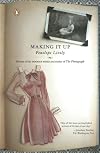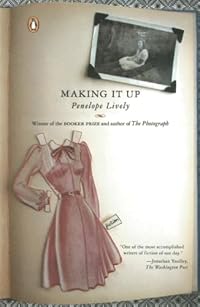
Making It Up
by Penelope Lively
On This Page
Description
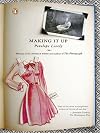
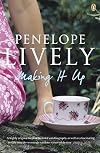
Look out for Penelope Lively's new book, The Purple Swamp Hen and Other Stories.Hailed by critics as a benchmark in a career full of award-winning achievements, Making It Up is Penelope Lively's answer to the oft-asked question, "How much of what you write comes from your own life?" What if Lively hadn't escaped from Egypt, her birthplace, at the outbreak of World War II? What would her life have been like if she'd married someone else? From a hillside in Italy to an archaeological dig, the show more author explores the stories that could have been hers, fashioning a sublime dance between reality and imagination that confirms her reputation as a singular talent.
From the Trade Paperback edition.. show less
Tags
Recommendations
















Member Reviews
Confabulations. Exploring turning points in her life and how her life might have been if she'd taken a different turning, eg if when fleeing Egypt, they'd gone to S Africa instead of Palestine then England, if she'd got pregnant when young and single. Each self-contained diversion is opened and closed with the real life context. Clever concept, well executed.
I read this novel for book club, so didn’t exactly know what I was getting into – just knew the basic premise that the author was writing an ‘anti-memoir’, versions of her life that were possible but didn’t exist. Although I’d pictured something else, I wasn’t disappointed. Lively’s prose is unobtrusive, but detailed, with well-chosen phrasing. The book is really more like a series of stories, connected by the author’s introduction to what actually happened and how it could have changed. I appreciated the fact that while some of the stories were obvious in how different her life would have been – her death in a couple, her husband going off to war, moving to the US and marrying an American – others just described show more small changes (in one, she goes on an archaeological dig, but there’s no indication it changed her career – just that she would remember it for a long time). After I’d read some of the stories, it seemed like the actual plot for a few of them could be a cliché – the caring nanny dealing with a shy charge and self-involved mother, the girl who becomes a conservative control freak after her upbringing with a hippie-type mother – but I never thought about it while I was reading, due to the already established framework and Lively’s prose and attention to detail. In many stories, the ‘Penelope’ character is just a side note to the action which was a nice way to vary narrators. I was surprised that she didn’t adhere a little more closely to reality by having all the characters with their correct name (only in a couple was she named Penelope) though this stopped bothering me after awhile. Also, I was hoping she’d depict the moment where the alternative history started – the crucial, but seemingly insignificant decisions that led the change. show less
How often do you get to mark a book memoir and fiction, and mean it well? Such an interesting premise--exploring paths her life didn't take, and beautifully executed. Also quite interesting if you, like me, love reading fiction but can't quite imagine how one would go about writing it--here's one way. I've been meaning to read Lively for a while, and am excited to think of all the books of hers that are waiting!
Lively describes this book as "an exercise in confabulation". Each chapter starts with a key decision that affected the path her life took, and builds a counterfactual story imagining what might have been had things turned out slightly differently. This is a fascinating premise for a book, and it gives her the latitude to showcase many different kinds of writing, some serious, for example the chapter in which her husband is sent to the Korean war before they met, and others humorous, such as the chapter which analyses a dysfunctional group of archaeologists on a dig. As always her prose is a pleasure to read.
This really fired my imagination for some reason; I'm not sure I know why. It's a collection of short stories, which aren't really my favourite thing. They are loosely coupled together as being offshoots from Penelope Lively's own life. It's the old alternate history game made personal: "What if my life had taken a different turn?". And I found it quite compelling. It's all fiction but weakly linked together with fact and I found the junctions and the similarities and differences between the alternates lives interesting.
Hmmm... interesting. It's a book of "this could have been my memoirs if things had just been a little different". It tells us something about Penelope Lively, but isn't straight fact. Despite this linkage, it can be seen as a series of short stories, and I think it definitely succeeds as that. Perhaps not enough character development in each story for my liking.
I really can't pick my favorite Lively novel, but this collection of what-could-have-been vignettes is certainly up there. Lively's usual delicious prose, combined with hints of autobiography, is twisted into fiction spanning the 40s-80s. I'm not sure I can pick a favorite story or permutation of Lively. I can't recommend this book enough!
Members
- Recently Added By
Author Information

73+ Works 14,500 Members
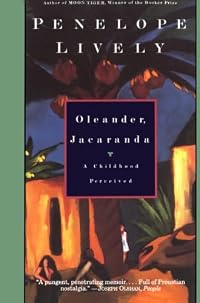
Penelope Lively has written over 18 books for children, and over 15 titles for adults, distinguishing herself on both levels. Among the awards she has received are the coveted Booker Prize for the adult novel "Moon Tiger" (1987) and the Carnegie Medal for the highly acclaimed juvenile work, "The Ghost of Thomas Kempe" (1973). In Lively's writing, show more for both adults and children, the recurrent theme is interpreting the past through exploring the function of memory. "My particular preoccupation as a writer is with memory. Both with memory in the historical sense and memory in the personal sense." Beginning her writing career in the early 1970's, Lively wrote exclusively for children for over a decade. Because children have limited memories, devices were used to explore their perceptions of the past, such as ghosts in "Uninvited Ghosts and Other Stories" (1985), and a sampler in "A Stitch in Time' (1976). Lively's first adult novel, "The Road to Lichfield" (1977) was the result of turning to an older audience when she felt inspiration running out. Her adult novels include "Passing On" (1995), the story of a mother's legacy to her children and 'Oleander, Jacarandi: A Childhood Perceived' (1994) which is a memoir of Lively's childhood. Penelope (Low) Lively, born March 17, 1933 in Cairo, Egypt, had a most unusual childhood. She grew up in Cairo with no formal education until age 12, when her family put her in boarding school in England. After earning a B.A. in history at Oxford in 1955, she married Jack Lively, a university professor, whom she calls her most useful critic. They have a son and a daughter, Adam and Josephine. (Bowker Author Biography) show less
Common Knowledge
- Original publication date
- 2005
- Dedication
- To Lawrence and Helen
- First words
- When I was very young I made up stories - the refuge of an isolated and frequently bored child.
- Last words
- (Click to show. Warning: May contain spoilers.)This exercise in confabulation has been another kind of experiment, a different way of enlisting story to complement reality, at the opposite end of my life.
Classifications
Statistics
- Members
- 370
- Popularity
- 84,344
- Reviews
- 12
- Rating
- (3.60)
- Languages
- English, French
- Media
- Paper, Audiobook, Ebook
- ISBNs
- 14
- ASINs
- 5