
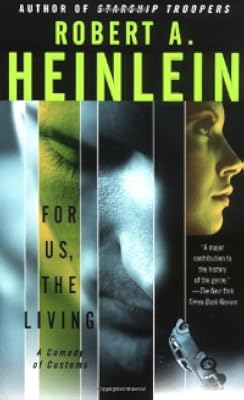
For Us, The Living: A Comedy of Customs
by Robert A. Heinlein
On This Page
Description
From Grand Master Robert A. Heinlein comes a long-lost first novel, written in 1939, introducing ideas and themes that would shape his career and define the genre that is synonymous with his name.July 12, 1939: Perry Nelson is driving along the palisades when another vehicle swerves into his lane, a tire blows out, and his car careens off the road and over a bluff. The last thing he sees before his head connects with the boulders below is a girl in a green bathing suit, prancing along the show more shore.
When he wakes, the girl in green is a woman dressed in furs, and the sun-drenched shore has been replaced by snowcapped mountains. The woman, Diana, rescues Perry from the bitter cold and takes him to her home to rest and recuperate. Later they debate the cause of the accident, for Diana is unfamiliar with the concept of a tire blowout and Perry cannot comprehend snowfall in mid-July. Then Diana shares with him a vital piece of information: the date is now January 7, the year 2086.
When his shock subsides, Perry begins an exhaustive study of global evolution over the past 150 years. He learns, among other things, that a United Europe was formed; the military draft was completely reconceived; banks became publicly owned and operated; and in the year 2003, two helicopters destroyed Manhattan in a galvanizing act of war.
But education brings with it inescapable truths—the economic and legal systems, the government, and even the dynamic between men and women remain alien to Perry, the customs of the new day continually testing his mental and emotional resolve. Yet it is precisely his knowledge of a bygone era that will serve Perry best, as the man from 1939 seems destined to lead his newfound peers even further into the future than they could have imagined.
A classic example of the future history that Robert Heinlein popularized during his career, For Us, the Living marks both the beginning and the end of an extraordinary arc comprising the political, social, and literary crusading that is his legacy.
. show less
Tags
Recommendations














Member Reviews
This is Heinlein's earliest work (although unpublished until recently). It's interesting in that this was written around the start of WWII, so his alternate history reads very odd at times. So, the whole of WWII is different and man hasn't landed on the moon. You can see the seeds of later works in this one, most notably Nehemiah Scudder from [b:Revolt in 2100|1116661|Revolt in 2100|Robert A. Heinlein|http://d.gr-assets.com/books/1266721800s/1116661.jpg|2835460] (although the dates are different from that book). He's basically the same character in both books (and as mentioned in other books of his as well).
This book doesn't really have much of a plot at all. A guy from 1939 ends up in the far future and has to deal with the changes in show more the society. That's about it. Some of the customs are interesting (and I wouldn't mind if they were true now), like the concept of public and private spheres. By custom, no one intrudes on another's private sphere. An implication of this is that public figures' private lives are just that, private. It can be very preachy at times, like in his discussion of economics and how our economic system doesn't work (and it attempts to prove that it doesn't). This kind of thing is somewhat interesting but can be tedious.
All told, I wouldn't recommend it to any but Heinlein fans. show less
This book doesn't really have much of a plot at all. A guy from 1939 ends up in the far future and has to deal with the changes in show more the society. That's about it. Some of the customs are interesting (and I wouldn't mind if they were true now), like the concept of public and private spheres. By custom, no one intrudes on another's private sphere. An implication of this is that public figures' private lives are just that, private. It can be very preachy at times, like in his discussion of economics and how our economic system doesn't work (and it attempts to prove that it doesn't). This kind of thing is somewhat interesting but can be tedious.
All told, I wouldn't recommend it to any but Heinlein fans. show less
This novel was not published until after Heinlein's death, but was written by him in 1938 or 1939, and consequently has been called Heinlein's first novel. When reading the novel it quickly becomes apparent why no publisher wanted to release it when Heinlein originally tried to sell it: the book simply isn't that good. It would also have been unsalable in the 1930s with its open attitude towards sex, and almost offhanded acceptance of lesbianism. The story, such as it is, follows Perry who is catapulted from a fatal accident in 1936 forward 150 years to the U.S.A. of the future. The reader is then treated to a badly written utopian fantasy that only makes sense if you assume that the entire book is merely Perry's dying brain spinning an show more elaborate delusion in the last seconds of his life.
The novel shows glimpses of ideas that Heinlein would flesh out and make interesting in other books. One can see the first elements of his future history here, including Neimiah Scudder, the development of Coventry as a place to store disaffected exiles, the use of psychology to treat criminals rather than using a penal system, and so on. Many of Heinlein's ideas are here in embryonic form as well: the idea that government should leave people's social relations solely up to them, an advocacy for an open "free-love" type arrangement between the sexes, and so on.
But the novel is saddled with characters so wooden that you get splinters reading about them. The novel is so didactic that much of it is nothing more than characters giving long lectures on the "correct" ways of doing things. The economic system presented in the novel is ludicrous in the extreme (and is clearly one that only an engineer could love) that has so many things wrong with it that it would be difficult to list them all (some of the most glaring are that the system presented is a recipe for hyperinflation, demonstrates an abject lack of knowledge concerning how banks work, and clearly has no grasp of the time value of money). The social system presented (in the same heavy handed moralizing manner as the economic system) is just as silly, requiring characters to behave in inhuman ways to make it work. The novel is almost as annoying as Bellamy's Looking Backward or Star Trek: The Next Generation, littered with repeated statements about how the humans of the future are so superior to those who lived in the past (the extended lecture supposedly demonstrating why Congress is so much better run in 2086 is simultaneously absurd and offensive).
One element that is clear is that the young Heinlein had an almost child-like faith in the ability of government to cure all ills. Political campaigns are regulated by the government, which makes politicians better. The government takes over banks, which makes them better. The government runs the economy on an engineering basis, which makes it better, and on and on.
The end result is a novel that is boring to read when it isn't making your head hurt with the incredibly silly ideas that are presented as being incredibly good ideas. The book is really only of interest to a Heinlein fan looking to see the development of Heinlein's thought process. For anyone else, this book is simply not worth the time it takes to read it.
This review has also been posted to my blog Dreaming About Other Worlds. show less
The novel shows glimpses of ideas that Heinlein would flesh out and make interesting in other books. One can see the first elements of his future history here, including Neimiah Scudder, the development of Coventry as a place to store disaffected exiles, the use of psychology to treat criminals rather than using a penal system, and so on. Many of Heinlein's ideas are here in embryonic form as well: the idea that government should leave people's social relations solely up to them, an advocacy for an open "free-love" type arrangement between the sexes, and so on.
But the novel is saddled with characters so wooden that you get splinters reading about them. The novel is so didactic that much of it is nothing more than characters giving long lectures on the "correct" ways of doing things. The economic system presented in the novel is ludicrous in the extreme (and is clearly one that only an engineer could love) that has so many things wrong with it that it would be difficult to list them all (some of the most glaring are that the system presented is a recipe for hyperinflation, demonstrates an abject lack of knowledge concerning how banks work, and clearly has no grasp of the time value of money). The social system presented (in the same heavy handed moralizing manner as the economic system) is just as silly, requiring characters to behave in inhuman ways to make it work. The novel is almost as annoying as Bellamy's Looking Backward or Star Trek: The Next Generation, littered with repeated statements about how the humans of the future are so superior to those who lived in the past (the extended lecture supposedly demonstrating why Congress is so much better run in 2086 is simultaneously absurd and offensive).
One element that is clear is that the young Heinlein had an almost child-like faith in the ability of government to cure all ills. Political campaigns are regulated by the government, which makes politicians better. The government takes over banks, which makes them better. The government runs the economy on an engineering basis, which makes it better, and on and on.
The end result is a novel that is boring to read when it isn't making your head hurt with the incredibly silly ideas that are presented as being incredibly good ideas. The book is really only of interest to a Heinlein fan looking to see the development of Heinlein's thought process. For anyone else, this book is simply not worth the time it takes to read it.
This review has also been posted to my blog Dreaming About Other Worlds. show less
According to the introduction, this is a never before published novel/story collection. A young man from 1939 has a car accident and then wakes up in 2086, inhabiting another man's body. Apparently the previous owner had voluntarily 'abandoned' the body and the spirit of Perry had wandered around until it found the vacant body. The man from 1939 then spends the rest of the book getting educated on the customs and past history of 2086. This book is part prediction, part Heinlein telling us how he thinks 'customs' should evolve. If you are familiar with his work, these customs aren't a surprise - he strongly believes in different marriage rules, different economic structures and a different form of democracy. He was also apparently a show more fervent isolationist, which is not surprising for someone writing in 1938, but amazingly shortsighted for someone as far thinking as Heinlein. Overall, I found this interesting but disappointing, more of a curiosity than a worthwhile novel. show less
Yup, the 5 stars is for the politics, not the story, so stop your whining. If you're new to Heinlein, this is not the place to start. Read everything else, then see the "DNA seeds" of it all here. I don't know any other book I've read this year that has compelled me to discuss it with everyone I know, willing or not. Outrageous, brilliant, and, yes, one long lecture. God I wish more lectures were like this one. Two words: War Amendment.
I was a bit chagrined when I found that my local library only had two Robert A. Heinlein books on the adult shelves. I was happy, though, that one was this one. This is Heinlein's first novel, never before released. It was rejected a couple of times and he moved on to other projects. The book is a bit rough, and overly preachy. He did, in fact, write it to present his ideas on politics, finance, and society in general.
I enjoyed it, however. It was fun to see the seeds of his later "future history" novels. It was stated that perhaps this was why he didn't pursue publishing it further, since he had pretty much developed everything in it in further works.
It makes sense. It was still and enjoyable read for me.
Of course, now it's a bit of show more a let down to know that I don't have any more Heinlein novels to look forward to, alas. show less
I enjoyed it, however. It was fun to see the seeds of his later "future history" novels. It was stated that perhaps this was why he didn't pursue publishing it further, since he had pretty much developed everything in it in further works.
It makes sense. It was still and enjoyable read for me.
Of course, now it's a bit of show more a let down to know that I don't have any more Heinlein novels to look forward to, alas. show less
This is Heinlein's first novel, never published while he was alive. As Spider Robinson says in the introduction, instead of calling it RAH's first novel, it might be more accurate to say "It is all of them, dormant."
In 1939, Perry Nelson is in a car accident from which he awakens in 2086. He spends the rest of the book learning how the world has changed and growing accustomed to living in this new Utopia.
The cover blurb which ends with "Yet it is precisely his knowledge of a bygone era that will serve Perry best, as he unexpectedly leads his peers towards a new horizon that they had never imagined..." gives the false impression that something actually happens in this book. It doesn't, really. As the introduction makes quite clear, it is show more more of a lecture disguised as fiction than anything else.
I didn't expect to keep this book after reading it once, yet surprisingly I am. I don't normally like authors to lecture me, but I have repeatedly found Heinlein to be the exception, whether or not I think he's making sense. show less
In 1939, Perry Nelson is in a car accident from which he awakens in 2086. He spends the rest of the book learning how the world has changed and growing accustomed to living in this new Utopia.
The cover blurb which ends with "Yet it is precisely his knowledge of a bygone era that will serve Perry best, as he unexpectedly leads his peers towards a new horizon that they had never imagined..." gives the false impression that something actually happens in this book. It doesn't, really. As the introduction makes quite clear, it is show more more of a lecture disguised as fiction than anything else.
I didn't expect to keep this book after reading it once, yet surprisingly I am. I don't normally like authors to lecture me, but I have repeatedly found Heinlein to be the exception, whether or not I think he's making sense. show less
Heinlein ordered the manuscripts of this book burned. Turns out, he was right... He just didn't get all the copies.
Not to say there's nothing worth discussing about it. (I will be doing a proper review as part of my Virginia Edition series.) [a:William H. Patterson, Jr.|28589|William H. Patterson Jr.|https://d.gr-assets.com/authors/1350060046p2/28589.jpg] is right that it includes kernels of what was to come in Heinlein's later work. But who wants kernels? I want the fully popped corn, salted and buttered, with a handful of M&Ms thrown in for kicks and giggles...
Not to say there's nothing worth discussing about it. (I will be doing a proper review as part of my Virginia Edition series.) [a:William H. Patterson, Jr.|28589|William H. Patterson Jr.|https://d.gr-assets.com/authors/1350060046p2/28589.jpg] is right that it includes kernels of what was to come in Heinlein's later work. But who wants kernels? I want the fully popped corn, salted and buttered, with a handful of M&Ms thrown in for kicks and giggles...
Members
- Recently Added By
Published Reviews
Written around 1939 and predating his first published novel by a decade. Heinlein's first science fiction novel is a gripping story of a man catapulted into a time not his own, as well as a keen examination of freedom both personal and political.
added by libraryuser59
Author Information

458+ Works 174,088 Members
Robert Anson Heinlein was born on July 7, 1907 in Butler, Mo. The son of Rex Ivar and Bam Lyle Heinlein, Robert Heinlein had two older brothers, one younger brother, and three younger sisters. Moving to Kansas City, Mo., at a young age, Heinlein graduated from Central High School in 1924 and attended one year of college at Kansas City Community show more College. Following in his older brother's footsteps, Heinlein entered the Navel Academy in 1925. After contracting pulmonary tuberculosis, of which he was later cured, Heinlein retired from the Navy and married Leslyn MacDonald. Heinlein was said to have held jobs in real estate and photography, before he began working as a staff writer for Upton Sinclair's EPIC News in 1938. Still needing money desperately, Heinlein entered a writing contest sponsored by the science fiction magazine Thrilling Wonder Stories. Heinlein wrote and submitted the story "Life-Line," which went on to win the contest. This guaranteed Heinlein a future in writing. Using his real name and the pen names Caleb Saunders, Anson MacDonald, Lyle Monroe, John Riverside, and Simon York, Heinlein wrote numerous novels including For Us the Living, Methuselah's Children, and Starship Troopers, which was adapted into a big-budget film for Tri-Star Pictures in 1997. The Science Fiction Writers of America named Heinlein its first Grand Master in 1974, presented 1975. Officers and past presidents of the Association select a living writer for lifetime achievement. Also, the Science Fiction and Fantasy Hall of Fame inducted Heinlein in 1998. Heinlein died in 1988 from emphysema and other related health problems. Heinlein's remains were scattered from the stern of a Navy warship off the coast of California. (Bowker Author Biography) show less
Some Editions
Awards and Honors
Distinctions
Series
Belongs to Publisher Series
Common Knowledge
- Original publication date
- 2004
- People/Characters
- Perry Vance Nelson; Diana; Olga
- Epigraph
- "It is for us, the living, rather, to be dedicated to the unfinished work . . . that this nation, under God, shall have a new birth of freedom . . ."
----Lincoln at Gettysburg
"Any map of the world that does not include
Utopia is not even worth glancing at."
----Oscar Wilde - Dedication
- for Heinlein's Children
- First words
- "Look out!" The cry broke involuntarily from Perry Nelson's lips as he twisted the steering wheel.
- Last words
- (Click to show. Warning: May contain spoilers.)The port cover swung into place from inside the rocket, rotated clockwise a quarter turn, and rested.
- Blurbers
- Pohl, Frederik
Classifications
Statistics
- Members
- 1,505
- Popularity
- 15,328
- Reviews
- 34
- Rating
- (3.03)
- Languages
- English, German, Italian
- Media
- Paper, Audiobook, Ebook
- ISBNs
- 18
- ASINs
- 6