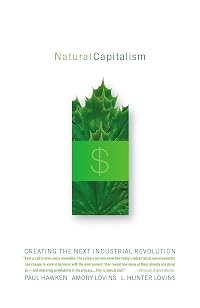
Natural Capitalism: Creating the Next Industrial Revolution
by Paul Hawken, Amory B. Lovins, L. Hunter Lovins
On This Page
Description
On its first publication 10 years ago, Natural Capitalism rocked the world of business with its innovative new approach - an approach that fused ecological integrity with business acumen using the radical concept of natural capitalism. This 10th-anniversary edition features a new Introduction by Amory B. Lovins and Paul Hawken which updates the story to include the successes of the last decade. It clearly sets out the path that we must now take to ensure the future prosperity of our show more civilisation and our planet. show lessTags
Recommendations













Member Reviews
Natural Capitalism starts with a description of a clean, peaceful city with public transportation, low energy costs and little or no un- or underemployment. At the beginning of the book, this vision strained the bounds of credulity. By the middle of the book, I was describing to friends and family the only optimistic book about the environment I've ever read. And by the end, I was done with conventional debate about the zero-sum game between economic gain and the environment. Why can't we design a tax system that rewards efficiency instead of punishing it? Why can't we support ourselves and our families in a way that doesn't preclude future generations from supporting their families?
This is the sort of breath of fresh air that political show more debate needs - why can't we create a health care system that doesn't have an interest in keeping us as unhealthy as possible? Why can't we attract human capital from all over the globe that contributes to our prosperity? Why can't the Red Sox win the World Series? Twice? [10/30/07 - or many, many times!?!?]
The key - according to Natural Capitalism - is to fix some of the weird leftovers from previous experiments in economics. Subsidies to destructive industries, disincentives to invest in efficiency and public finance of environmental degradation have all got to go. In their place, take your pick between thousands of successful programs around the world (and even here in the US) including taxes, fees, rebates, markets to trade energy savings for energy consumption, better information, better design, and even letting a free market drive competition. There aren't a lot of examples of good old fashioned regulation, and with good reason - the things that need regulating are growing faster than our ability to write and fund regulations. Instead, Natural Capitalism turns toward encouraging a few basic principles: energy efficiency, reduction in waste in any form (effluent, toxins, CO2, etc.) and not spending down the enormous natural endowment of the planet. The market sorts out the rest.
I hope there's a companion volume in he works. 8 years from the original publication date, are we any closer to this world? show less
This is the sort of breath of fresh air that political show more debate needs - why can't we create a health care system that doesn't have an interest in keeping us as unhealthy as possible? Why can't we attract human capital from all over the globe that contributes to our prosperity? Why can't the Red Sox win the World Series? Twice? [10/30/07 - or many, many times!?!?]
The key - according to Natural Capitalism - is to fix some of the weird leftovers from previous experiments in economics. Subsidies to destructive industries, disincentives to invest in efficiency and public finance of environmental degradation have all got to go. In their place, take your pick between thousands of successful programs around the world (and even here in the US) including taxes, fees, rebates, markets to trade energy savings for energy consumption, better information, better design, and even letting a free market drive competition. There aren't a lot of examples of good old fashioned regulation, and with good reason - the things that need regulating are growing faster than our ability to write and fund regulations. Instead, Natural Capitalism turns toward encouraging a few basic principles: energy efficiency, reduction in waste in any form (effluent, toxins, CO2, etc.) and not spending down the enormous natural endowment of the planet. The market sorts out the rest.
I hope there's a companion volume in he works. 8 years from the original publication date, are we any closer to this world? show less
I abandoned this book after a few chapters due to the fact that it didn't make much sense. Initially it promises to describe how, without any effort, the whole economy can - and in fact will - change to become sustainable. In fact, a sustainable economy is actually more efficient and more profitable than the one we have now, it promises.
Already there is a significant problem with this promise. If it's more profitable, and we can put our faith in the market, why isn't it already happening? This is especially pertinent given that this book was written over ten years ago and none of the predictions I read have come to pass.
The book says that it will explain how the market will provide all of these solutions but the two chapters that show more follow don't explain it at all. Instead they abandon economics altogether in favour of propagating half-truths about engineering and science that seem to contradict the thesis of the book.
At that point I gave up. show less
Already there is a significant problem with this promise. If it's more profitable, and we can put our faith in the market, why isn't it already happening? This is especially pertinent given that this book was written over ten years ago and none of the predictions I read have come to pass.
The book says that it will explain how the market will provide all of these solutions but the two chapters that show more follow don't explain it at all. Instead they abandon economics altogether in favour of propagating half-truths about engineering and science that seem to contradict the thesis of the book.
At that point I gave up. show less
The author lays out a compelling case for economic evolution; he argues convincingly that we need to adjust our economic system to include "natural capital", and that our GNP needs to be adjusted to include damage to natural resources in the costs of products.
This is one of the best books of the type that I have ever read. It gives a clear blueprint to how we can save the world from ecological disaster. I think often of sending this book to Congresspeople, legislators and company boards. I am disappointed that more people don't read it and that it isn't mentioned in the news more often.
Liked it.
Find in Seattle Public Library: https://catalog.spl.org/ipac20/ipac.jsp?index=BIB&term=1870416
(from SPL summary): Natural Capitalism shows how cutting-edge businesses are increasing their earnings, boosting growth, reducing costs, enhancing competitiveness, & restoring the earth by harnessing a new design mentality. The authors offer dozens of examples of businesses that are making fourfold or even tenfold gains in efficiency, from self-heating & self-cooling buildings to 200-miles-per-gallon cars, while ensuring that workers aren't downsized out of their jobs.
Find in King County Library:
http://catalog.kcls.org/search/i=0316353167
(from SPL summary): Natural Capitalism shows how cutting-edge businesses are increasing their earnings, boosting growth, reducing costs, enhancing competitiveness, & restoring the earth by harnessing a new design mentality. The authors offer dozens of examples of businesses that are making fourfold or even tenfold gains in efficiency, from self-heating & self-cooling buildings to 200-miles-per-gallon cars, while ensuring that workers aren't downsized out of their jobs.
Find in King County Library:
http://catalog.kcls.org/search/i=0316353167
Members
- Recently Added By
Published Reviews
ThingScore 50
The concept and strategies of Natural Capitalism hold immense promise for one of the true challenges of our times: bringing our way of living in industrial societies into harmony with the natural systems of which we are but one small part.
added by mikeg2
Lists

Rethinking Money
21 works; 4 members

Terrapin's Deserted Island Ecology Reading List
13 works; 1 member
Author Information

18+ Works 4,373 Members
31+ Works 1,515 Members
Amory Bloch Lovins was born on November 13, 1947 in Washington, DC. He is an American physicist, environmental scientist, writer, and Chief Scientist of the Rocky Mountain Institute. He attended Harvard College. After two years there, he transferred to Magdalen College, Oxford University, England, where he studied physics and other topics. In 1969 show more he became a Junior Research Fellow at Merton College, Oxford, where he received an Oxford master of arts as a result of becoming a university don. However, the University would not allow him to pursue a doctorate in energy, as it was two years before the 1973 oil embargo, and energy was not yet considered an academic subject. Lovins resigned his Fellowship and moved to London to pursue his energy work. During the early seventies, Lovins became interested in the area of resource policy, especially energy policy. The 1973 energy crisis helped create an audience for his writing and an essay originally penned as a U.N. paper grew into his first book concerned with energy, World Energy Strategies. His next book was Non-Nuclear Futures: The Case for an Ethical Energy Strategy, co-authored with John H. Price. Lovins published a 10,000-word essay "Energy Strategy: The Road Not Taken?" in Foreign Affairs, in October 1976. Its contents were the subject of many seminars at government departments, universities, energy agencies, and nuclear energy research centers, during 1975-1977. The article was expanded and published as Soft Energy Paths: Toward a Durable Peace in 1977. He has worked in the field of energy policy and related areas for four decades. He was named by Time magazine one of the World's 100 most influential people in 2009. His titles include Let the Mountains Talk, Let the Rivers Run: A Call to Save the Earth,The Essential Amory Lovins, Winning the Oil Endgame: Innovation for Profit, Jobs and Security and Reinventing Fire: Bold Business Solutions for the New Energy Era. (Bowker Author Biography) show less

6 Works 1,190 Members
Some Editions
Awards and Honors
Notable Lists
Common Knowledge
- Canonical title
- Natural Capitalism: Creating the Next Industrial Revolution
- Original title
- Natural Capitalism: Creating the Next Industrial Revolution
- Epigraph
- Loaves and Fishes
This is not the age of information.
This is not
the age of information.
Forget the news,
and the radio,
and the blurred screen.
This is the time
of loaves
and fishes.
People are hungry,
and one good word is bread
for a thousand.
--David Whyte - Dedication
- To Dana, David, Herman, and Ray
- First words
- Imagine for a moment a world where cities have become peaceful and serene because cars and buses are whisper quiet, vehicles exhaust only water vapor, and parks and greenways have replaced unneeded urban freeways.
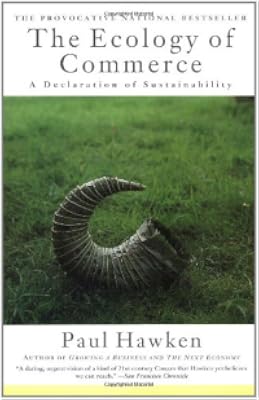
Preface: Natural Capitlism as an idea and thesis for a book emerged in 1994, the year after the publication of The Ecology of Commerce. - Last words
- (Click to show. Warning: May contain spoilers.)And it is already occurring—because it is necessary, possible, and practical.
- Blurbers
- Baldwin, J.; Hart, Stuart; Brower, David R.; Knickerbocker, Brad; Elkington, John; Jackson, Dana (show all 18); Colasurdo, Christine; Hershkowitz, Allen; McKibben, Bill; Senge, Peter M.; Kiuchi, Tachi; Gould, Kira L.; Roddick, Anita; Durrett, Jim; Orr, David W.; Clinton, Bill; Cairncross, Frances; Greider, William
Classifications
- Genres
- Economics, Science & Nature, Nonfiction, Business, General Nonfiction, Religion & Spirituality, History
- DDC/MDS
- 337 — Society, government, & culture Economics International economics
- LCC
- HC106.82 .H39 — Social sciences Economic history and conditions Economic history and conditions By region or country
- BISAC
Statistics
- Members
- 999
- Popularity
- 26,161
- Reviews
- 10
- Rating
- (4.12)
- Languages
- 9 — Chinese, Czech, Dutch, English, Estonian, French, German, Italian, Portuguese
- Media
- Paper, Ebook
- ISBNs
- 23
- ASINs
- 8