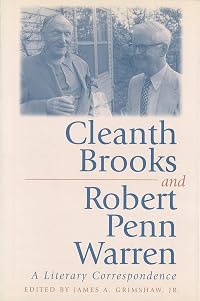
Cleanth Brooks and Robert Penn Warren: A Literary Correspondence
by Cleanth Brooks, Robert Penn Warren
On This Page
Description
James A. Grimshaw, Jr., brings together for the first time more than 350 letters exchanged by two scholars who altered the way literature is taught in this country. The selected letters focus on the development of their five major textbooks--the rationale for selections, the details involved in obtaining permissions and preparing indexes, and the demands of meeting deadlines. More important, these letters reveal their attitudes toward literature, teaching, and scholarship. Providing insight show more into two of the most influential literary minds of this century, these letters show two men who were deeply involved in research and writing, and who were committed to a life of travel, conversation, and learning. Their zest for life and their love of literature explain, in part, their uncanny ability to persevere and to succeed. Yet their human qualities are also present in the letters, which bring Brooks and Warren to life as rare individuals able to sustain a deep, lifelong friendship. Cleanth Brooks and Robert Penn Warren will help readers better understand the critical work of Brooks and the creative work of Warren. Students and teachers of American literature will find this book indispensable. show lessTags
Members
- Recently Added By
Author Information

58+ Works 2,004 Members
Cleanth Brooks was born in Murray, Kentucky on October 16, 1906. He was educated at Vanderbilt, Tulane, and Oxford universities. From 1932 to 1947, he taught English at Louisiana State University and then moved on to Yale University. At Yale, he helped to articulate the principles of New Criticism, which dominated literary studies in the 1940s and show more 1950s. He coedited the journal Southern Review with Robert Penn Warren. He also wrote several titles in collaboration with Warren, including Understanding Poetry and Understanding Fiction. A third work Understanding Drama was written in collaboration with Robert Heilman. His other works included The Well Wrought Urn: Studies in the Structure of Poetry and Modern Poetry and the Tradition. He died on May 10, 1994. (Bowker Author Biography) show less

138+ Works 14,461 Members
Robert Penn Warren, the first Poet Laureate of the United States, was an unusually versatile writer who tried his hand at almost every kind of literature. In all of these forms, he achieved recognition and distinction, but it is as a poet, critic, and novelist that he was most widely known. Writing almost always about his native South, Warren show more produced 10 novels and a collection of short stories, The Circus in the Attic and Other Stories (1948). By far the most successful of his novels is All the King's Men (1946), the story of a southern politician and demagogue named Willie Stark, which Warren based on the rise and fall of Huey Long. Warren was considered one of the most influential of the New Critics, whose influence on the teaching of literature in American schools and universities during the late 1940s and 1950s could scarcely be overestimated. Because All the King's Men seemed to be the very epitome of what a good work of literature should be in New Critical terms---a complicated but highly readable narrative filled with irony and ambiguity---the novel came to be used widely in courses on modern fiction. It won both the Pulitzer Prize and the Southern Authors Award in 1947. Warren's other novels are disappointing by comparison. Following the success of All the King's Men, however, Warren seemed to turn to more loosely told stories about dramatic and romantic subjects, such as the interracial theme of Band of Angels (1955) or the natural catastrophes that serve as the crisis background for The Cave (1959) and Flood: A Romance of Our Time (1964). Wilderness: A Tale of the Civil War (1961) is an allegory of a man's spiritual quest for truth about himself and the world. Meet Me in the Green Glen (1971), the story of a tragic love affair, seemed to mark a return to the tighter structure and more complex artistry of Warren's earlier novels, but A Place to Come To (1977), his last novel, in which an elderly and renowned scholar who seems to owe much to Warren himself looks back on his family's past in an effort to find the meaning of his life, struck some reviewers as a confused and tired work. Sometime midway through his career as a novelist it is as if Warren stopped thinking of himself as a southern writer in the tradition of William Faulkner and turned instead to Thomas Wolfe for inspiration. Although in retrospect that switch must be regretted, no one can deny the immense influence of Robert Penn Warren on modern letters. Warren's poetry is intellectual, rich in powerful images, and has its roots in the pre-Civil War South. He continued to write impressive poetry almost until the time of his death. (Bowker Author Biography) show less
All Editions
Classifications
- Genres
- Literature Studies and Criticism, Fiction and Literature, Biography & Memoir
- DDC/MDS
- 809 — Literature & rhetoric Literature, rhetoric & criticism History, description, critical appraisal of more than two literatures
- LCC
- PS29 .B74 .A4 — Language and Literature American literature American literature
- BISAC
Statistics
- Members
- 2
- Popularity
- 6,037,983
- Languages
- English
- Media
- Paper
- ISBNs
- 1