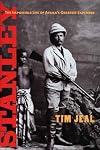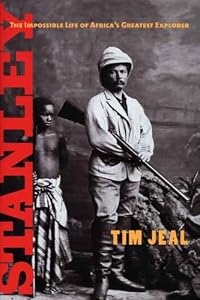
Stanley: The Impossible Life of Africa's Greatest Explorer
by Tim Jeal
On This Page
Description
We think of Stanley as a cruel imperialist who connived with King Leopold II of Belgium in horrific crimes against the people of the Congo--and the journalist who conducted the most legendary celebrity interview in history, opening with, "Dr. Livingstone, I presume?" But these perceptions are not quite true, as biographer Jeal shows. With access to previously closed Stanley family archives, Jeal reveals the extent to which Stanley's career and life have been misunderstood and undervalued. show more Few have started life as disadvantaged as Stanley. Rejected by both parents and consigned to a Welsh workhouse, he emigrated to America as a penniless eighteen-year-old. Jeal re-creates Stanley's rise to success, his friendships and romantic relationships, and his life-changing decision to assume an American identity. Stanley's epic but unfairly forgotten African journeys are described, establishing the explorer as the greatest to set foot on the continent.--From publisher description. show lessTags
Recommendations














Member Reviews
Stanley is most famous for finding Livingstone, but it was a publicity stunt, his real legacy were two crossings of equatorial Africa, the first in recorded history. The popular perception of Stanley as a young upstart who finds Livingstone then turns into a brute killer and imperialist enabler, a model for the Heart of Darkness turns out to be wrong, he is more victim than victimizer, a scapegoat. Jeal does an admirable job establishing Stanley as one of the great African explorers who was unfairly maligned, in no small part due to Stanley's own insecurities from his workhouse upbringing. He wanted to appear tough and strong, and went too far in his memoirs, even when the truth was more sanguine. Of course much of this is speculation, show more other authors might speculate differently, but Jeal had access to a trove of newly available primary source materials. And Jeal is no hagiographer, as his biography of Livingstone can attest, so his opinion is credible. The third major expedition Stanley took, the rescue of Emin Pasha, is about as Apocalypse Now as it gets for Victorian explorers. They went deep up the Congo, then up another major river into a thousand mile forest full of headhunters, columns got separated and people went insane committing brutish atrocities. Documented in Stanley's In Darkest Africa and later adapted to the 1978 play The Rear Column (dir. Harold Pinter). show less
More of a hagiography than a biography, but very well done. The affect of Stanley’s traumatic childhood on his entire life is very much front and center. The author acknowledges his desertions and his sometimes brutal behavior, though he definitely downplays them. Uses tons of primary sources to demonstrate how Stanley was often his own worst enemy, trying to burnish his reputation by presenting himself as having killed and exerted control more than was actually the case. The items about his relationship with his son were particularly touching, leaving me to wonder how he fared when Stanley died
I liked this, though I quickly grew to dislike Jeal and his constant refrain of "no one else has ever used these materials or drawn these conclusions - everyone else has always been wrong about Stanley and I alone am right!" He wrote a biography of Livingstone in which I gather he claimed to be the only person ever who didn't think Livingstone was an angel, and in this he claims to be the only person ever who didn't think Stanley was a devil. It is a very good biography when the biographer keeps his ego out of it, which he sometimes manages to do for twenty pages at a time.
Written with access to a wealth of new documentary material, Jeal goes a long way toward rehabilitating Stanley's clearly erroneous reputation for bloodthirsty conquest, etc. Even so, Stanley is not a terrifically sympathetic character, as ambitious as he was. If anything, this biography is a case study in why it's better in the end to tell the truth, instead of having to weave one tissue of lies to cover another tissue of lies.
An interesting biography of the journalist and explorer which introduces evidence from Stanley's diaries and letters to counter the prevailing image of him as a brutal opportunist who colluded with Belgium's King Leopold in ruthlessly exploiting the people and resources of the Congo basin. I was most impressed by the accounts of Stanley's trans-African journeys, which were quite amazing.
This was maybe a little too long for my interest level in Stanley. Exhaustive. And a little apologetic.
PLodding. Parts great but more than I ever wanted to know about his sex life.
Members
- Recently Added By
Lists

In Our Time books
4,934 works; 2 members
Author Information

12 Works 1,148 Members
Tim Jeal is a highly acclaimed biographer and novelist. (Bowker Author Biography)
Awards and Honors
Common Knowledge
- Original publication date
- 2007
- People/Characters
- Henry Morton Stanley; Emin Pasha; David Livingstone; Leopold II, King of the Belgians
- Important places
- Africa
- Epigraph
- ... away from people who had already made up their minds about me, I could be different. I could introduce myself as ... a boy of dignity and consequence, and without any reason to doubt me people would believe I was that boy... (show all). I recognised no obstacle to miraculous change but the incredulity of others ... Tobias Wolff, This Boy's Life
- Dedication
- To my sister, Thomasina
- First words
- Chapter One: John Rowlands - who would one day be known to the world as Henry Morton Stanley - was five and a half when a great disaster befell him. His grandfather, Mose Parry - once a prosperous butcher, but now living in r... (show all)educed circumstances - dropped dead in a potato field on the outskirts of the Welsh market town where John had lived all his life. The place was Denbigh, the date 22 June 1846, and the old man was seventy-five years old.
- Quotations
- Dr Livingstone, I presume?
- Last words
- (Click to show. Warning: May contain spoilers.)... one day, Henry Morton Stanley will no longer be a scapegoat for the post-colonial guilt of successive generations.
Classifications
Statistics
- Members
- 382
- Popularity
- 81,366
- Reviews
- 9
- Rating
- (4.04)
- Languages
- English
- Media
- Paper, Ebook
- ISBNs
- 7
- ASINs
- 3