
On This Page
Description
Lensman Kimball Kinnison has attained the goal which every Lensman seeks, and so few attain, that of Unattached Lensman, a Lensman who is accountable to no one anywhere, completely independent, completely free. Further, he is learning how to fully use his lens. This knowledge is crucial, because as he works his way up through the ranks of the enemy the problems are growing more and more complex and dangerous. Coming face-to-face, and mind-to-mind, with the multi-tentacled scaley creature in show more his corpse-littered domain, Kimball Kinnison must use everything he has learned to defeat the beast or die trying.. show less
Tags
Recommendations


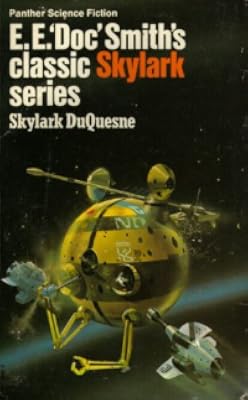
















Member Reviews
Sometimes, I'm a fool. I thought, perhaps, that the "so called" golden age of sci-fi before Heinlein would be as painful to read as the old Jules Verne. I even tried to read the first ten pages of the first book of the Lensman of E. E. Smith PHD and cringed down to my soul. I was thinking that nothing would be worth the pain of reading this trash. And yet, all of my favorite past couple of generations of sci-fi authors swore by the old doc, and there are still generations of readers that are surprised and delighted by the stories. Heck, the fourth book is considered by some to be the 98th best sci-fi book of all time. I buckled down, gritted my teeth, and picked up the fourth without so much as reading eleven pages of the first three.
I show more WAS DUMBFOUNDED. I was awestruck. I was plainly amazed and giddy in the reading of these little serialized bubblegum stories of sci-fi heroes. I'm too young to have watched Flash Gordon, but I understand the draw. I'm certainly old enough to have sat amazed through all the Star Wars at the inception. I've watched all of the original Star Treks, (not to mention every iteration after). I was forced to re-evaluate my entire internal consistency engine of sci-fi idea sources and lineage, and all of a sudden, the mitochondrial eve of sci-fi tropes (at least the best surviving eve) is FOUND. Now I understand. The light shines upon my mind. The great cosmic egg lights up like a big bulb.
So I asked in a small voice... "So the Lensman series is what encouraged the Green Lantern Comics into being? It also encouraged the biggest space operas? It took over as the sci-fi successor to all westerns and greek hero myths?" And E. E. Smith replied, "Yes, you dumbshit."
AAaaahhhh... ok... I feel like a moron now, but at least I didn't proliferate that weird-ass idea about galaxies colliding... whew... I'm back on my moral high ground again. :)
I might just have to read them in order again and ignore, dutifully, the Really Bad Physics in favor of the Great Fun.
Update:
I can't get this out of my head: The proper term for the collision of two planets is "Squishingly". I can't unread what I have read, so I pay it forward. :) show less
I show more WAS DUMBFOUNDED. I was awestruck. I was plainly amazed and giddy in the reading of these little serialized bubblegum stories of sci-fi heroes. I'm too young to have watched Flash Gordon, but I understand the draw. I'm certainly old enough to have sat amazed through all the Star Wars at the inception. I've watched all of the original Star Treks, (not to mention every iteration after). I was forced to re-evaluate my entire internal consistency engine of sci-fi idea sources and lineage, and all of a sudden, the mitochondrial eve of sci-fi tropes (at least the best surviving eve) is FOUND. Now I understand. The light shines upon my mind. The great cosmic egg lights up like a big bulb.
So I asked in a small voice... "So the Lensman series is what encouraged the Green Lantern Comics into being? It also encouraged the biggest space operas? It took over as the sci-fi successor to all westerns and greek hero myths?" And E. E. Smith replied, "Yes, you dumbshit."
AAaaahhhh... ok... I feel like a moron now, but at least I didn't proliferate that weird-ass idea about galaxies colliding... whew... I'm back on my moral high ground again. :)
I might just have to read them in order again and ignore, dutifully, the Really Bad Physics in favor of the Great Fun.
Update:
I can't get this out of my head: The proper term for the collision of two planets is "Squishingly". I can't unread what I have read, so I pay it forward. :) show less
Gray Lensman is the fourth book in the classic Lensman series and the second to focus on the adventures of Lensman extraordinaire Kim Kinnison. While the novel is colored by 1930s sensibilities (including a healthy dollop of sexism) it remains an exciting space opera complete with lantern jawed heroes, bizarre aliens, scheming villains, and colossal space battles.
The action in Gray Lensman picks up immediately where Galactic Patrol left off, in the middle of the battle against Helmuth's forces as they uncover clues as to the location of his backers, and deal with a deadly parting trap left by the now dead Helmuth. The clues (plus some deduction about the effects of colliding galaxies) lead Kinnison to mount an expedition aboard the show more newly constructed super dreadnought Dauntless into another galaxy where he thinks the true Boskone resides. The Dauntless locates a planet under attack and comes to its aid, destroying the Boskonian forces and discovering that the entire planet is capable of going "free" (that is, inertialess, the method used in the Lensman books to achieve interstellar and intergalactic space travel). As quickly as they arrived on Boskonian turf, the Lensman return to the "First Galaxy" (the Milky Way) with the space-faring planet and its grateful residents.
Having made an expedition into a Boskonian-held galaxy (and making the assumption that pretty much all of the galaxy save for the one planet they brought back is under Boskonian control) and returned with an entire planet, Kinnison decides that the greatest threat the Patrol should deal with is, once again, the traffic in the illegal drug thionite. Despite the numerous galaxy spanning space battles, the key, according to Kinnison, is to quash the presumably Boskonian backed trade in narcotics. Of course, this being a space opera, he is completely correct, but it does seem quite silly.
The novel then turns in to "Kimball Kinnison: Undercover Vice-Cop" as Kinnison tries to infiltrate the Boskonian drug network. Along the way, Kinnison learns something else new: he no longer needs his Lens to do Lensman things like read minds or communicate telepathically, adding still more powers in the repertoire of this ridiculously super-powered space hero. Kinnison suffers some setbacks, and has to assume a couple different identities, eventually one requiring him to learn to drink and use drugs with no ill effects. Eventually he uncovers the information leading him to the boss of all Boskonian drug traffic in the galaxy.
Oddly, there is a minor interlude in the middle of Kinnisons undercover work in which the Delgonian overlords seem to have returned. Kinnison, of course, is asked to lead the expedition to hunt them down, and the reptilian Worsel comes along (Worsel becomes his constant sidekick for the rest of the book). The Delgonians are dispatched in fairly short order, and Kim beats himself up over the casualties that he suffered. He quickly recovers and heads back to his assumed identity to complete his drug busting mission, but not before convening all the greatest scientists in the galaxy to work on some weapon development projects (a sequence in which we find out that Kim and Worsel are apparently the most highly rated geniuses in the galaxy). After a certain point in the story, Kinnison’s hyper-competence becomes quite silly: it seems that if there is any job that needs doing, the best man suited for the job is Kinnison, and as a result, he ends up being handed the assignment. One wonders what the other Lensman in the galaxy are up to in the meantime. Actually, with only a few exceptions, the other Lensman who appear in the books seem somewhat less than impressive. Remember, this is a group that is so selective that only a handful of the inhabitants on any given planet will qualify. And yet many of the run of the mill Lensman (who should be incredibly competent supergeniuses) seem almost doltish.
Kim and Worsel then set out on what amounts to a suicide mission to uncover the location of Boskone. Of course, since Kinnison is involved, the suicide mission doesn't quite kill him. Given the fact that Kim seems to be the only person in Civilization who can foil the evil Boskonians, one wonders what would have happened if he had been killed. It is this sort of “indispensable man” element to the Lensman stories that I believe Asimov was reacting to when he wrote the Foundation series which feature the idea that it is masses of people, not individual supermen, that make up history. To a certain extent, the Mule in Second Foundation seems to be the anti-Kinnison, a study in what a person with such superhuman powers and wide-ranging authority might actually be like. He then leads an expedition to destroy the Boskonian base in the first galaxy (using a negasphere, essentially a black hole) and then traveling to the Boskonian home turf to destroy their fleet and then their home base (using a planet cracker). The book is capped off by the culmination of the romance between Kimball and Clarissa MacDougal resulting in their marriage.
It is the super science where Doc Smith really shines. Considering that the stories were written in 1939, some of the super science devices are quite imaginative: a negasphere, composed of negative energy that consumes anything it touches, using a pair of "free" planets as a nutcracker to destroy a third, a massive command and control ship to coordinate millions of warships, a hyperspace vortex that changes the mass of objects inside it, limb and body regeneration, and so on. From scenes of a battle using space weaponry that levels a city in the process, to a massive engagement in the depths of intergalactic space, Smith writes on a scale that simply dwarfs his contemporaries.
Unusually for a writer of the era, Smith also populates his stories with bizarre and grotesque but friendly aliens. Despite being published in 1939, the Lensman books hold a decidedly xeno-friendly attitude, and one could even infer an undercurrent of antiracism in them. Unfortunately, one cannot find anti-sexism in them. Clarissa MacDougal, despite supposedly being Kinnison's equal, is relegated to the position of nurse. She's a powerful nurse, to be sure, in charge of other nurses, but she is not allowed to hold any kind of position that is not one traditionally occupied by women. She is also, of course, given the sole job of preparing the wedding when she and Kimball plan to get married. Through this, she displays no resentment concerning the fact that while the various "superior men" who populate the stories have jobs with power and responsibility (and massive credit accounts to draw upon), she is stuck working as a subordinate to random doctors on a hospital ship. Despite the blatant sexism, the story still holds up, one simply has to overlook it as an artifact of the time in which is was written.
The book also has a definite undercurrent of elitism: the Lensman in general, and Kim in particular, are simply better than those around them. They are smarter, braver, tougher, and morally superior. This is not an attitude unique to the Lensman series, but it seems that the elitism of the series has percolated into the wider science fiction world through those stories that seem to be clearly inspired by it: the elite Jedi ruling council in Star Wars, the aristocracy (and mentats, and Bene Gesserit) in Dune, and so on. Effectively, there does not seem to be any kind of democracy in the Lensman universe, just the benevolent rule by the super elite. In the Lensman series, this is supposed to be acceptable, as the Arisians ensure that only the altruistic and incorruptible will become Lensman, and thus, part of the ruling elite, but who watches over the Arisians? In the novels it is a given that the Arisians are wholly good, but without the omniscient assurance of the author, how would one know? The books that take inspiration from the Lensman series and place an elite on the throne (so to speak) rarely seem to take this into account.
Despite the elitist overtones, and the blatant sexism, Gray Lensman remains a classic of the genre. The enormous scope of the action and the incredible range of imagined superscience is simply breathtaking for a novel of its day. As an integral part of one of the most influential series of books in the genre, Gray Lensman is a must read for anyone who wants to truly understand the underpinnings of science fiction. The fast paced action, bizarre aliens, and cruel villains are simply a bonus.
This review has also been posted to my blog Dreaming About Other Worlds. show less
The action in Gray Lensman picks up immediately where Galactic Patrol left off, in the middle of the battle against Helmuth's forces as they uncover clues as to the location of his backers, and deal with a deadly parting trap left by the now dead Helmuth. The clues (plus some deduction about the effects of colliding galaxies) lead Kinnison to mount an expedition aboard the show more newly constructed super dreadnought Dauntless into another galaxy where he thinks the true Boskone resides. The Dauntless locates a planet under attack and comes to its aid, destroying the Boskonian forces and discovering that the entire planet is capable of going "free" (that is, inertialess, the method used in the Lensman books to achieve interstellar and intergalactic space travel). As quickly as they arrived on Boskonian turf, the Lensman return to the "First Galaxy" (the Milky Way) with the space-faring planet and its grateful residents.
Having made an expedition into a Boskonian-held galaxy (and making the assumption that pretty much all of the galaxy save for the one planet they brought back is under Boskonian control) and returned with an entire planet, Kinnison decides that the greatest threat the Patrol should deal with is, once again, the traffic in the illegal drug thionite. Despite the numerous galaxy spanning space battles, the key, according to Kinnison, is to quash the presumably Boskonian backed trade in narcotics. Of course, this being a space opera, he is completely correct, but it does seem quite silly.
The novel then turns in to "Kimball Kinnison: Undercover Vice-Cop" as Kinnison tries to infiltrate the Boskonian drug network. Along the way, Kinnison learns something else new: he no longer needs his Lens to do Lensman things like read minds or communicate telepathically, adding still more powers in the repertoire of this ridiculously super-powered space hero. Kinnison suffers some setbacks, and has to assume a couple different identities, eventually one requiring him to learn to drink and use drugs with no ill effects. Eventually he uncovers the information leading him to the boss of all Boskonian drug traffic in the galaxy.
Oddly, there is a minor interlude in the middle of Kinnisons undercover work in which the Delgonian overlords seem to have returned. Kinnison, of course, is asked to lead the expedition to hunt them down, and the reptilian Worsel comes along (Worsel becomes his constant sidekick for the rest of the book). The Delgonians are dispatched in fairly short order, and Kim beats himself up over the casualties that he suffered. He quickly recovers and heads back to his assumed identity to complete his drug busting mission, but not before convening all the greatest scientists in the galaxy to work on some weapon development projects (a sequence in which we find out that Kim and Worsel are apparently the most highly rated geniuses in the galaxy). After a certain point in the story, Kinnison’s hyper-competence becomes quite silly: it seems that if there is any job that needs doing, the best man suited for the job is Kinnison, and as a result, he ends up being handed the assignment. One wonders what the other Lensman in the galaxy are up to in the meantime. Actually, with only a few exceptions, the other Lensman who appear in the books seem somewhat less than impressive. Remember, this is a group that is so selective that only a handful of the inhabitants on any given planet will qualify. And yet many of the run of the mill Lensman (who should be incredibly competent supergeniuses) seem almost doltish.
Kim and Worsel then set out on what amounts to a suicide mission to uncover the location of Boskone. Of course, since Kinnison is involved, the suicide mission doesn't quite kill him. Given the fact that Kim seems to be the only person in Civilization who can foil the evil Boskonians, one wonders what would have happened if he had been killed. It is this sort of “indispensable man” element to the Lensman stories that I believe Asimov was reacting to when he wrote the Foundation series which feature the idea that it is masses of people, not individual supermen, that make up history. To a certain extent, the Mule in Second Foundation seems to be the anti-Kinnison, a study in what a person with such superhuman powers and wide-ranging authority might actually be like. He then leads an expedition to destroy the Boskonian base in the first galaxy (using a negasphere, essentially a black hole) and then traveling to the Boskonian home turf to destroy their fleet and then their home base (using a planet cracker). The book is capped off by the culmination of the romance between Kimball and Clarissa MacDougal resulting in their marriage.
It is the super science where Doc Smith really shines. Considering that the stories were written in 1939, some of the super science devices are quite imaginative: a negasphere, composed of negative energy that consumes anything it touches, using a pair of "free" planets as a nutcracker to destroy a third, a massive command and control ship to coordinate millions of warships, a hyperspace vortex that changes the mass of objects inside it, limb and body regeneration, and so on. From scenes of a battle using space weaponry that levels a city in the process, to a massive engagement in the depths of intergalactic space, Smith writes on a scale that simply dwarfs his contemporaries.
Unusually for a writer of the era, Smith also populates his stories with bizarre and grotesque but friendly aliens. Despite being published in 1939, the Lensman books hold a decidedly xeno-friendly attitude, and one could even infer an undercurrent of antiracism in them. Unfortunately, one cannot find anti-sexism in them. Clarissa MacDougal, despite supposedly being Kinnison's equal, is relegated to the position of nurse. She's a powerful nurse, to be sure, in charge of other nurses, but she is not allowed to hold any kind of position that is not one traditionally occupied by women. She is also, of course, given the sole job of preparing the wedding when she and Kimball plan to get married. Through this, she displays no resentment concerning the fact that while the various "superior men" who populate the stories have jobs with power and responsibility (and massive credit accounts to draw upon), she is stuck working as a subordinate to random doctors on a hospital ship. Despite the blatant sexism, the story still holds up, one simply has to overlook it as an artifact of the time in which is was written.
The book also has a definite undercurrent of elitism: the Lensman in general, and Kim in particular, are simply better than those around them. They are smarter, braver, tougher, and morally superior. This is not an attitude unique to the Lensman series, but it seems that the elitism of the series has percolated into the wider science fiction world through those stories that seem to be clearly inspired by it: the elite Jedi ruling council in Star Wars, the aristocracy (and mentats, and Bene Gesserit) in Dune, and so on. Effectively, there does not seem to be any kind of democracy in the Lensman universe, just the benevolent rule by the super elite. In the Lensman series, this is supposed to be acceptable, as the Arisians ensure that only the altruistic and incorruptible will become Lensman, and thus, part of the ruling elite, but who watches over the Arisians? In the novels it is a given that the Arisians are wholly good, but without the omniscient assurance of the author, how would one know? The books that take inspiration from the Lensman series and place an elite on the throne (so to speak) rarely seem to take this into account.
Despite the elitist overtones, and the blatant sexism, Gray Lensman remains a classic of the genre. The enormous scope of the action and the incredible range of imagined superscience is simply breathtaking for a novel of its day. As an integral part of one of the most influential series of books in the genre, Gray Lensman is a must read for anyone who wants to truly understand the underpinnings of science fiction. The fast paced action, bizarre aliens, and cruel villains are simply a bonus.
This review has also been posted to my blog Dreaming About Other Worlds. show less
Published in book form in 1951 this novel length story was originally serialised in 1939. Reading this science fiction space opera today one can hardly believe it was written as early as 1939. It is part of a series featuring chosen men of the Galactic Patrol who are given a Lens by an Alien race which allows them to read minds. Kimball Kinnison is the all American hero who develops further the power of the Lens. The story is a sequel to Doc Smiths previous novel The Galactic Patrol.
The humans and aliens who make up the Galactic Patrol are threatened by Boskone another powerful alien race who are looking to control the Galaxy. Most of the action takes place in outer space involving space ships that have an incredible array of fighting show more equipment. The hard science is impressive enough without getting in the way of a fairly straightforward story line. The inertialess power and anti gravity machinery is plausibly described as is the development of a new line in mathematics that results in a negasphere composed of something combining the attributes of antimatter and negative matter: there is also interdimensional travel. All this complicated science is in many respects more impressive than the storyline. The love story is pure 1930's Hollywood with all the familiar sexism and is one of the aspects that betrays the early date of this novel. There is no getting away from it that it is comic book stuff, but credible/incredible comic book stuff. 3 stars. show less
The humans and aliens who make up the Galactic Patrol are threatened by Boskone another powerful alien race who are looking to control the Galaxy. Most of the action takes place in outer space involving space ships that have an incredible array of fighting show more equipment. The hard science is impressive enough without getting in the way of a fairly straightforward story line. The inertialess power and anti gravity machinery is plausibly described as is the development of a new line in mathematics that results in a negasphere composed of something combining the attributes of antimatter and negative matter: there is also interdimensional travel. All this complicated science is in many respects more impressive than the storyline. The love story is pure 1930's Hollywood with all the familiar sexism and is one of the aspects that betrays the early date of this novel. There is no getting away from it that it is comic book stuff, but credible/incredible comic book stuff. 3 stars. show less
Painfully dated, painfully sexist and, even ignoring the former two complaints, painfully written.
And yet, having originated many of the tropes of my favourite genre I cannot entirely condemn it.
And yet, having originated many of the tropes of my favourite genre I cannot entirely condemn it.
Action-packed pulp that's classic sci-fi, but a bit short on character and development. Otherwise the plot moves well and Smith certainly has imagination. However, he's definitely old school so he likes his men to be men and his women to stand by supporting their men - so definitely *not* in the feminist category.
Gray Lensman by E. E. "Doc" Smith (1951) starts us up right after the action of Galactic Patrol. Our hero, Kim Kinnison, is once again using all his resources, strength and smarts to try and infiltrate the drug- dealing, power- hoarding, Civilization- hating entity known as Boskone. In doing this, he will have to stretch his power with the Lens beyond that of any other lensman, and although he has a lot of help from his friends, most of the work can only be done by him alone.
Well, him and the brief help of the "trimly attractive blonde" librarian at the Library of Science. The library interaction happens around page 99 on my copy -- worth reading if you are a librarian, but not really worth quoting. The librarian helps Kinnison sort show more through the great thinkers of the world by running a set of data cards through their computer and selecting for the highest ratings of different criteria. Yay libraries!
Full review here (includes spoilers): http://spacebeer.blogspot.com/2007/10/gray-lensman.html show less
Well, him and the brief help of the "trimly attractive blonde" librarian at the Library of Science. The library interaction happens around page 99 on my copy -- worth reading if you are a librarian, but not really worth quoting. The librarian helps Kinnison sort show more through the great thinkers of the world by running a set of data cards through their computer and selecting for the highest ratings of different criteria. Yay libraries!
Full review here (includes spoilers): http://spacebeer.blogspot.com/2007/10/gray-lensman.html show less
Embarrassingly badly written. He spends time telling us in detail things we don't care about and glosses over what would be interesting. He just can't seem to be bothered to do it properly. Poor show.
Members
- Recently Added By
Lists

S.F. Masterworks (Complete)
229 works; 15 members

Books Read in 2016
4,666 works; 197 members

Books Read in 2018
4,360 works; 110 members
Talk Discussions
Past Discussions
Two Guns, Will Travel in Good Show Sir! — bad science fiction and fantasy covers (March 2025)
***Group Read: The Lensman Series (Spoiler-free) in 75 Books Challenge for 2010 (June 2010)
Author Information

10+ Works 9,198 Members
Some Editions
Awards and Honors
Distinctions
Notable Lists
Series


Belongs to Publisher Series
Work Relationships
Is contained in
Common Knowledge
- Canonical title
- Gray Lensman
- Original title
- Gray Lensmen
- Original publication date
- 1951
- People/Characters
- Kimball Kinnison; Clarissa MacDougall; Worsel
- Original language
- English
- Canonical DDC/MDS
- 813.087625
Classifications
- Genres
- Science Fiction, Fiction and Literature
- DDC/MDS
- 813.087625 — Literature & rhetoric American literature in English American fiction in English By type Genre fiction Adventure fiction Speculative fiction Science fiction Space opera
- LCC
- PS3537 .M349 .G73 — Language and Literature American literature American literature Individual authors 1900-1960
- BISAC
Statistics
- Members
- 1,466
- Popularity
- 15,992
- Reviews
- 15
- Rating
- (3.55)
- Languages
- English, French, German, Portuguese
- Media
- Paper, Audiobook, Ebook
- ISBNs
- 25
- UPCs
- 1
- ASINs
- 43