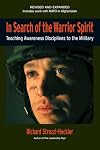
In Search of the Warrior Spirit
by Richard Strozzi-Heckler
On This Page
Description
The war in Iraq has heightened interest in the military mindset and raised questions about whether it's possible to be a mindful, moral fighter at a time when impersonal, technology based warfare reigns. In Search of the Warrior Spirit confronts this thorny issue with Richard Strozzi-Heckler's trademark personal, sympathetic style. In a top-secret U.S. military experiment, the author was asked to teach Eastern awareness disciplines ranging from aikido to meditation to a group of twenty-five show more Green Berets. This account chronicles his experiences in the training program and his attempts to revive traditional warriorship in a technological society. In Search of the Warrior Spirit explores the nature of war, the meaning of masculinity, and the need for moral values in the military. The book includes Heckler's response to 9/11, his experiences with the Pentagon and U.S. soldiers in Afghanistan, and his poignant reflections on the movie Black Hawk Down, which depicts the deaths of two of his trainees. In this revised edition, the author talks movingly of his visits to Afghanistan with NATO and about the Trojan Warrior Project and Marine Warrior Project, relating the tragic events in a war zone and revelatory conversations with both ordinary soldiers and such leaders as the Supreme Allied Commander of Europe. show lessTags
Recommendations














































Member Reviews
You're probably familiar with the late 70s military interest in the Human Potential movement as written up by Jon Ronson in The Men Who Stare At Goats and adapted into a movie. The basic gist is that a few renegade officers envisioned a unit of tuned in Warrior-Monks, who would dominate the battlefield with ESP. The whole thing got funded with the DoD equivalent of spare change, and went nowhere because it was mostly nonsense.
One of those efforts which actually went through in 1985 was a six month school to teach 25 Green Berets the basics of Aikido and Zen meditation. Strozzi-Heckler was one of the instructors in the Trojan Warrior Program (logo: a trojan horse over crossed lightsabers, with the motto "May the Force be with you" in show more Latin.) This book is structured as a journal of the school, and Strozzi-Heckler's own thoughts on the relationship between his warrior tradition, the profession of arms as practiced by his students, and Reagan's America.
Strozzi-Heckler is evangelical about Aikido, and the benefits of its "way of harmonious spirit." Rather than opposing strength on strength, Aikido is about entering and blending with the attack, an using its energy against the aggressor. Martial arts are a relatively easy sell to the Green Berets, but Zen and meditation are much harder. Strozzi-Heckler and his fellow teachers endure mockery and deception as they try and get their soldiers to become comfortable with their feelings, with sitting quietly, and with emptiness. And even though he's in good shape, Special Forces training is hard, and Strozzi-Heckler is injured several times in the dojo and in ruck marches. Maritime training along the Atlantic Coast seems very dangerous.
The description of the course is interspersed with essays on warrior culture, machismo, the potential of honor in the atomic age, and the ethics of teaching New Age techniques to men who will likely be deployed to a dirty war in Latin America. These essays can get repetitive, but Strozzi-Heckler circles around to two basic core ideas: Warriors are authentic in thought, word, and deed; and warriors strive for self-knowledge and self-improvement in a holistic sense. The students know the value of the warrior ideal, and it pains them to fall short, to be caught up in machismo posturing and military careerism. Yet those transcendent moments of physical excellent, of measuring oneself against the Ultimate in battle, make up for lousy pay and a chance of death. Strozzi-Heckler learned a lot from this book, and his students did too, although not enough to make aikido and meditation part of Army Basic, or even Special Forces training.
My edition is the 1992 paperback, with an afterwards about the Gulf War. I'm interested to see what's changed in light of the Long War on Terror. show less
One of those efforts which actually went through in 1985 was a six month school to teach 25 Green Berets the basics of Aikido and Zen meditation. Strozzi-Heckler was one of the instructors in the Trojan Warrior Program (logo: a trojan horse over crossed lightsabers, with the motto "May the Force be with you" in show more Latin.) This book is structured as a journal of the school, and Strozzi-Heckler's own thoughts on the relationship between his warrior tradition, the profession of arms as practiced by his students, and Reagan's America.
Strozzi-Heckler is evangelical about Aikido, and the benefits of its "way of harmonious spirit." Rather than opposing strength on strength, Aikido is about entering and blending with the attack, an using its energy against the aggressor. Martial arts are a relatively easy sell to the Green Berets, but Zen and meditation are much harder. Strozzi-Heckler and his fellow teachers endure mockery and deception as they try and get their soldiers to become comfortable with their feelings, with sitting quietly, and with emptiness. And even though he's in good shape, Special Forces training is hard, and Strozzi-Heckler is injured several times in the dojo and in ruck marches. Maritime training along the Atlantic Coast seems very dangerous.
The description of the course is interspersed with essays on warrior culture, machismo, the potential of honor in the atomic age, and the ethics of teaching New Age techniques to men who will likely be deployed to a dirty war in Latin America. These essays can get repetitive, but Strozzi-Heckler circles around to two basic core ideas: Warriors are authentic in thought, word, and deed; and warriors strive for self-knowledge and self-improvement in a holistic sense. The students know the value of the warrior ideal, and it pains them to fall short, to be caught up in machismo posturing and military careerism. Yet those transcendent moments of physical excellent, of measuring oneself against the Ultimate in battle, make up for lousy pay and a chance of death. Strozzi-Heckler learned a lot from this book, and his students did too, although not enough to make aikido and meditation part of Army Basic, or even Special Forces training.
My edition is the 1992 paperback, with an afterwards about the Gulf War. I'm interested to see what's changed in light of the Long War on Terror. show less
Ratings
Members
- Recently Added By
Author Information
13 Works 399 Members
Classifications
- Genres
- Sports and Leisure, Nonfiction, History, General Nonfiction, Philosophy
- DDC/MDS
- 355.0019 — Society, Government, and Culture Public administration & military science The Military - Land, Air & Sea / Warfare
- LCC
- U22.3 .H37 — Military Science Military science (General) War. Philosophy. Military sociology
- BISAC
Statistics
- Members
- 133
- Popularity
- 244,908
- Reviews
- 1
- Rating
- (4.00)
- Languages
- English
- Media
- Paper, Audiobook, Ebook
- ISBNs
- 7
- ASINs
- 2