On This Page
Description
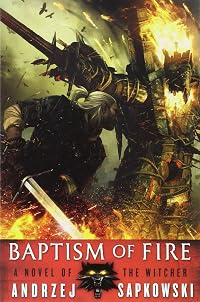
The Wizards Guild has been shattered by a coup and, in the uproar, Geralt was seriously injured. The Witcher is supposed to be a guardian of the innocent, a protector of those in need, a defender against powerful and dangerous monsters that prey on men in dark times. But now that dark times have fallen upon the world, Geralt is helpless until he has recovered from his injuries. While war rages across all of the lands, the future of magic is under threat and those sorcerers who survive are show more determined to protect it. It's an impossible situation in which to find one girl--Ciri, the heiress to the throne of Cintra, has vanished--until a rumor places her in the Niflgaard court, preparing to marry the Emperor. Injured or not, Geralt has a rescue mission on his hands. show lessTags
Recommendations













Member Reviews
I think “Quantum of Solace” is one of the best films in the James Bond franchise. I understand the complaints — the pacing, the fragmented plot, the forgettable villain — but QoS is a rare gem in that Bond has an actual arc and character growth. Shooting and punching are well and good, but I like to see a character change under adversity. Since nothing drives change like fire, this is probably why I like “Baptism of Fire” despite consistent fan rankings near the middle or bottom of the Witcher books.
Now, I don’t like the book half as much as Andrzej Sapkowski likes the analogy of fire. If you forget the title, don’t worry. He’ll repeat the phrase or concept almost to the point of self-parody. The book is strong enough show more that I can forgive this, especially since people enduring geopolitical convulsions naturally find fire an apt analogy for what they’re going through — and through is the only direction left when the fires of war are lit. As an elven guerilla says in response to criticism that he and his ilk, by acting as partisans for Nilfgaard, are lighting a fire that will consume them, “Fire purges. And hardens. It must be passed through. Aenyell’hael, ell’ea, sor’ca? In your tongue: a baptism of fire.”
The story picks up where “The Time of Contempt” left off. The Wizards Guild is gone, blown apart by the attempted coup that left the Witcher Geralt of Rivia near death and Ciri, child of dark destiny, missing. The Nilfgaardian Empire, having split the fractious alliance of Northern kings, is finally across the Yaruga and working to roll up the North. Deep in Brokilon Forest, under the protection of the dryads, Geralt inches back to life only to learn that Ciri is reportedly deep within Nilfgaard awaiting marriage to Emperor Emhyr var Emreis. How can one man rescue one girl when the space between them is a sea of blood and fire?
I didn’t expect a novel of high fantasy to give me some of the best descriptions of war I’ve ever read, but Sapkowski delivers. I don’t mean the battles themselves, since we spend little time with the soldiery. What I mean is that, as Geralt and his slowly gathering band of misfits probe for a way through the fighting, the ignobility of war is raw and real: its bottomless cruelty, random savagery, and senseless misery. Sapkwoski reminds us that such horrors come when collaboration crumbles, and that it can crumble fast. As Philippa Eilhart puts it while attempting to forge a new and female-first magical order, “The tragic events on Thanedd, to which my thoughts return with regret and reluctance, proved that the effects of hundreds of years of apparently peaceful cooperation could be laid waste in an instance, as self-interest and inflated ambitions came to the fore.”
In a world where cooperation has collapsed into an inferno, baptisms of fire abound. Some, like the fanatical priest of a refugee camp, see an opportunity to purge undesirable elements: “I say to you, before we join battle with Nilfgaard, let us first purge our own house of these abominations! Scorch this abscess with a white-hot iron! Subject it to a baptism of fire!” Others, such as the free elven sorceress Ida Emean aep Sivney, accept the chance of a fiery demise in hopes of a better future: “Fire burns, but it also purifies. It must be passed through. Risks have to be taken.”
And some, like the Witcher, pursue penance for the guilt they feel at failing to protect their loved ones, seeking a solitary atonement without the risk of failing anyone else. I understand that feeling, but here’s the thing: inviting a baptism of fire alone is foolish and self-defeating. An unlikely ally confronts Geralt along these lines, saying, “Advice is superfluous to you, allies are superfluous, you’ll get by without any traveling companions. The goal of your expedition is, after all, personal and private. More than that, the nature of the goal demands that you accomplish it alone, in person. The risks, dangers, hardships and constant struggle with doubt must burden only you. For, after all, they are components of the penance, the expiation of guilt you want to earn. A baptism of fire, I’d say. You’ll pass through the fire, which burns, but also purges. And you’ll do it alone…Only you have a debt to pay off, and you don’t want to run up debts with other creditors at the same time.”
The closing words of this confrontation sum up the book’s core theme, the arc of Geralt’s character growth, and a vital truth: “Life differs from banking because it has debts which are paid off by running up debts with others.” I had to sit with this sentence for a while. I’m prone to wall myself off on my island of competence, to need no one, to engage no debts to another. I need reminders that community isn’t just a nice word. Or as Geralt’s best friend and troubadour put it, “But you haven’t got a clue what you’re doing. You even owe the soup you gobbled down to us. Were it not for us, you’d be hungry. We would be too, had we waited for you to act. That cauldron of soup was the result of cooperation. Of teamwork. The joint efforts of a fellowship united by a common goal. Get it, friend?” If no one is willing to owe anything to anyone, then everyone goes hungry.
The world can be a hard place, especially when it seems to be on fire and it’s every man for himself. Paradoxically, these are the times when good people most need and most often find one another: “In this rotten world, Zoltan Chivay, goodness, honesty and integrity become deeply engraved in the memory.” You won’t get anywhere in hard times if you act like Geralt of Rivia, holding friends and allies at arm’s length, afraid to let them in. The way through your baptism of fire is to know who you are, know who your friends are, and hold fast to what you know to be true: “The challenge you have in front of you is the same one we face: to survive and stay alive. In order for this noble mission to continue. Or live an ordinary life, but so as not to be ashamed at the hour of death. You think you’ve changed. That the world has changed. But look; the world’s the same as it’s always been. Quite the same. And you’re the same as you used to be. Don’t fret.” show less
Now, I don’t like the book half as much as Andrzej Sapkowski likes the analogy of fire. If you forget the title, don’t worry. He’ll repeat the phrase or concept almost to the point of self-parody. The book is strong enough show more that I can forgive this, especially since people enduring geopolitical convulsions naturally find fire an apt analogy for what they’re going through — and through is the only direction left when the fires of war are lit. As an elven guerilla says in response to criticism that he and his ilk, by acting as partisans for Nilfgaard, are lighting a fire that will consume them, “Fire purges. And hardens. It must be passed through. Aenyell’hael, ell’ea, sor’ca? In your tongue: a baptism of fire.”
The story picks up where “The Time of Contempt” left off. The Wizards Guild is gone, blown apart by the attempted coup that left the Witcher Geralt of Rivia near death and Ciri, child of dark destiny, missing. The Nilfgaardian Empire, having split the fractious alliance of Northern kings, is finally across the Yaruga and working to roll up the North. Deep in Brokilon Forest, under the protection of the dryads, Geralt inches back to life only to learn that Ciri is reportedly deep within Nilfgaard awaiting marriage to Emperor Emhyr var Emreis. How can one man rescue one girl when the space between them is a sea of blood and fire?
I didn’t expect a novel of high fantasy to give me some of the best descriptions of war I’ve ever read, but Sapkowski delivers. I don’t mean the battles themselves, since we spend little time with the soldiery. What I mean is that, as Geralt and his slowly gathering band of misfits probe for a way through the fighting, the ignobility of war is raw and real: its bottomless cruelty, random savagery, and senseless misery. Sapkwoski reminds us that such horrors come when collaboration crumbles, and that it can crumble fast. As Philippa Eilhart puts it while attempting to forge a new and female-first magical order, “The tragic events on Thanedd, to which my thoughts return with regret and reluctance, proved that the effects of hundreds of years of apparently peaceful cooperation could be laid waste in an instance, as self-interest and inflated ambitions came to the fore.”
In a world where cooperation has collapsed into an inferno, baptisms of fire abound. Some, like the fanatical priest of a refugee camp, see an opportunity to purge undesirable elements: “I say to you, before we join battle with Nilfgaard, let us first purge our own house of these abominations! Scorch this abscess with a white-hot iron! Subject it to a baptism of fire!” Others, such as the free elven sorceress Ida Emean aep Sivney, accept the chance of a fiery demise in hopes of a better future: “Fire burns, but it also purifies. It must be passed through. Risks have to be taken.”
And some, like the Witcher, pursue penance for the guilt they feel at failing to protect their loved ones, seeking a solitary atonement without the risk of failing anyone else. I understand that feeling, but here’s the thing: inviting a baptism of fire alone is foolish and self-defeating. An unlikely ally confronts Geralt along these lines, saying, “Advice is superfluous to you, allies are superfluous, you’ll get by without any traveling companions. The goal of your expedition is, after all, personal and private. More than that, the nature of the goal demands that you accomplish it alone, in person. The risks, dangers, hardships and constant struggle with doubt must burden only you. For, after all, they are components of the penance, the expiation of guilt you want to earn. A baptism of fire, I’d say. You’ll pass through the fire, which burns, but also purges. And you’ll do it alone…Only you have a debt to pay off, and you don’t want to run up debts with other creditors at the same time.”
The closing words of this confrontation sum up the book’s core theme, the arc of Geralt’s character growth, and a vital truth: “Life differs from banking because it has debts which are paid off by running up debts with others.” I had to sit with this sentence for a while. I’m prone to wall myself off on my island of competence, to need no one, to engage no debts to another. I need reminders that community isn’t just a nice word. Or as Geralt’s best friend and troubadour put it, “But you haven’t got a clue what you’re doing. You even owe the soup you gobbled down to us. Were it not for us, you’d be hungry. We would be too, had we waited for you to act. That cauldron of soup was the result of cooperation. Of teamwork. The joint efforts of a fellowship united by a common goal. Get it, friend?” If no one is willing to owe anything to anyone, then everyone goes hungry.
The world can be a hard place, especially when it seems to be on fire and it’s every man for himself. Paradoxically, these are the times when good people most need and most often find one another: “In this rotten world, Zoltan Chivay, goodness, honesty and integrity become deeply engraved in the memory.” You won’t get anywhere in hard times if you act like Geralt of Rivia, holding friends and allies at arm’s length, afraid to let them in. The way through your baptism of fire is to know who you are, know who your friends are, and hold fast to what you know to be true: “The challenge you have in front of you is the same one we face: to survive and stay alive. In order for this noble mission to continue. Or live an ordinary life, but so as not to be ashamed at the hour of death. You think you’ve changed. That the world has changed. But look; the world’s the same as it’s always been. Quite the same. And you’re the same as you used to be. Don’t fret.” show less
Andrzej Sapkowski, while being a 72 year old white man (Polish), has given more power, autonomy, and diversity to his female characters than most authors his age, and even many male authors of the younger generation. His female characters are strong and capable. He makes it CLEAR that they have the only say about what happens with their bodies. In this book especially, he shows how women can be politically, physically, and intelligently empowered without the help of men. Ciri, while being 16, struggles through her young adulthood by being faced with many different ideologies. For the first time, she has to make decisions on her own which result disastrously. However, the Witcher is on his way to find her (again). Although he wants to show more protect her, save her even, it's clear she is not in need of saving, except, perhaps, from her own depravity. Not only is this a journey through a war and through the woods, but a journey through morality. Truly a beautiful, fun, and intelligent novel, can't wait to read the next one. show less
A slower entry in the Witcher series, much of which is defined by Geralt's journey to find Ciri. Still, even when the story slows down, I can't help but tear through the pages.
While in prior books the triangular (and sometimes barbed) relationship between Yen, Ciri, and Geralt has enthralled me. Here, I was enchanted by Milva, a newcomer who jumps off the page as if this is her series, not Geralt's. Since the majority of the book is told through Geralt's POV, I really loved reading their interactions.
In many ways, this book felt like a holding pattern for the larger story. At the same time, I appreciate the character depth it offers.
While in prior books the triangular (and sometimes barbed) relationship between Yen, Ciri, and Geralt has enthralled me. Here, I was enchanted by Milva, a newcomer who jumps off the page as if this is her series, not Geralt's. Since the majority of the book is told through Geralt's POV, I really loved reading their interactions.
In many ways, this book felt like a holding pattern for the larger story. At the same time, I appreciate the character depth it offers.
Best Witcher novel so far - Sapkowski had outdone himself (literally, I thought no one could write better, but forgot that Sapkowski himself can write better than Sapkowski).
Also, one of the best fantasy novels I have ever read.
Actually, for my taste, one of the best novels in general ever read be me, whatever the genre. It has them all, anyway: military (war), espionage, friendship, love, courtly intrigues, politics... and a surprising amount of very good and funny humor (of the ”tongue in the cheek” kind).
I must also say I was amazed by the high quality translation: it reads as a very well-written book in English - the fact it was actually written in a very different language is incredible (în comparație cu traducerea show more execrabilă în română - par alte cărți, unele proaste și de necitit).
PS for the gamers: so far this is the most relevant Witcher novel for understanding the game: it explains the background of many characters and also the political conflicts and some hate relationships. After this book, I understand W3WH completely differently. show less
Also, one of the best fantasy novels I have ever read.
Actually, for my taste, one of the best novels in general ever read be me, whatever the genre. It has them all, anyway: military (war), espionage, friendship, love, courtly intrigues, politics... and a surprising amount of very good and funny humor (of the ”tongue in the cheek” kind).
I must also say I was amazed by the high quality translation: it reads as a very well-written book in English - the fact it was actually written in a very different language is incredible (în comparație cu traducerea show more execrabilă în română - par alte cărți, unele proaste și de necitit).
PS for the gamers: so far this is the most relevant Witcher novel for understanding the game: it explains the background of many characters and also the political conflicts and some hate relationships. After this book, I understand W3WH completely differently. show less
Once again Geralt and Ciri have been separated by war and circumstances. Recovering from brutal injuries, Geralt is trekking across a war zone with Dandelion and a ragtag group of misfits and refugees. Although the rumor is that Ciri has been kidnapped and forced into a political marriage, Geralt's dreams tell him that she is riding with a group of bandits. That she's happy enough, but won't be safe until he's with her again. Joining forces with dwarves, vampires, and whoever else they come across, they make their way towards Ciri as best they can.
Although I'm getting a little tired of this plot device of separation, I do very much enjoy these books. The author has such commitment to the characters he introduces and such devotion to his show more themes that I cannot help but be entranced. show less
Although I'm getting a little tired of this plot device of separation, I do very much enjoy these books. The author has such commitment to the characters he introduces and such devotion to his show more themes that I cannot help but be entranced. show less
I wont spoil much or even anything of importance. But some people might find even mentioning of potential plot a spoiler so I marked this as one. Reading Andrzejs books always catches me thinking about how much I enjoy the simple things.In one instance of the book a soup is being made. And the dialogue and the circumstances surrounding the event are so funny and so well written it made my giggle and stop to think how much I enjoyed what I have just read. Most of the books I tend to value are praised by me for their action, depth of character , plot twists , the magic system and things of that nature. This books however made me appreciate the little things, it is excellent on how down to earth it is and how the simple things make the show more fantasy more real. It is not a story about a knight in shining armour , who braves the dangers without flinching. No this is a story about destiny that happened to, what feels like , ordinary people who just happened to have some special traits. I love the flow of the book I love the characters , I value the slow pace and I love that humanity is brought to the forefront instead of heroism and impossible deeds. Let's go ant make some soup everyone! show less
Although the plot felt a little stagnant in this book, I loved the focus on the intricacies of the characters and how their stories all wove together. I felt that it gave real context to the world I was reading about and the characters I was following.
Members
- Recently Added By
Lists

Books Read in 2019
4,052 works; 110 members

Mind Expanding Books by hackerkid
581 works; 8 members

Ranking
66 works; 1 member

Witchy Fiction
253 works; 126 members

Books Read in 2024
4,727 works; 128 members

Top Five Books of 2024
795 works; 264 members

Books Read in 2022
5,226 works; 115 members
Author Information

121+ Works 43,667 Members
Andrzej Sapkowski is a fantasy writer, economist, and translator, he wrote the best-selling book series The Witcher and recently wrote the best-selling book, Lady of the Lake. In 2018 his title, Season of Storms, made the bestseller list. (Bowker Author Biography)
Some Editions
Awards and Honors
Awards
Series

Work Relationships
Is contained in
Has the adaptation
Common Knowledge
- Canonical title
- Baptism of Fire
- Original title
- Chrzest ognia
- Alternate titles*
- غسل آتش
- Original publication date
- 1996
- People/Characters
- Geralt of Rivia; Ranuncolo; Milva; Zoltan Chivay; Emiel Regis Rohellec Terzieff-Godefroy; Cahir Mawr Dyffryn aep Ceallach (show all 13); Percival Schuttenbach; Yennefer of Vengerberg; Francesca Findabair; Filippa Eilhart; Assire var Anahid; Fringilla Vigo; Ciri
- Epigraph*
- Through these fields of destruction
Baptism of Fire
I've watched all your suffering
As the battles raged higher
And though they did hurt me so bad
In the fear and alarm
You did not desert me
My ... (show all)brothers in arms...
Dire Straits - First words
- Entonces le dijo la profetisa al brujo: Este consejo te doy: ponte botas de yerro, toma en la mano un bastón de yerro.
Los arbustos reventaban de pájaros. - Last words
- (Click to show. Warning: May contain spoilers.)El caballero Geralt de Rivia hizo una profunda reverencia, para que la reina Meve, su soberana, no distinguiera la sonrisa, la amrga sonrisa que no era capaz de dominar.
- Publisher's editor*
- Kowalski Mirosław
- Original language
- Polish
*Some information comes from Common Knowledge in other languages. Click "Edit" for more information.
Classifications
- Genres
- Fantasy, Fiction and Literature
- DDC/MDS
- 891.8 — Literature & rhetoric Literatures of other languages East Indo-European and Celtic literatures West and South Slavic languages (Bulgarian, Slovene, Polish, Czech, Slovak, Serbo-Croatian, and Macedonian)
- LCC
- PG7178 .A65 .C4813 — Language and Literature Slavic languages and literatures. Baltic languages. Albanian language Slavic. Baltic. Albanian Slavic Polish
- BISAC
Statistics
- Members
- 4,050
- Popularity
- 3,847
- Reviews
- 47
- Rating
- (4.03)
- Languages
- 29 — Bulgarian, Czech, Danish, Dutch, English, Estonian, Finnish, French, German, Greek, Hungarian, Italian, Japanese, Lithuanian, Norwegian, Farsi/Persian, Polish, Romanian, Russian, Serbian, Croatian, Slovak, Spanish, Swedish, Turkish, Portuguese (Portugal), Portuguese (Brazil), Chinese, traditional, Chinese, simplified
- Media
- Paper, Audiobook, Ebook
- ISBNs
- 81
- ASINs
- 21