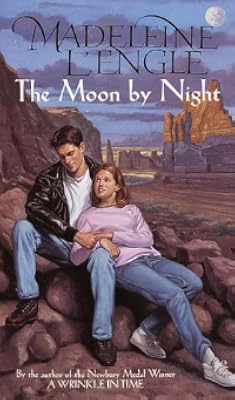
The Moon by Night
by Madeleine L'Engle
Chronos/The Austins: Publication Order (2), Chronos/The Austins: Chronological Order (4)
On This Page
Description
"As if simply being fourteen-years-old weren't bad enough -- what with the usual teenage angst and uncertainty, Vicky Austin's always comforting and reliable home life is changing completely. Her brother John is going off to college in the fall. Maggy, an orphan taken in by the Austins two years ago, has gone to live with her legal guardian. And the rest of Vicky's family is moving from their quiet house in the country to the heart of New York City. But before the big move, the entire Austin show more family is taking a meandering trip across the country in their station wagon, stopping to camp along the way, with no set schedule and not a single night of camping experience among them. Wild animal attacks. Life-threatening natural disasters. Cute boys on the prowl. Anything can happen in the great outdoors"--P. [4] of cover. show lessTags
Recommendations









Member Reviews
Ms. L'Engle takes the familiar motif of a journey in the form of a family vacation and ties it neatly into the metaphorical journey that all adolescent girls take as they move from being a child to being a woman. Vicky is a nice girl, but even nice girls have their moments of moodiness, of falling for the "bad boy", of just wanting to be alone, of feeling misunderstood. The beauty of this particular journey is that the Austins are a family that sticks together, even when one of their members is being hard to love. They make allowances and love each other anyway. I also enjoyed seeing many places that I am familiar with through the eyes of a young person seeing them for the first time.
I might have enjoyed this second book in the Austin Family Chronicles even more than the first. The Austins are about to move to New York City, but first they are taking a cross-country camping trip to see the country and visit friends and relatives. The story comes through the perspective of Vicky, second oldest of the Austin children as she begins to itch a bit at the confines of family, begins to have interest in boys, and discovers more about who she is. Sometimes slightly dated in some attitudes, but not enough to be terribly bothersome, though of course that is YMMV. More annoying is the boy who won't leave Vicky alone. We're supposed to think he's kind of okay despite being... not all that okay, and that was the hardest thing to show more sit with for me. show less
Twice I have read a series by the late Madeleine L’Engle, loving the debut novel while hating the sequel. But the sophomore slump is over! I really liked the first book in the Austin Family Chronicles, Meet the Austins, but I loved this follow-up, even more!
Like many teenagers, Vicky Austin, now nearly 15, has become moody and confused. Orphan Maggy Hamilton, who has lived with the Austins for two years, will be moving with her new family to California. Maggy is thrilled, but Vicky realizes that, with the loss of Maggy and her older brother John heading off to M.I.T. in the fall, her life would be bound to change; on top of that, the Austins are moving to New York City temporarily while her dad, Dr. Wallace Austin, conducts research show more there.
The Austins drive out to California to visit with Maggy, Uncle Doug and Aunt Elena, camping all the way there and back. I won’t spoil the novel by telling any more. But Vicky does quite a bit of growing up. I’ve never seen an adult create a more accurate picture of what it’s like to be a teenager betwixt and between her old life and the new. It rekindled by own, long-forgotten memories. Again, thank you, Manybooks. Without your recommendation, I wouldn’t have found this fabulous series! show less
Like many teenagers, Vicky Austin, now nearly 15, has become moody and confused. Orphan Maggy Hamilton, who has lived with the Austins for two years, will be moving with her new family to California. Maggy is thrilled, but Vicky realizes that, with the loss of Maggy and her older brother John heading off to M.I.T. in the fall, her life would be bound to change; on top of that, the Austins are moving to New York City temporarily while her dad, Dr. Wallace Austin, conducts research show more there.
The Austins drive out to California to visit with Maggy, Uncle Doug and Aunt Elena, camping all the way there and back. I won’t spoil the novel by telling any more. But Vicky does quite a bit of growing up. I’ve never seen an adult create a more accurate picture of what it’s like to be a teenager betwixt and between her old life and the new. It rekindled by own, long-forgotten memories. Again, thank you, Manybooks. Without your recommendation, I wouldn’t have found this fabulous series! show less
Let me say first that it's a wonderful book. The characters are people you care about, and get very involved with. The plot is fun. The writing is excellent.
However, I think it is dated, no matter what Wendy says to the contrary. The attitudes of the menfolk, first of all- Daddy makes all the calls, takes the women and children out of danger, and dictates what his wife may not wear (pants, natch). John, the priggish elder brother, follows Daddy's lead here. The overarching worry about nuclear war with the Soviets dates it. The wondering if humans will ever fly to the moon dates it. The painful slang- including "hoods" and "beatniks". Even the logging trucks with one log per load make it read as dated. And who calls their father 'Daddy' show more un-ironically when they are 14? Or like John, 17?
Why do I find this particular book dated in a fashion I don't notice with, say, the Betsy-Tacy books? Probably because it feels like L'Engle is attempting to comfort the people who were genuinely Vicky's age when this book came out. There's an undercurrent of very pointed reassurance that seems to be grounded in time, and I think that's what makes parts of this book a little stale. I think that had I been reading this as a young teen in 1963 I would have clung to it like grim death. I read it as a young teen in the mid-70's and thought the slang very silly at the time. But it didn't stop me loving the book.
In addition to the things I'm complaining about, there's a timeless story here too, wherein a young girl tries to make sense out of the senseless, to grasp the meaning, if any, of her life at the same time she's beginning to pull away from her family of origin and find her own path. Here is the place in which L'Engle shines like the sun. Her essential, unshakable conviction that there IS a reason for everything, that there IS a hand at the wheel, and that the driving force of that hand is the power of love, infuses every word. And makes all my bitching about beatniks sound as small as it is.
It's a wonderful book. I love that it's anchored at both ends with Grandfather. I'll always love Grandfather for giving me Henry Vaughan, but as Kipling said, that is another story. show less
However, I think it is dated, no matter what Wendy says to the contrary. The attitudes of the menfolk, first of all- Daddy makes all the calls, takes the women and children out of danger, and dictates what his wife may not wear (pants, natch). John, the priggish elder brother, follows Daddy's lead here. The overarching worry about nuclear war with the Soviets dates it. The wondering if humans will ever fly to the moon dates it. The painful slang- including "hoods" and "beatniks". Even the logging trucks with one log per load make it read as dated. And who calls their father 'Daddy' show more un-ironically when they are 14? Or like John, 17?
Why do I find this particular book dated in a fashion I don't notice with, say, the Betsy-Tacy books? Probably because it feels like L'Engle is attempting to comfort the people who were genuinely Vicky's age when this book came out. There's an undercurrent of very pointed reassurance that seems to be grounded in time, and I think that's what makes parts of this book a little stale. I think that had I been reading this as a young teen in 1963 I would have clung to it like grim death. I read it as a young teen in the mid-70's and thought the slang very silly at the time. But it didn't stop me loving the book.
In addition to the things I'm complaining about, there's a timeless story here too, wherein a young girl tries to make sense out of the senseless, to grasp the meaning, if any, of her life at the same time she's beginning to pull away from her family of origin and find her own path. Here is the place in which L'Engle shines like the sun. Her essential, unshakable conviction that there IS a reason for everything, that there IS a hand at the wheel, and that the driving force of that hand is the power of love, infuses every word. And makes all my bitching about beatniks sound as small as it is.
It's a wonderful book. I love that it's anchored at both ends with Grandfather. I'll always love Grandfather for giving me Henry Vaughan, but as Kipling said, that is another story. show less
The summer she was fourteen, Vicky Austin was dealing with a lot of changes. For one, she's just getting into that in-between age where moodiness is expected and she's just not a little kid anymore. For another, Maggy is moving in with Aunt Elena and Uncle Douglas, who are getting married, and her dad got a new job in New York, so they're moving. But first, they're taking a cross country road and camping trip. One thing is for sure: after this summer, nothing will ever be the same.
The title is taken from a line in Psalm 121, "I lift my eyes up to the mountains...the sun will not harm you by day, / nor the moon by night." The psalm is referred to often throughout, as Vicky deals with a crisis of faith and identity. She meets a boy and show more experiences all sorts of new, complicated feelings - along with the disapproval of her family, who don't like Zachary, who is a bit of a spoiled and pessimistic brat, all that much. I enjoyed the descriptions of various places around the country: the Great Smoky Mountains National Park in Tennessee, Indian reservations, and more. It's rather episodic as they move around and have adventures in each new place, culminating with a climactic event that was suddenly more than I expected. I had a weird sense of deja vu, too, as if I had read the story once before as a kid. Things would happen and I would think, that's right, that sounds familiar. Anyway, if I had read it when I was younger I'm not sure I had the same compassion for Vicky that I did this time around, trying to come to terms with her own beliefs and growing up. The story was written in the 60s and is in some ways a bit dated ("Daddy doesn't like women in pants"), but in others shows great tolerance and urges people to listen to each other without judgment. show less
The title is taken from a line in Psalm 121, "I lift my eyes up to the mountains...the sun will not harm you by day, / nor the moon by night." The psalm is referred to often throughout, as Vicky deals with a crisis of faith and identity. She meets a boy and show more experiences all sorts of new, complicated feelings - along with the disapproval of her family, who don't like Zachary, who is a bit of a spoiled and pessimistic brat, all that much. I enjoyed the descriptions of various places around the country: the Great Smoky Mountains National Park in Tennessee, Indian reservations, and more. It's rather episodic as they move around and have adventures in each new place, culminating with a climactic event that was suddenly more than I expected. I had a weird sense of deja vu, too, as if I had read the story once before as a kid. Things would happen and I would think, that's right, that sounds familiar. Anyway, if I had read it when I was younger I'm not sure I had the same compassion for Vicky that I did this time around, trying to come to terms with her own beliefs and growing up. The story was written in the 60s and is in some ways a bit dated ("Daddy doesn't like women in pants"), but in others shows great tolerance and urges people to listen to each other without judgment. show less
This gentle book is an excellent one, provided you understand it is rooted in its time period. There are certainly cultural things (the father being in charge, the fears of a nuclear war) that make it clear when it was written. That said, it still speaks to me now.
Young Vicky Austin is now 14, and learning just who she is. She discovers, "You have to go off by yourself or you just stop being you, and after all I was just beginning to be me." And that in some ways is the theme of the book. Who are you and how do you know? And what happens when you meet someone different, not the same ethically as you?
I enjoyed the tour across the country, especially the descriptions of the Palo Duro Canyon, not far from where I live now. I also enjoyed show more the philosophical passages in the book. It was exactly what I needed to take a break from my hectic real-world life.
Thoughtful young teens would enjoy this book. Adults who still remember what it was like to be 14 and who enjoy philosophy would like it, too. show less
Young Vicky Austin is now 14, and learning just who she is. She discovers, "You have to go off by yourself or you just stop being you, and after all I was just beginning to be me." And that in some ways is the theme of the book. Who are you and how do you know? And what happens when you meet someone different, not the same ethically as you?
I enjoyed the tour across the country, especially the descriptions of the Palo Duro Canyon, not far from where I live now. I also enjoyed show more the philosophical passages in the book. It was exactly what I needed to take a break from my hectic real-world life.
Thoughtful young teens would enjoy this book. Adults who still remember what it was like to be 14 and who enjoy philosophy would like it, too. show less
As if simply being fourteen-years-old weren't bad enough--what with the usual teenage angst and uncertainty, Vicky Austin's always comforting and reliable home life is changing completely. Her brother John is going off to college in the fall. Maggy, an orphan taken in by the Austins two years ago, has gone to live with her legal guardian. And the rest of Vicky's family is moving from their quiet house in the country to the heart of New York City.
But before the big move, the entire Austin family is taking a meandering trip across the country in their station wagon, stopping to camp along the way, with no set schedule and not a single night of camping experience among them.
Wild animal attacks. Life-threatening natural disasters. Cute boys show more on the prowl. Anything can happen in the great outdoors. show less
But before the big move, the entire Austin family is taking a meandering trip across the country in their station wagon, stopping to camp along the way, with no set schedule and not a single night of camping experience among them.
Wild animal attacks. Life-threatening natural disasters. Cute boys show more on the prowl. Anything can happen in the great outdoors. show less
Members
- Recently Added By
Lists

Honey For a Child's Heart
1,152 works; 25 members

Two faces on cover -- children's/young adult fiction
120 works; 2 members
Author Information

122+ Works 129,130 Members
Author Madeleine L'Engle was born in New York City on November 29, 1918. She graduated from Smith College. She is best known for A Wrinkle in Time (1962), which won the 1963 Newbery Medal for best American children's book. While many of her novels blend science fiction and fantasy, she has also written a series of autobiographical books, including show more Two Part Invention: The Story of a Marriage, which deals with the illness and death of her husband, soap opera actor Hugh Franklin. In 2004, she received a National Humanities Medal from President George W. Bush. She died on September 6, 2007 of natural causes. Since 1976, Wheaton College in Illinois has maintained a special collection of L'Engle's papers, and a variety of other materials, dating back to 1919. (Bowker Author Biography) show less
Awards and Honors
Awards
Series


Work Relationships
Common Knowledge
- Canonical title
- The Moon by Night
- Original publication date
- 1963
- People/Characters
- Vicky Austin; Zachary Gray; Suzy Austin; Elena Huxley Austin; Douglas Austin; Maggy Hamilton (show all 13); Grandfather; Wallace Austin; Victoria Eaton (Victoria Austin); John Austin; Rob Austin; Commander Rodney; Leo Rodney
- Dedication
- To Hugh, Jo, Maria, and Bion.
- First words
- "Vicky!"
- Last words
- (Click to show. Warning: May contain spoilers.)I was Vicky Austin.
Classifications
- Genres
- Fiction and Literature, Kids, Teen, Children's Books, Young Adult
- DDC/MDS
- 813.54 — Literature & rhetoric American literature in English American fiction in English 1900-1999 1945-1999
- LCC
- PZ7 .L5385 .M — Language and Literature Fiction and juvenile belles lettres Fiction and juvenile belles lettres Juvenile belles lettres
- BISAC
Statistics
- Members
- 1,427
- Popularity
- 16,605
- Reviews
- 18
- Rating
- (3.74)
- Languages
- English, German
- Media
- Paper, Audiobook, Ebook
- ISBNs
- 24
- ASINs
- 12