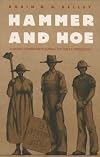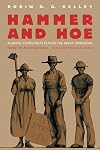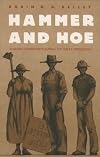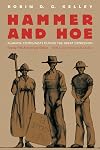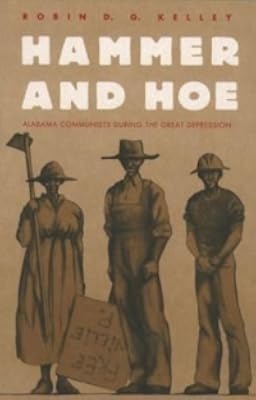
Hammer and Hoe: Alabama Communists During the Great Depression
by Robin D. G. Kelley
Fred W. Morrison Series in Southern Studies (1990)
On This Page
Description
A groundbreaking contribution to the history of the "long Civil Rights movement," Hammer and Hoe tells the story of how, during the 1930s and '40s, Communists took on Alabama's repressive, racist police state to fight for economic justice, civil and political rights, and racial equality. The Alabama Communist Party was made up of working people without a Euro-American radical political tradition: devoutly religious and semiliterate black laborers and sharecroppers, and a handful of whites, show more including unemployed industrial workers, housewives, youth, and renegade liberals. In this book, Robin D. G. Kelley reveals how the experiences and identities of these people from Alabama's farms, factories, mines, kitchens, and city streets shaped the Party's tactics and unique political culture. The result was a remarkably resilient movement forged in a racist world that had little tolerance for radicals. After discussing the book's origins and impact in a new preface written for this twenty-fifth-anniversary edition, Kelley reflects on what a militantly antiracist, radical movement in the heart of Dixie might teach contemporary social movements confronting rampant inequality, police violence, mass incarceration, and neoliberalism. show lessTags
Recommendations




Member Reviews
Much of this information is new to me, so I can't critique the book on grounds of inaccuracies, etc.
A really thorough and enlightening study on communist and labour organising in the American South. This book goes a long way towards demonstrating how American anticommunism is deeply rooted in white supremacy. In some ways, it is also a depressing read--Kelley talks about how a young black man was arrested once, and subject to police brutality, simply because he was having a seizure and a theatre manager "misread" the situation and called the cops instead of an ambulance. This was around 1940. Having a seizure while black is a risk to your life in more ways than the obvious one. That brief anecdote left me reeling.
Another illuminating show more quote:
This fascist resistance to "integration" and intermingling of races, genders, etc. brings to mind Klaus Theweleit's Male Fantasies, which also talks about how fascists deplored "communistic" ideas that would to lead pure, Aryan masculinity and femininity being "contaminated" by working-class and nonwhite elements.
A dense and fascinating read and recommended to those interested in learning more about racism, class politics and black radical activism and organising in the US. show less
A really thorough and enlightening study on communist and labour organising in the American South. This book goes a long way towards demonstrating how American anticommunism is deeply rooted in white supremacy. In some ways, it is also a depressing read--Kelley talks about how a young black man was arrested once, and subject to police brutality, simply because he was having a seizure and a theatre manager "misread" the situation and called the cops instead of an ambulance. This was around 1940. Having a seizure while black is a risk to your life in more ways than the obvious one. That brief anecdote left me reeling.
Another illuminating show more quote:
Indeed, the [KKK], the League to Maintain White Supremacy, and the Alabama American Legion deftly appropriated Cold War language to legitimize white supremacy before the rest of the world. The racist response to Communism was not limited to white supremacist and conservative groups, however. After taking a strong stand against anti-Communist legislation throughout most of 1947, Southern Labor Review editor A.H. Cather assailed efforts to integrate colleges as "a part of communistic doctrine ... aimed at America with the intention of provoking revolution." "To insist that Africans leave their own institutions and attend Aryans," Cather complained, "would place this nation in the ridiculous position of fighting communism abroad and encouraging it at home."
This fascist resistance to "integration" and intermingling of races, genders, etc. brings to mind Klaus Theweleit's Male Fantasies, which also talks about how fascists deplored "communistic" ideas that would to lead pure, Aryan masculinity and femininity being "contaminated" by working-class and nonwhite elements.
A dense and fascinating read and recommended to those interested in learning more about racism, class politics and black radical activism and organising in the US. show less
This book was really a delight. I strongly recommend getting the 25th-anniversary edition if you can find it, because my #1 favorite part was in that (a quotation from Lemon Johnson--god it was so good, ahh.) In a lot of ways, this is definitely a product of its time; it reads just like an old-school labor history book, and it can be very easy to get lost amid all the names and acronyms (and Kelley for some reason decided to just dive into those and not do like a first-reference full name thing, which was a Choice for sure) but also it's an incredible story of Black radical politics and Black folks doing what they can and organizing to survive. WITH added 'well-meaning white Communists fucking up' which is my favorite genre. Overall a show more great read, and a deep reminder of what I love about history. show less
Robin D. G. Kelley is a great radical historian. His writing is clear and his wisdom is great.
Ratings
Members
- Recently Added By
Lists

Labor History
77 works; 5 members

Changamire's Bookshelf
19 works; 1 member

United States
35 works; 1 member
Author Information

20+ Works 2,049 Members
Robin D. G. Kelley, a frequent contributor to The New York Times, is professor of history and Africana studies at New York University City
Awards and Honors
Series

Common Knowledge
- Canonical title
- Hammer and Hoe: Alabama Communists During the Great Depression
- Original publication date
- 1990
- People/Characters
- Hosea Hudson (US activist); Clyde Johnson (US labor organizer); Joseph Gelders (US activist); Robert Fowler Hall, "Rob"; Al Murphy (US Communist); Earl Browder (US politician) (show all 10); James Ford (US Communist); Angelo Herndon (US Communist); Tom Johnson (US Communist); Lemon Johnson (US Communist)
- Important places
- Alabama, USA; Birmingham, Alabama, USA; Bessemer, Alabama, USA; Camp Hill, Alabama, USA; Chambers County, Alabama, USA; Dadeville, Alabama, USA (show all 14); Jefferson County, Alabama, USA; Montgomery, Alabama, USA; Reeltown, Alabama, USA; Scottsboro, Alabama, USA; Tallapoosa County, Alabama, USA; Tarrant City, Alabama, USA; Lee County, Alabama, USA; Lowndes County, Alabama, USA
- Important events
- Great Depression; New Deal; Red Scare (1919 | 1920); Little Red Scare (1938 | 1940); Second Red Scare (1947 | 1957); Scottsboro Trial (show all 10); Camp Hill shootout (1931-07-16); Reeltown shootout (1932-12-19); Strike wave of 1934; World War II
- Epigraph
- [Preface:] Ain’t no country in the world foreign as Alabama to a New Yorker. They know all about England, maybe, France, never met one who knew ‘Bama.’
—Anonymous black Communist, 1945 - Dedication
- In memory of Hosea Hudson, griot of Alabama radicalism, whose assiduous note-taking and impeccable memory made this book possible, and for Diedra Harris-Kelley, whose love, criticism, encouragement, and heroic tolerance for l... (show all)iving in poverty made this book a reality.
- First words
- After spending several years hobnobbing with European, Asian, and Soviet dignitaries of the Third International, Daily Worker correspondent Joseph North made a most unforgettable journey to, of all places, Chambers Cou... (show all)nty, Alabama. Traveling surreptitiously with a black Birmingham Communist as his escort, North reached his destination—the tumbledown shack of a “sharecropper comrade”—in the wee hours of the night.
- Last words
- (Click to show. Warning: May contain spoilers.)Most young Alabama radicals who had the opportunity to shake Hudson's hand in 1982 probably knew close to nothing about the struggles of fifty and sixty years ago. Like Hudson’s comrades in the 1930s, who knew just as little about the Union Leagues and black militias during Reconstruction, the Knights of Labor, the Populists, and the UMWA during the 1890s, the new radicals unwittingly constructed a movement rooted in the past and shaped by the present. When they finally met the old, brown-skinned ex-iron molder, they discovered a living example of a history lost.
- Blurbers
- Naison, Mark; Painter, Nell Irvin
- Original language
- English US
Classifications
- Genres
- Nonfiction, History, General Nonfiction, Politics and Government
- DDC/MDS
- 324.2761 — Society, government, & culture Political science Politics & Elections Political parties North America South Central U.S. Alabama
- LCC
- HX91 .A2 .K45 — Social sciences Socialism. Communism. Anarchism Socialism. Communism. Anarchism
- BISAC
Statistics
- Members
- 358
- Popularity
- 88,377
- Reviews
- 3
- Rating
- (4.25)
- Languages
- English
- Media
- Paper, Audiobook, Ebook
- ISBNs
- 8
- ASINs
- 2