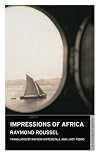
Impressions of Africa
by Raymond Roussel
On This Page
Description
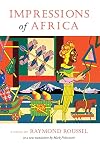
The first of Roussel's two major prose works, Impressions of Africa is not, as the title may suggest, a conventional travel account, but an adventure story put together in a highly individual fashion and with an unusual time sequence, whereby the reader is even made to choose whether to begin with the first or the tenth chapter. A veritable literary melting pot, Roussel's groundbreaking text makes ample use of wordplay and the surrealist techniques of automatic writing and private allusion.Tags
Recommendations
























Member Reviews
The first third or so of this book is a long series of fantastic theatrical, pseudo-scientific and artistic events performed for an african king. The extraordinary tableau's march past in excruciatingly specific detail in the literary equivalent of a dull monotone.
It was one of the dullest and most painful reading experiences i have had in quite some time.
The rest of the work is a flashback which explains each of the previous scenes you didn't care about. The convoluted sequence of events with numerous tangents, is at least mildly engaging in places.
Overall some of the details are at least interesting if not the delivery but 2 stars still feels like i'm being generous.
It was one of the dullest and most painful reading experiences i have had in quite some time.
The rest of the work is a flashback which explains each of the previous scenes you didn't care about. The convoluted sequence of events with numerous tangents, is at least mildly engaging in places.
Overall some of the details are at least interesting if not the delivery but 2 stars still feels like i'm being generous.
This is one of those books that left me flummoxed when I was reading it. I normally don't read any information about the 1001 list books before I tackle them if I can help it at all - I like to see what I can get out of them on my own first. However, by about 50 pages into this one, I'd read the back of the book, the first couple of paragraphs of the introduction, the wikipedia article about the book, and a couple of other readers' reviews. I was desperate to see if I was seriously missing something. The answer: yes and no.
Everything I read said that this was a book about a group of passengers shipwrecked in a fictional African country. The problem is that by nearly the halfway point, you will not know that if you haven't read any show more supplemental material (but since you're reading this review, you will. You're welcome.). What you will know is that there is a group of people from a ship in attendance at some sort of coronation ceremony for an emperor of a fictional African nation. You will also know that all kinds of bizarre performances are taking place - women doing a belching dance, men with chests that can reflect sound into echoes over long distances, a giant worm that plays a zither in a contraption involving water and holes it blocks with its body. The first half of the book is an endless cavalcade of these interludes, all described in fascinating (or excruciating, depending on your point of view) detail. Then the second half begins, and you finally learn about the shipwreck, who the performers are, why the emperor is having a celebration, and how the various demonstrations were conceived. In other words, the plot is all in the back half. And I wondered if perhaps I should have read the second half first - then found out that some editions of the book had suggested exactly that. However, in retrospect, I wouldn't recommend that at all - there's no intrigue at a magic show if you are first shown how all the illusions are performed. Best is just to know that you're not going to get any plot at all for the first part and to sit back and enjoy what you do get instead.
I did contemplate for a while if something was lost in translation since wordplay is supposed to be a big part of how Roussel wrote the book. But as it turns out, nearly all of the techniques he used would be just as obscure to the French reader as to anyone else. His toying with language involves not so much simple puns or soundalikes but complicated strings of word associations that Roussel used to give himself a starting and ending point for different sections. It would be like an English speaker starting with the words "cow" and "cowl," then choosing a pair of verbs that are homonyms like "herd" and "heard" and telling yourself you have to now make up a story that gets you from a cow in a herd to a person wearing a cowl who heard something. I'd have gone the distance with that and given an object for the verbs as well, but honestly it's exhausting trying to think like that. The point is just to make it clear that there are probably relatively few things that would be more obvious to someone reading the book in its original language than they are to someone reading in translation.
I thought I was really going to regret reading this, but in the end, after I'd read the introduction and some background information on the novel and its author, I'm really glad I did. I'm just also really glad it's over.
Recommended for: magicians, lucid dreamers
Quote: "The midget Philippo was carried like an infant by his impresario Jenn, while Tancrède Bourcharessas, with a family of trained cats, rode on a small cripple's trolley pushed by his son Hector." show less
Everything I read said that this was a book about a group of passengers shipwrecked in a fictional African country. The problem is that by nearly the halfway point, you will not know that if you haven't read any show more supplemental material (but since you're reading this review, you will. You're welcome.). What you will know is that there is a group of people from a ship in attendance at some sort of coronation ceremony for an emperor of a fictional African nation. You will also know that all kinds of bizarre performances are taking place - women doing a belching dance, men with chests that can reflect sound into echoes over long distances, a giant worm that plays a zither in a contraption involving water and holes it blocks with its body. The first half of the book is an endless cavalcade of these interludes, all described in fascinating (or excruciating, depending on your point of view) detail. Then the second half begins, and you finally learn about the shipwreck, who the performers are, why the emperor is having a celebration, and how the various demonstrations were conceived. In other words, the plot is all in the back half. And I wondered if perhaps I should have read the second half first - then found out that some editions of the book had suggested exactly that. However, in retrospect, I wouldn't recommend that at all - there's no intrigue at a magic show if you are first shown how all the illusions are performed. Best is just to know that you're not going to get any plot at all for the first part and to sit back and enjoy what you do get instead.
I did contemplate for a while if something was lost in translation since wordplay is supposed to be a big part of how Roussel wrote the book. But as it turns out, nearly all of the techniques he used would be just as obscure to the French reader as to anyone else. His toying with language involves not so much simple puns or soundalikes but complicated strings of word associations that Roussel used to give himself a starting and ending point for different sections. It would be like an English speaker starting with the words "cow" and "cowl," then choosing a pair of verbs that are homonyms like "herd" and "heard" and telling yourself you have to now make up a story that gets you from a cow in a herd to a person wearing a cowl who heard something. I'd have gone the distance with that and given an object for the verbs as well, but honestly it's exhausting trying to think like that. The point is just to make it clear that there are probably relatively few things that would be more obvious to someone reading the book in its original language than they are to someone reading in translation.
I thought I was really going to regret reading this, but in the end, after I'd read the introduction and some background information on the novel and its author, I'm really glad I did. I'm just also really glad it's over.
Recommended for: magicians, lucid dreamers
Quote: "The midget Philippo was carried like an infant by his impresario Jenn, while Tancrède Bourcharessas, with a family of trained cats, rode on a small cripple's trolley pushed by his son Hector." show less
I found Raymond Roussel's "Impressions of Africa" to be practically unreadable. I've read a lot of books over the years written about Africa and this may be the very worst one.
The first 80 pages or so are spent detailing various uninteresting performances going on while some random people (who turn out to be shipwrecked on Africa and are held for ransom.... no need to impart any of this information until nearly a dozen chapters pass.)
There are plenty of racist attitudes (as you'd expect from a book written in this period) just make it even more intolerable.
The first 80 pages or so are spent detailing various uninteresting performances going on while some random people (who turn out to be shipwrecked on Africa and are held for ransom.... no need to impart any of this information until nearly a dozen chapters pass.)
There are plenty of racist attitudes (as you'd expect from a book written in this period) just make it even more intolerable.
I read this book as part of a challenge, otherwise it would never have made it onto my radar. The challenge was to find a book from Boxall's List of Books to Read Before You Die with less than 1000 ratings. This book fit the criteria.
This book is very strange. I began reading it from page 1 and found it to be incredibly boring as it was descriptions of events and spectacles in minutiae - rather like directions for repairing appliances. I returned to Goodreads to see what was going on and discovered that the book could be started at Chapter 10. I switched to that format and the book became a bit more interesting and linked what was in the first nine chapters with the persons from the second half of the book. When I returned to Chapter 2 show more to complete my reading, it was again boring, but it did make more sense.
So now I've added one more rating to this infrequently rated book. My rating did not raise the overall rating of this book because I found it tolerable and I liked it - only a little. show less
This book is very strange. I began reading it from page 1 and found it to be incredibly boring as it was descriptions of events and spectacles in minutiae - rather like directions for repairing appliances. I returned to Goodreads to see what was going on and discovered that the book could be started at Chapter 10. I switched to that format and the book became a bit more interesting and linked what was in the first nine chapters with the persons from the second half of the book. When I returned to Chapter 2 show more to complete my reading, it was again boring, but it did make more sense.
So now I've added one more rating to this infrequently rated book. My rating did not raise the overall rating of this book because I found it tolerable and I liked it - only a little. show less
Ratings
Members
- Recently Added By
Lists

1,001 BYMRBYD Concensus
723 works; 27 members
Author Information

49+ Works 1,596 Members
Eccentric writer Raymond Roussel was born in Paris, France in 1877. Although Roussel's works are very difficult to translate due to the complexity of their wordplay and his own attempts to translate them to the stage failed, he had a strong influence on a group of experimental Parisian writers known as OuLiPo, and on artists such as Salvador Dali show more and Marcel Duchamp. He died in Palermo, Italy in 1933. (Bowker Author Biography) show less
Some Editions
Awards and Honors
Series
Belongs to Publisher Series
Work Relationships
Common Knowledge
- Canonical title
- Impressions of Africa
- Original publication date
- 1910
- First words
- At around four p.m. that June 25th, everything seemed ready for the coronation of Talou VII, Emperor of Ponukele and King of Drelchkaff.
- Original language
- French
Classifications
Statistics
- Members
- 432
- Popularity
- 70,945
- Reviews
- 4
- Rating
- (3.47)
- Languages
- 9 — Catalan, Czech, Dutch, English, French, German, Italian, Japanese, Spanish
- Media
- Paper, Ebook
- ISBNs
- 25
- ASINs
- 13