On This Page
Description
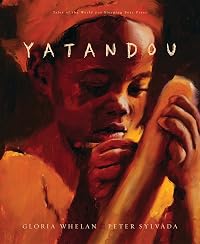
"Yatandou lives in a Mali village with her family and neighbors. And though she is only eight years old and would much rather play with her pet goat, she must sit with the women and pound millet kernels. To grind enough millet for one day's food, the women must pound the kernels with their pounding sticks for three hours. It is hard work, especially when one is eight years old. But as they work, the women dream of a machine that can grind the millet and free them from their pounding sticks. show more But the machine will only come when the women have raised enough money to buy it. Yatandou must help raise the money, even if it means parting with something she holds dear. Through the eyes and voice of a young girl, award-winning author Gloria Whelan brings to life one village's dream of a better future. Atmospheric paintings from artist Peter Sylvada capture the landscape and spirit of this inspiring story of sacrifice and hope."--From publisher description. show lessTags
Recommendations








Member Recommendations
Member Reviews
Part of Sleeping Bear Press's Tales of the World series, a collection of picture-books meant to introduce children to diverse parts of the world through the stories of the young children living there - other entries include Yuki and the One Thousand Carriers (Japan), The Gift of the Inuksuk (Arctic Canada), and Waiting for the Owl's Call (Afghanistan) - Yatandou follows the adventures of an eight-year-old girl from Mali, who spends hours out of her day grinding millet with the older women. It is back-breaking work, and allows little time for play, or for schooling. Then Yatandou learns of a machine, something the women of the village are saving up to buy, that will do the grinding for them! Can she bring herself to sacrifice something show more very precious, if it will help toward that goal...?
As engaging tale of one young girl, her relationships with her family (I liked her brief interaction with her brother, Madou), with her special goat Sunjata, and with her village, Yatandou is also an introduction to the realities of life in a poor village. I appreciated the fact that Whelan managed to highlight the real difference that a seemingly small change, like the procurement of a grinding machine, can make in the lives of the poor, without veering too sharply into the realm of didacticism. The accompanying artwork by Peter Sylvada has a lovely, light-filled quality to it, with shapes that are sometimes a little indistinct, but also surprisingly solid. All in all, an appealing title that I would recommend to young readers who are curious about how children in other parts of the world, particularly Mali, live. show less
As engaging tale of one young girl, her relationships with her family (I liked her brief interaction with her brother, Madou), with her special goat Sunjata, and with her village, Yatandou is also an introduction to the realities of life in a poor village. I appreciated the fact that Whelan managed to highlight the real difference that a seemingly small change, like the procurement of a grinding machine, can make in the lives of the poor, without veering too sharply into the realm of didacticism. The accompanying artwork by Peter Sylvada has a lovely, light-filled quality to it, with shapes that are sometimes a little indistinct, but also surprisingly solid. All in all, an appealing title that I would recommend to young readers who are curious about how children in other parts of the world, particularly Mali, live. show less
Yatandou is from a small village in Mali, where men work in onion fields all day and the women must pound millet meal for hours to eat. When the women in her village band together to raise money for a machine that will grind the millet for them, Yatandou helps, too. Soon, the women are able to spend time learning and growing their business. The story tells a beautiful tale about progress and hope for impoverished countries.
Personal reaction:
I loved that this story was laced with African words and the author, Gloria Whelan, was able to intertwine daily life with the story. Throughout the tale, she gave rich descriptions to set the scene and give you a look at daily life in Mali.
Classroom extension:
1. Throughout the story, there are many show more African words. Create a matching game for students to play in groups with the African word and its English counterpart.
2. Yatandou’s female ancestors had been grinding millet meal with sticks and the men had been harvesting onions for generations. Compare and contrast with the class on how the African village maintained life versus how Native American tribes harvested. show less
Personal reaction:
I loved that this story was laced with African words and the author, Gloria Whelan, was able to intertwine daily life with the story. Throughout the tale, she gave rich descriptions to set the scene and give you a look at daily life in Mali.
Classroom extension:
1. Throughout the story, there are many show more African words. Create a matching game for students to play in groups with the African word and its English counterpart.
2. Yatandou’s female ancestors had been grinding millet meal with sticks and the men had been harvesting onions for generations. Compare and contrast with the class on how the African village maintained life versus how Native American tribes harvested. show less
This book is a realistic fiction about a girl in Mali as her village sells what they have to purchase a grain grinder so they can sell ground millet. The illustrations are exquisite oil paintings and the writing is very full of beautiful imagery. It can be used to talk to students about what life is like for other children around the world, and since the girl is 8 years old, it would do well for early elementary, 3rd grade and below.
I had hoped to use this for story time but there's not enough action. It's a nice story describing life in a small village in Mali, but it's nothing special. Upper elementary school interest level.
Personal Response:
I enjoyed the description of Yatandou's daily activities in her village in Mali before and after the arrival of the grinding machine. The glimpse into another child's life is a unique experience for children to realize the challenges that exist in this world.
Curricular Connections:
I would use this story as part of a story time on children around the world/farming/Africa.
I enjoyed the description of Yatandou's daily activities in her village in Mali before and after the arrival of the grinding machine. The glimpse into another child's life is a unique experience for children to realize the challenges that exist in this world.
Curricular Connections:
I would use this story as part of a story time on children around the world/farming/Africa.
This beautifully illustrated realistic fiction tells the tale of young Yatandou, a girl who lives in a Mali village. Readers will see the simplicity and strength of Africans as they read the of their daily work to survive through the eyes of Yatandou. This book is appropriate for intermediate readers.
Age: Primary, Intermediate & Middle School
Genre: Realistic Fiction
Media: Oil Paint
Review: This book is realistic fiction because the author has created a fictional story about a girl living in a Mali village that is based off of an actual way of life. It tells how the people in the villages of Mali live (in poverty, sustenance agriculture, lack of education for children etc.) and how the introduction of new technology creates changes in their lives. The actual characters are not real, but the story is a representation of the lives of many people.
Use: learning about other cultures/life in other parts of the world, benefits of technology, poverty
Genre: Realistic Fiction
Media: Oil Paint
Review: This book is realistic fiction because the author has created a fictional story about a girl living in a Mali village that is based off of an actual way of life. It tells how the people in the villages of Mali live (in poverty, sustenance agriculture, lack of education for children etc.) and how the introduction of new technology creates changes in their lives. The actual characters are not real, but the story is a representation of the lives of many people.
Use: learning about other cultures/life in other parts of the world, benefits of technology, poverty
Members
- Recently Added By
Lists

A Child's Book Tour of West Africa ::: Côte d'Ivoire, Mali, Ghana, Nigeria
59 works; 5 members

One Picture Book Per Country
206 works; 1 member
Author Information

70+ Works 12,388 Members
Gloria Whelan was born on November 23, 1923 in Detroit, Michigan. She took a strong interest in reading early in life when she was bedridden for a year with rheumatic fever. She dictated stories to her sister who would then type them. She then went on to writing poetry and later editing her high school newspaper. She attended the University of show more Michigan and earned her B.S.degree and M.S.W. degree. She began working as a social worker in Minneapolis and Detroit. She soon became tired of Detroit's hectic pace and moved to a cabin in northern Michigan.This peace was disrupted by an oil company 's desire to drill on her property. Because she did not own the mineral rights, the drilling proceeded. This experience inspired Gloria Whelan to write her children's novel, A Clearing in the Forest in 1978, which was about a boy working on an oilrig. Gloria Whelan has written several works of fiction for children and adults, many set in rural Michigan. She has also written stories set in exotic places like China and India. She won the National Book Award for Young People's Literature in 2000 for Homeless Bird - the story of a young woman in India abandoned by her mother-in-law. show less
All Editions
Awards and Honors
Notable Lists
Series

Common Knowledge
- Important places
- Mali
Classifications
Statistics
- Members
- 144
- Popularity
- 227,883
- Reviews
- 7
- Rating
- (3.84)
- Languages
- English, French
- Media
- Paper, Ebook
- ISBNs
- 5
- ASINs
- 1