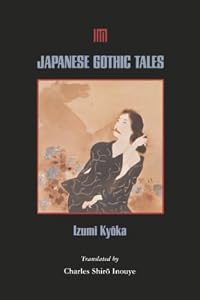
Japanese Gothic Tales
by Izumi Kyoka
On This Page
Description
"Resisting the various forms of realism popular during the Meiji "enlightenment," Izumi Kyoka (1873-1939) was among the most popular writers who continued to work in the old-fashioned genres of fantasy, mystery, and romance. Gothic Tales makes available for the first time a collection of stories by this highly influential writer, whose decadent romanticism led him to envision an idiosyncratic world--a fictive purgatory --precious and bizarre though always genuine despite its melodramatic show more formality. The four stories presented here are among Kyoka's best-known works. They are drawn from four stages of the author's development, from the "conceptual novels" of 1895 to the fragmented romanticism of his mature work. In the way of introduction, Inouye presents a clear analysis of Kyoka's problematic stature as a "great gothic writer" and emphasizes the importance of Kyoka's work to the present reevaluation of literary history in general and modern Japanese literature in particular. The extensive notes that follow the translation serve as an intelligent guide for the reader, supplying details about each of the stories and how they fit into the pattern of mythic development that allowed Kyoka to deal with his fears in a way that sustained his life and, as Mishima Yukio put it, pushed the Japanese language to its highest potential." -- Publisher's description. show lessTags
Recommendations






Member Reviews
As the title indicates, these tales reveal themselves through the atmosphere of Izumi's writing. It is masterful. The landscapes twist and dissolve and resonate with fear and anticipation. Some of the descriptions are among the most unique I have ever encountered.
But it's not just the atmosphere. The formalistic approach Izumi employs complements the gothic mood. The stories also twist and dissolve into themselves, their resolution never sure at hand. At the end, a cloud of melancholy pervades the book. But that is one with the idea of the gothic.
The stories are set from a period between the turn of the last century to the third decade of the twentieth century. This was a period of intense Japanese modernization, building upon what had show more already begun during the latter half of the nineteenth century. Izumi's stories reflect those times, but they do so in a timeless manner. Railways and hospital surgeries become places of haunting memories. Seasides and festivals provide a background to enchantments and encounters with death. Utterly fascinating. show less
But it's not just the atmosphere. The formalistic approach Izumi employs complements the gothic mood. The stories also twist and dissolve into themselves, their resolution never sure at hand. At the end, a cloud of melancholy pervades the book. But that is one with the idea of the gothic.
The stories are set from a period between the turn of the last century to the third decade of the twentieth century. This was a period of intense Japanese modernization, building upon what had show more already begun during the latter half of the nineteenth century. Izumi's stories reflect those times, but they do so in a timeless manner. Railways and hospital surgeries become places of haunting memories. Seasides and festivals provide a background to enchantments and encounters with death. Utterly fascinating. show less
I wanted to enjoy it more than I did.
Truly beautiful language and descriptions, extremely cinematic and visual, but this oddly contrasts to the plots and symbolism of these short stories which are very hermetic to me, at this point in time anyway.
I would absolutely love to see if anyone has made an analysis of the stories, especially for “the surgery room” and “the spring day” which are both extremely enigmatic.
Truly beautiful language and descriptions, extremely cinematic and visual, but this oddly contrasts to the plots and symbolism of these short stories which are very hermetic to me, at this point in time anyway.
I would absolutely love to see if anyone has made an analysis of the stories, especially for “the surgery room” and “the spring day” which are both extremely enigmatic.
Ratings
Members
- Recently Added By
Author Information

46+ Works 413 Members
Some Editions
Classifications
- Genres
- Fiction and Literature, Horror, General Fiction
- DDC/MDS
- 895.6 — Literature & rhetoric Asian Literature Literatures of East and Southeast Asia Japanese
- LCC
- PL809 .Z9 .A25 — Language and Literature Languages and literatures of Eastern Asia, Africa, Oceania Languages of Eastern Asia, Africa, Oceania Japanese language and literature Japanese literature Individual authors and works
- BISAC
Statistics
- Members
- 219
- Popularity
- 148,430
- Reviews
- 3
- Rating
- (3.77)
- Languages
- English
- Media
- Paper, Ebook
- ISBNs
- 4