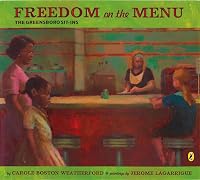
Freedom on the Menu: The Greensboro Sit-Ins
by Carole Boston Weatherford
On This Page
Description
The 1960 civil rights sit-ins at the Woolworth's lunch counter in Greensboro, North Carolina, are seen through the eyes of a young Southern black girl.Tags
Recommendations















Member Reviews
Perfect for the target audience, and any of the rest of us who aren't familiar enough with the lunch counter sit-ins. It reminds us that the movement spread all over the south, and that even young Black women were jailed, and that some white folks did participate alongside the Black people. (More detailed clarity in an author's note.) It did *not* show anything that a child reading the book would be traumatized by.
I learned something, too - I learned that the first Black people served at the Woolworths were the women who had worked in the kitchen. Geneva Tisdale had cooked the food the white people ate for 35 years; how is it possible that her sitting & eating next to a racist can be justified as a problem; it just doesn't make sense show more to me on any level whatsoever. This book says the waitress who didn't serve the young men was, in her heart, on their side, not on the side of her manager... I don't know if that's true but I hope it is.
And I hope that racism dies out. The rise of the far-right in the US, Europe, and some other countries concerns me, but I do believe that most young people are wiser than those bigots. Still, we do need to still give them more books like this. show less
I learned something, too - I learned that the first Black people served at the Woolworths were the women who had worked in the kitchen. Geneva Tisdale had cooked the food the white people ate for 35 years; how is it possible that her sitting & eating next to a racist can be justified as a problem; it just doesn't make sense show more to me on any level whatsoever. This book says the waitress who didn't serve the young men was, in her heart, on their side, not on the side of her manager... I don't know if that's true but I hope it is.
And I hope that racism dies out. The rise of the far-right in the US, Europe, and some other countries concerns me, but I do believe that most young people are wiser than those bigots. Still, we do need to still give them more books like this. show less
Goodreads Review:
When four courageous black teens sat down at a lunch counter in the segregated South of 1960, the reverberations were felt both far beyond and close to home. This insightful story offers a child's-eye view of this seminal event in the American Civil Rights Movement. Connie is used to the signs and customs that have let her drink only from certain water fountains and which bar her from local pools and some stores, but still . . . she'd love to sit at the lunch counter, just like she's seen other girls do.
Showing how an ordinary family becomes involved in the great and personal cause of their times, it's a tale that invites everyone to celebrate our country's everyday heroes, of all ages.
When four courageous black teens sat down at a lunch counter in the segregated South of 1960, the reverberations were felt both far beyond and close to home. This insightful story offers a child's-eye view of this seminal event in the American Civil Rights Movement. Connie is used to the signs and customs that have let her drink only from certain water fountains and which bar her from local pools and some stores, but still . . . she'd love to sit at the lunch counter, just like she's seen other girls do.
Showing how an ordinary family becomes involved in the great and personal cause of their times, it's a tale that invites everyone to celebrate our country's everyday heroes, of all ages.
Taking place in the 1960s during the beginning of the Civil Rights movement, a young eight-year-old girl, Connie, begins to question why she can't do certain things and notices the signs on everything from water fountains to bathrooms; "All over town, signs told Mama and me where we could and couldn't go.". Her dad said, "Dr. King's coming to town.". After Dr. King's speech the sit-ins and protesting began which led to Connie being able to sit at the counter in a restaurant and enjoy a banana split at the end. This book is great for lessons on the Civil Rights movement, and a lesson on what the African-American community faced at this time. Student will be able to learn lessons from this book, and it is a very enjoyable book to read. I show more do recommend it for grades 3-5. show less
There were signs all throughout town telling eight-year-old Connie where she could and could not go. But when Connie sees four young men take a stand for equal rights at a Woolworth’s lunch counter in Greensboro, North Carolina, she realizes that things may soon change. This event sparks a movement throughout her town and region. And while Connie is too young to march or give a speech, she helps her brother and sister make signs for the cause. Changes are coming to Connie’s town, but Connie just wants to sit at the lunch counter and eat a banana split like everyone else.
The setting is Greensboro, North Carolina in the 1960’s. While now it seems crazy that you would not be able to sit down and drink a coke at a store because of the color of your skin, fifty years ago, this was a fact. A seven-year-old girl who wants to be able to eat a banana split sitting down at a restaurant tells this story of her family getting involved in protests for equal rights for black people in their town as well as across the southern states. The oil painting illustrations make the reader feel they are part of the era. After reading, I would want the kids to discuss these questions with each other. If no one ever argued for equal rights, if there were no protests, what do you think it would be like today? Do you think show more there are things worth going to jail for? show less
All Connie wanted was a coke and a banana split and to sit at the counter and eat. Her perspective is different than the contentions of the adults on either side of the prevailing societal issues of the 60's. She just wanted to drink and eat without being told where. The book highlights the famous four who sat in order to take a stand and against social inequity and racism. I enjoyed the sfumato style painted illustrations to which I believed moved the story along while lending to the overall tone of the story. These were sad times for black families especially in considering how to even broach this very visible societal problem to young black family member who were just as stunned and befuddled as Connie.
During the Civil Rights era there are many true and living stories told of the direct struggles of how african americans fought against all odds to be seen as equals. This story speaks of 8 year old Connie and her family during the Greebsboro Sit-ins in 1960. It tells of Connie's perspective being shaped by her sister and brother joining the resistance against white suppression, the negative and dire circumstances of being arrested for standing up to injustices and hate. The story is told from Connie's perspective and the setting takes on a character of its own, as people push the boundaries of suppression. I love how the muted tones and how the author brushed Connie with such inspiring descriptions such as "I can't even stand the smell show more of egg salad, but I watched them take every bite". I also loved how it exemplifies the spirit that the community shared as they came together to fight for what was right. show less
Members
- Recently Added By
Lists

Picture Books About Civil Rights
51 works; 4 members
Author Information

86+ Works 9,771 Members
All Editions
Awards and Honors
Awards
Common Knowledge
Classifications
- Genre
- Children's Books
- DDC/MDS
- 323.1196 — Society, government, & culture Political science Civil Rights & Liberties/ Human Rights Minority Politics Specific Groups Biography And History African Origin
- LCC
- PZ7 .W3535 .F — Language and Literature Fiction and juvenile belles lettres Fiction and juvenile belles lettres Juvenile belles lettres
- BISAC
Statistics
- Members
- 1,254
- Popularity
- 19,619
- Reviews
- 42
- Rating
- (4.26)
- Languages
- English
- Media
- Paper
- ISBNs
- 7
- ASINs
- 1