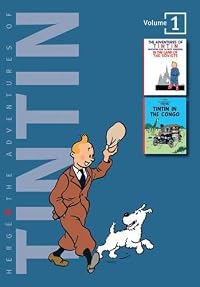
The Adventures of Tintin [1]: Tintin in the Land of the Soviets / Tintin in the Congo
by Hergé
On This Page
Description
Featuring the enduring adventures of Tintin and his faithful dog Snowy, this collection includes some of Herge's best-known stories."Tags
Recommendations




Member Reviews
Tintin in the Land of the Soviets is roughly drawn, crude, badly plotted and incoherent while Tintin in the Congo has much benefited from being redrawn, replotted and tightened up.
It is the first volume of the Tintin adventures and is a political satire. poking fun at Soviet Union: I gather Herge had never been to Moscow however and relied only on one single source for his information. Evidently he was not impressed by his story since it was the only one he did not revisit. It appeared in 1929 - 1930.
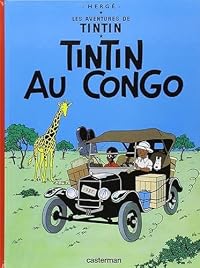
Tintin in the Congo is probably his most controversial book because many find it racist, patronising, cruel and inhumane to animals - certainly, some of the hunting scenes are shocking to our modern sensibilities.
Tintin in the Congo [1930 show more - 31] leads into the following volume, Tintin in America: Tintin is pursued around Africa by a criminal known as Tom, who repeated attrmpts to kill him. When Tom is eventualy eaten by crocodiles, a note is found on him giving directions for Tintin's death, signed by AC.
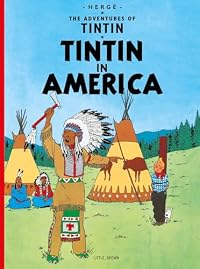
What with diamond smuggling and A; Capone, it is small wonder Tintin heads off to America next, where he can offend the yanks with portrayals of lynching, drunken officials at a time of Prohibition, stereotypical African Americans and sympathy for Native Americans.
Tintin in the land of the Soviets is not worth reading, scoring 2 stars, but Tintin in the Congo, providing you do not judge it too harshly and see it as a product of its time, is a well-drawn 4 stars. show less
It is the first volume of the Tintin adventures and is a political satire. poking fun at Soviet Union: I gather Herge had never been to Moscow however and relied only on one single source for his information. Evidently he was not impressed by his story since it was the only one he did not revisit. It appeared in 1929 - 1930.
Tintin in the Congo is probably his most controversial book because many find it racist, patronising, cruel and inhumane to animals - certainly, some of the hunting scenes are shocking to our modern sensibilities.
Tintin in the Congo [1930 show more - 31] leads into the following volume, Tintin in America: Tintin is pursued around Africa by a criminal known as Tom, who repeated attrmpts to kill him. When Tom is eventualy eaten by crocodiles, a note is found on him giving directions for Tintin's death, signed by AC.
What with diamond smuggling and A; Capone, it is small wonder Tintin heads off to America next, where he can offend the yanks with portrayals of lynching, drunken officials at a time of Prohibition, stereotypical African Americans and sympathy for Native Americans.
Tintin in the land of the Soviets is not worth reading, scoring 2 stars, but Tintin in the Congo, providing you do not judge it too harshly and see it as a product of its time, is a well-drawn 4 stars. show less
Ratings
Members
- Recently Added By
Lists

The bookshelf of Lisa Simpson
23 works; 4 members

Drawn Out: The 50 Best Non-Superhero Graphic Novels
175 works; 8 members
Author Information

549+ Works 59,519 Members
'Hergé' was born Georges Remi on 22 May, 1907 in Etterbeek, a suburb of Brussels, in Belgium. After leaving school, he worked for the daily newspaper, Le XXe Siècle (The 20th Century). He was responsibe the for the section of the newspaper designed for children. Tintin, the main character in his works, was introduced on January 10, 1929 in a show more story entitled 'Tintin in the Land of the Soviets.' Each story ran as a comic strip in the newspaper and then was published as a book. Some of these books were adapted for the small screen including The Crab With The Golden Claws, Star of Mystery, Red Rakham's Treasure, Black Island, Objective Moon and The Calculus Affair. French TV produced longer versions of twenty of the books in 1992, which have been broadcast in over fifty countries. On 3 March, 1983, he died in Brussels. At the time of his death, he was working on Tintin and the Alpha-Art, which was published in an unfinished form. (Bowker Author Biography) show less
Awards and Honors
Notable Lists
Work Relationships
Contains
Common Knowledge
- Canonical title
- Tintin in the Land of the Soviets / Tintin in the Congo; The Adventures of Tintin [1]: Tintin in the Land of the Soviets / Tintin in the Congo
Classifications
- Genre
- Graphic Novels & Comics
- DDC/MDS
- 741.59493 — Arts & recreation Drawing & decorative arts Drawing Comic books, graphic novels, fotonovelas, cartoons, caricatures, comic strips History, geographic treatment, biography European Other European Belgium & Luxembourg
- LCC
- PN6790 .B43 .H545 — Language and Literature Literature (General) Literature (General) Collections of general literature Comic books, strips, etc.
- BISAC
Statistics
- Members
- 172
- Popularity
- 189,805
- Reviews
- 1
- Rating
- (3.48)
- Languages
- 5 — Dutch, English, German, Italian, Norwegian (Bokmål)
- Media
- Paper
- ISBNs
- 4