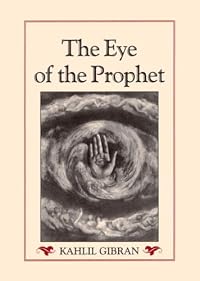
The Eye of the Prophet
by Kahlil Gibran
On This Page
Description
The Eye of the Prophet is a treasury of wisdom, of lyrical joy, of comfort and hope. Above all, it makes the perfect companion to The Prophet.Tags
Recommendations





















Member Reviews
The Eye of the Prophet opens in a less poetic and more opinionated set of short speeches than
illuminated The PROPHET. Inspiration becomes more subtle.
As the author extols his own Lebanon, he does not admit that truths may lie between his and "Your" Lebanon.
He also doesn't allow that "Courage" may contain Fear and that a moth encircling sure death
is likely NOT more admirable than a beautiful underground mole.
"The First Glance" at last offers hope from his despair.
Other favorites include: Life, Understanding and Reason and Understanding, The Mind, Unity,
Earth, Cities, Art, Counsel, Faith, Religion, Jesus of Nazareth, Perfection, Eternity,
and The Death of the Prophet.
illuminated The PROPHET. Inspiration becomes more subtle.
As the author extols his own Lebanon, he does not admit that truths may lie between his and "Your" Lebanon.
He also doesn't allow that "Courage" may contain Fear and that a moth encircling sure death
is likely NOT more admirable than a beautiful underground mole.
"The First Glance" at last offers hope from his despair.
Other favorites include: Life, Understanding and Reason and Understanding, The Mind, Unity,
Earth, Cities, Art, Counsel, Faith, Religion, Jesus of Nazareth, Perfection, Eternity,
and The Death of the Prophet.
> L’OEIL DU PROPHÈTE, de Khalil Gibran (Albin Michel, 1991). — Une anthologie constituée de textes pris dans toute l’oeuvre anglaise et arabe de Gibran, ainsi que dans sa correspondance. Ces extraits, souvent inédits, suivent le déroulement de l’oeuvre maîtresse du poète-philosophe libanais, Le Prophète : « L’Amour », « Les Enfants », « La Joie et la Tristesse », « La Raison et la Passion », « La Prière »... (Spiritualités Vivantes)
> Babelio : https://www.babelio.com/livres/Gibran-LOeil-du-prophete/130218
> Babelio : https://www.babelio.com/livres/Gibran-LOeil-du-prophete/130218
Apr 3, 2021 (Edited)French
Ratings
Members
- Recently Added By
Author Information

741+ Works 29,299 Members
Khalil Gibran, also known as Kahlil Gibran, was born on January 6, 1883 in Northern Lebanon. As a result of his family's poverty, he received no formal education as a small child but had regular visits from the local priest who taught him about the Bible as well as the Syrian and Arabic languages. After his father was imprisoned for embezzlement show more and his family's property was confiscated by the authorities, his mother decided to emigrate to the United States in 1895. They settled in Boston's South End. He attended public school and art school, where he was introduced to the artist, photographer, and publisher Fred Holland Day. A publisher used some of Gibran's drawings for book covers in 1898. His family forced him to return to Lebanon to complete his education and learn the Arabic language. He enrolled in Madrasat-al-Hikmah, a Maronite-founded school, which offered a nationalistic curriculum partial to church writings, history and liturgy. He learned Arabic, French, and exceled in poetry. He returned to the United States in 1902. In 1904, he hosted his first art exhibit, which featured his allegorical and symbolic charcoal drawings. During this exhibition, he met Mary Elizabeth Haskell, who would go on to fund Gibran's artistic development for nearly his entire life. Not only was he an artist, but he also wrote poetry and other works including The Madman, The Prophet, and Sand and Foam. He died of cirrhosis of the liver and tuberculosis on April 10, 1931. (Bowker Author Biography) show less
Classifications
- Genres
- Fiction and Literature, Poetry
- DDC/MDS
- 892.715 — Literature & rhetoric Asian Literature Afro-Asiatic literatures Arabic (Egypt, Lebanon, Palestine, Saudi Arabia, Sudan) Arabic poetry 1800–1945
- LCC
- PJ7826 .I2 .A224 — Language and Literature Oriental languages and literatures Oriental philology and literature Arabic Arabic literature Individual authors or works
- BISAC
Statistics
- Members
- 89
- Popularity
- 358,851
- Reviews
- 2
- Rating
- (4.30)
- Languages
- English, French, German
- Media
- Paper, Audiobook
- ISBNs
- 8
- ASINs
- 3