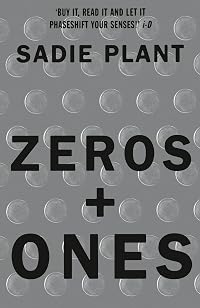
Zeros and Ones: Digital Women and the New Technoculture
by Sadie Plant
On This Page
Description
Leading global business school figures discuss the hottest debate in business education right now - what education business schools are providing, and their contribution to modern society.Tags
Recommendations











Member Reviews
I just picked this up randomly and was not expecting to enjoy it at all because it’s a subject that I find very boring (computers!). But it was actually very readable and easy to understand and dare I say… engaging? Even if I didn’t agree with all of her arguments, I really enjoyed reading this. And really, what’s the point of reading something you already 100% agree with?
“Zeros and Ones” is a half-biography of Ada Lovelace, half history, and half feminist theory book. The first half of the book traces the development of computers, and parallels between computers and fiber arts. If you think about it, both are complex systems made from repetitions of very simple actions (are knit/purl stitches binary code?) and also show more initially driven by women. The fact that weaving, and the profession “computer”, and many other things invented by women were initially devalued drew some parallels to my field, which is video editing… which was viewed as menial labor in the early days of Hollywood but was later developed into a serious art form by female editors. Did men delegate editing to women because of its similarity to sewing? I sort of wish she had talked about this field but I guess that wasn’t the focus of the book. Later on, Plant talks about the same pattern with regards to botany, which was initially viewed as inconsequential until women realized that the plant kingdom acts synergistically with zoology (a male domanated field). This part of the book was very emotional to me, and the biggest take away even though it only spanned a few pages. There’s a lot of similar ideas about biology as put forth in Dworkin’s “Woman Hating” towards the end too!
So the feminism parts were good, the craft parts were good, but towards the middle there was a slump where she starts talking about computers and philosophy and virtual reality, a lot of stuff that just went over my head, not because the writing was dense but because I honestly didn’t care that much. Her assertion that technological advancement is good is dubious— but then again, I totally assumed this book was contemporary, when it was actually written in the 90s! I barely noticed that it was 20 years old, which is a pretty impressive feat to not be outdated when writing about a field that’s as rapidly changing as technology. That being said, I wonder if it had been written during today’s era of cybersurveillance, would Plant be less approving of technological development?
Lastly, this isn’t a radical feminist book, despite citing radical feminists like Monique Wittig (quite a lot, which is cool cuz I love her!). To me it fell more under ‘cultural feminism’ because quite a bit of it seems predicated on some idea of female nature, that women are naturally drawn to computers because of biology and not because of society… I dunno if I buy that! Also, it’s sort of hard to tell whether she approves of various controversial issues (S&M for example). But I actually appreciate that, she puts forth her analysis and lets the reader make their own decision. show less
“Zeros and Ones” is a half-biography of Ada Lovelace, half history, and half feminist theory book. The first half of the book traces the development of computers, and parallels between computers and fiber arts. If you think about it, both are complex systems made from repetitions of very simple actions (are knit/purl stitches binary code?) and also show more initially driven by women. The fact that weaving, and the profession “computer”, and many other things invented by women were initially devalued drew some parallels to my field, which is video editing… which was viewed as menial labor in the early days of Hollywood but was later developed into a serious art form by female editors. Did men delegate editing to women because of its similarity to sewing? I sort of wish she had talked about this field but I guess that wasn’t the focus of the book. Later on, Plant talks about the same pattern with regards to botany, which was initially viewed as inconsequential until women realized that the plant kingdom acts synergistically with zoology (a male domanated field). This part of the book was very emotional to me, and the biggest take away even though it only spanned a few pages. There’s a lot of similar ideas about biology as put forth in Dworkin’s “Woman Hating” towards the end too!
So the feminism parts were good, the craft parts were good, but towards the middle there was a slump where she starts talking about computers and philosophy and virtual reality, a lot of stuff that just went over my head, not because the writing was dense but because I honestly didn’t care that much. Her assertion that technological advancement is good is dubious— but then again, I totally assumed this book was contemporary, when it was actually written in the 90s! I barely noticed that it was 20 years old, which is a pretty impressive feat to not be outdated when writing about a field that’s as rapidly changing as technology. That being said, I wonder if it had been written during today’s era of cybersurveillance, would Plant be less approving of technological development?
Lastly, this isn’t a radical feminist book, despite citing radical feminists like Monique Wittig (quite a lot, which is cool cuz I love her!). To me it fell more under ‘cultural feminism’ because quite a bit of it seems predicated on some idea of female nature, that women are naturally drawn to computers because of biology and not because of society… I dunno if I buy that! Also, it’s sort of hard to tell whether she approves of various controversial issues (S&M for example). But I actually appreciate that, she puts forth her analysis and lets the reader make their own decision. show less
Highly recommend for anyone who is into the lost promise/dream of a more radical, liberatory, humanist potential for computers/tech. A much needed and increasingly relevant alternative to the standard, tech-bro story of silicon valley heroism, elon musk-y bullshit. A 90's radical feminist take on the potential of the cyber-world that traces the development of binary through the loom and machine-aided weaving patterns, and the female "computers" who have always been at the root of the daily material construction of the digital world. A really well-structured and fun read. I hope she writes an update for the new age, but it seems unlikely.
Ratings
Members
- Recently Added By
Published Reviews
ThingScore 25
Abgewinnen läßt sich dem kuriosen Glaubensbekenntnis Plants erst etwas, wenn man es parallel liest zu einem anderen, das 1903 in Wien erschien und zu dem "Nullen und Einsen" gewissermaßen das komplementäre Gegenstück darstellt: Otto Weiningers misogynes "Geschlecht und Charakter". Plants idealisiertes Stereotyp vom weiblichen Weben findet sich auch bei ihm, denn Weininger bestimmte das show more "Wesen des Weibes" als "Kuppelei". Es ist dasselbe dualistische Weltbild, das hier wie dort propagiert wird, allein die Vorzeichen haben gewechselt. show less
added by Indy133
Author Information

6 Works 510 Members
Sadie Plant has been a lecturer in Cultural Studies at the University of Birmingham and a Research Fellow in the Department of Philosophy at the University of Warwick.
Common Knowledge
- Original title
- Zeros and Ones: Digital Women and the New Technoculture
- Original publication date
- 1995
- People/Characters
- Ada Byron Lovelace; Donna Haraway
Classifications
- Genres
- Nonfiction, Technology, General Nonfiction, Sexuality and Gender Studies
- DDC/MDS
- 303.483082 — Society, government, & culture Social sciences, sociology & anthropology Social processes Social change Causes of change Development of science and technology
- LCC
- HQ1233 .P53 — Social sciences The family. Marriage, Women and Sexuality The Family. Marriage. Women Women. Feminism
- BISAC
Statistics
- Members
- 215
- Popularity
- 151,537
- Reviews
- 2
- Rating
- (3.68)
- Languages
- Dutch, English, German
- Media
- Paper
- ISBNs
- 6
- ASINs
- 1