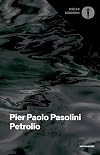
Petrolio
by Pier Paolo Pasolini
On This Page
Description
Suppressed by his family because of its controversial content, Pasolini's masterpiece is an exploration of the male libido, an ode to the lust for power and the power of lust, and an attempt to define the intellectual and his responsibilities.Tags
Recommendations


















Member Reviews
Scritto incredibile, a cui non riesco a dare un voto: perchè non mi viene.
E' stato pubblicato dopo la morte di Pasolini, ed è un abbozzo di un libro che stava preparando: lui dice che sono 600 pagine su 2000. Anche il titolo, "Petrolio", non è sicuro che fosse l'originale. Ed è realmente una bozza, in alcuni punti scritta molto bene ed in altri scritta male o semplicemente appuntata. Non penso che lui l'avrebbe apprezzata, per niente, e non so neanche quanto senso abbia avuto pubblicarla.
A me ha lasciato molto molto amaro in bocca, perchè è una traccia di romanzo: caotica, con troppi personaggi. Da questa traccia potrebbero avere origine due o tre romanzi diversi.
Davvero, non riesco a dargli un voto.
E' stato pubblicato dopo la morte di Pasolini, ed è un abbozzo di un libro che stava preparando: lui dice che sono 600 pagine su 2000. Anche il titolo, "Petrolio", non è sicuro che fosse l'originale. Ed è realmente una bozza, in alcuni punti scritta molto bene ed in altri scritta male o semplicemente appuntata. Non penso che lui l'avrebbe apprezzata, per niente, e non so neanche quanto senso abbia avuto pubblicarla.
A me ha lasciato molto molto amaro in bocca, perchè è una traccia di romanzo: caotica, con troppi personaggi. Da questa traccia potrebbero avere origine due o tre romanzi diversi.
Davvero, non riesco a dargli un voto.
Nov 18, 2022Italian
Ratings
Members
- Recently Added By
Lists

Italian Literature
558 works; 42 members
Lista dei 100 migliori libri italiani degli ultimi 200 anni
100 works; 1 member
Author Information

349+ Works 6,055 Members
Born in Bologna, Pasolini spent most of his childhood at his mother's birthplace in Friuli, where he learned the local dialect that he used in his first, last, and best poetry. He became a teacher in a local Communist party chapter, but was accused of blatant immorality in 1949, fired from his job, and expelled from the party. With his mother, he show more went to Rome, spending much time in the slums, mastering the Roman dialect. His novel Ragazzi di Vita (1955), based on his Roman street experience, established him as the leading neorealistic writer of the day. His second neorealistic novel, A Violent Life (1959), brought him greater success. Before long, however, he rejected neorealism and began to live for art's sake. Thereafter, except for what he called his "cat-like" nocturnal prowling for homosexual sex or love, Pasolini "did not lose a moment," as Cecelia Ross aptly said, "in his efforts to lay new directions for literature as well as for theater and television." He poured all his talents and energies into his major films, starting with The Gospel According to St. Matthew (1964), which sustains the mood of Bach's music, and running through The Hawks and the Sparrows (1966), Oedipus Rex (1967), Pigsty, Medea (1970), and a trilogy made up of The Decameron (1970), Canterbury Tales (1971), and Arabian Nights (1974). Throughout his works, Pasolini explored the culture and language of the outcasts living in the shabby Roman periphery. Shortly before he died, Pasolini published a revised and enlarged edition of his dialect poems, La nuova gioventu (The New Youth) (1975). Pasolini was murdered by being run over several times with his own car, dying on 2 November 1975 on the beach at Ostia, near Rome. Pasolini was buried in Casarsa. (Bowker Author Biography) show less
Awards and Honors
Awards
Series
Belongs to Publisher Series
Common Knowledge
- Canonical title*
- Petróleo
- Original title
- Petrolio
- Original publication date
- 1992
*Some information comes from Common Knowledge in other languages. Click "Edit" for more information.
Classifications
- Genres
- Fiction and Literature, General Fiction
- DDC/MDS
- 853.914 — Literature & rhetoric Italian, Romanian & related literatures Italian fiction 1900- 20th Century 1945-1999
- LCC
- PQ4835 .A48 .P5813 — Language and Literature French, Italian, Spanish and Portuguese literatures Italian literature Individual authors, 1900-1960
Statistics
- Members
- 284
- Popularity
- 113,295
- Reviews
- 1
- Rating
- (3.82)
- Languages
- 7 — Dutch, English, French, German, Italian, Portuguese, Spanish
- Media
- Paper, Ebook
- ISBNs
- 20
- ASINs
- 2