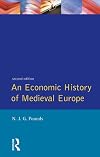
An economic history of medieval Europe
by Norman John Greville Pounds
On This Page
Description
A clear and readable account of the development of the European economy and its infrastructure from the second century to 1500. Professor Pounds provides a balanced view of the many controversies within the subject, and he has a particular gift for bringing a human dimension to its technicalities. He deals with continental Europe as a whole, including an unusually rich treatment of Eastern Europe. For this welcome new edition -- the first in twenty years -- text and bibliography have been show more reworked and updated throughout, and the book redesigned and reset. show lessTags
Recommendations


















Member Reviews
This seems like a fairly complete presentation of European economic history from the late Roman Empire to the 14th century. After starting in Rome the author goes on to discuss the general preconditions of medieval economic development; population growth, geographic expansion eastwards, urbanization, transport and agriculture. He continuously reflects on the limitations of the available macroeconomic evidence. In later chapters he discusses separate crafts and trades in more detail. This presentation is inevitably built on details which only professional historians will find interesting, but the author never gets bogged down with one topic for too long so it's quite readable.
The most interesting part of the book was chapter 9 on the show more commercial revolution. The author discusses the new methods of credit and financing which might have been the most impactful innovations of medieval times. The role of medieval government in the economy was clearly quite insignificant. The brief section in this book which focuses on government discusses mainly taxation. I would have liked to read a bit more on how medieval trade functioned without governmental help. Long-distance merchants must have gradually built trustworthy relationships amongst each other, but this book does not explicitly discuss how such webs of interpersonal acquaintance actually worked. But even so this book is a broad and very useful introduction to medieval economic history which can be recommended. show less
The most interesting part of the book was chapter 9 on the show more commercial revolution. The author discusses the new methods of credit and financing which might have been the most impactful innovations of medieval times. The role of medieval government in the economy was clearly quite insignificant. The brief section in this book which focuses on government discusses mainly taxation. I would have liked to read a bit more on how medieval trade functioned without governmental help. Long-distance merchants must have gradually built trustworthy relationships amongst each other, but this book does not explicitly discuss how such webs of interpersonal acquaintance actually worked. But even so this book is a broad and very useful introduction to medieval economic history which can be recommended. show less
Department of History, University of Hong Kong
Complimentary Copy From Longman Group( Far East) Ltd
Complimentary Copy From Longman Group( Far East) Ltd
Ratings
Members
- Recently Added By
Author Information
40+ Works 378 Members
Common Knowledge
- Canonical title
- An economic history of medieval Europe
- Original publication date
- 1974
- Important places
- Europe
- Original language
- English
Classifications
Statistics
- Members
- 58
- Popularity
- 532,244
- Reviews
- 2
- Rating
- (3.50)
- Languages
- English, Spanish
- Media
- Paper, Ebook
- ISBNs
- 7
- ASINs
- 2