
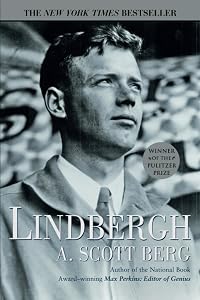
Lindbergh
by A. Scott Berg
On This Page
Description
Chronicles the life of Charles Lindbergh and discusses his childhood, his influence and accomplishments in the aviation industry, his child's murder, and his work on creating an artificial heart.Tags
Recommendations















Member Reviews
Living minutes from Lindbergh Boulevard and Lambert field, I simply wanted an introduction to the man beyond bare facts, and that's what I got. Turns out his St. Louis roots weren't as deep as I thought, beyond his having been based here at the time of the 1927 flight, but as I learned, he rarely settled in one spot for long. I learned a lot of things, such as his helping to develop the artificial heart, his deservedly controversial wartime views, his early support of the development of rocketry, and his extensive conservation work, among other things. But the chapter narrating the first Atlantic solo flight is by far the highlight. It also gives perspective on the emergence of contemporary celebrity culture.
The figure I sympathized show more with the most, however, was Anne, ever in his shadow. I really felt for her loneliness, her struggle to assert her identity and mount her own career, all of which comes through keenly because of her skill as a diarist. show less
The figure I sympathized show more with the most, however, was Anne, ever in his shadow. I really felt for her loneliness, her struggle to assert her identity and mount her own career, all of which comes through keenly because of her skill as a diarist. show less
From the moment Charles Lindbergh watched the Aeronautical Trials at Fort Meyer in June of 1912, he was hooked on planes and flying. Watching the maneuvers sparked his young mind's imagination. Fast forward fifteen years and May 21st, 1927 is a date for the record books. It is the date Charles Lindbergh became the first person to fly his plane, the Spirit of St. Louis, nonstop between America and Europe.
As an aside, I think it's fantastic that Lindbergh made the Spirit of St. Louis trip in 33 hours, 30 minutes and 30 seconds. That's one for the numerophiles. From that moment on Lindbergh became a global sensation. Like a folk hero, dozens of songs and poetry were written for and about him. A dance was created in his name. People wrote show more books and plays about his achievement and clamored to have a piece of his fame for their very own. For men and women alike, touching him was like experiencing nirvana. To talk to him was like seeing the face of God. He was that famous.
But Charles Lindbergh was not just a pilot. Flying aside, he became interested in finding a way to transplant body organs safely. He became interested in Anne Morrow, enough to marry her and have a son. Thus began Lindbergh's second bout with unwanted notoriety. When his first born son was kidnapped and killed the entire world was rapt with the horrific drama. Every update had people sitting on the edge of their seats. How could this happen to a famous colonel? When the tragedy had come to its terrible conclusion Lindbergh wanted to give up all aspects of aviation. It all led to publicity. The fame and notoriety got to be too much. Then came the Louise Brooks-like slide into scandal. The world was positioned for another Great War and this time Lindbergh was making headlines for all the wrong reasons. He had been enamored with the Germans for their ingenuity for a long time, but siding with them at this tumultuous time was the absolute wrong move. Berg's biography of Lindbergh is thorough and compelling through the good, the bad and the ugly. show less
As an aside, I think it's fantastic that Lindbergh made the Spirit of St. Louis trip in 33 hours, 30 minutes and 30 seconds. That's one for the numerophiles. From that moment on Lindbergh became a global sensation. Like a folk hero, dozens of songs and poetry were written for and about him. A dance was created in his name. People wrote show more books and plays about his achievement and clamored to have a piece of his fame for their very own. For men and women alike, touching him was like experiencing nirvana. To talk to him was like seeing the face of God. He was that famous.
But Charles Lindbergh was not just a pilot. Flying aside, he became interested in finding a way to transplant body organs safely. He became interested in Anne Morrow, enough to marry her and have a son. Thus began Lindbergh's second bout with unwanted notoriety. When his first born son was kidnapped and killed the entire world was rapt with the horrific drama. Every update had people sitting on the edge of their seats. How could this happen to a famous colonel? When the tragedy had come to its terrible conclusion Lindbergh wanted to give up all aspects of aviation. It all led to publicity. The fame and notoriety got to be too much. Then came the Louise Brooks-like slide into scandal. The world was positioned for another Great War and this time Lindbergh was making headlines for all the wrong reasons. He had been enamored with the Germans for their ingenuity for a long time, but siding with them at this tumultuous time was the absolute wrong move. Berg's biography of Lindbergh is thorough and compelling through the good, the bad and the ugly. show less
Lindbergh was close to being a Renaissance man. After winning fame in his early 20s for being the first person to fly solo from New York to Paris (1927), he became the first worldwide celebrity, and he spent the rest of his life trying to escape the intense interest of the media. Immediately following his flight he was greeted by immense crowds of fans in Paris, London, and New York. Crowds gathered around him for the rest of his life where ever he went. As a result of his celebrity, and his commitment to making aviation succeed on a commercial basis (he was on the boards of both TWA and Pan American, where he became Juan Trippe's lifelong friend) he gained access to powerful people in every nation. His celebrity was only increased when show more his first-born son was kidnapped and murdered in the "crime of the century." The trial focused the attention of millions. This University of Wisconsin dropout then was befriended by a famed surgeon (who had won a Nobel Prize in Medicine) and Lindbergh turned his attention to constructing a revolutionary new pump which enabled human organs to survive outside the body. Following this he became a leader of the America First movement, which sought to keep the U.S. out of WWII--then raging in Europe. He made a series of controversial speeches in which he seemed to be a fan of Hitler and the Nazis and how they had "successfully" transformed Germany, as well as an anti-Semitic critic of Jewish influence. This provoked a fire storm of condemnation in which Harold Ickes and FDR both became his enemy. The book also delves into his personal life and marriage. Someone who was comfortable with primitive people and a deprivation from modern conveniences, Lindbergh enjoyed the greatest luxury imaginable: being able to exactly what he wanted to do the moment he wanted to do it. He spent the last third of his life as a major advocate of conservation. He essentially deserted his wife and five children by traveling frequently all over the world--and the couple built homes in Darien, Connecticut; Switzerland; and Hawaii (where he died). In preparing for his Paris flight, Lindbergh is shown as an obsessive loner who was involved in every stage of the journey: from winning financial backing, to finding a company that would build the plane he wanted to use, to helping to design the aircraft, to participating in every stage of its construction, to formulating a list of what to take on the flight to allow for a maximum amount of fuel. He spent weeks preparing navigational aids. The flight itself was almost anti-climactic. This obsessive quality extended to the way he treated his wife and children. He was not an easy man to have as a husband or father. Berg tells us all this in highly readable prose. This is a model of a great biography, and Berg's work went on to win both the National Book Award and Pulitzer Prize. Highly recommended. show less
I am amazed at the potency of Lindbergh's charisma in granting him access to the tip-top leadership of pretty much any subject he took an interest in, whether it be pre-war escalation of aeronautical advances, space research, the development of a safer organ transplant system and artificial heart, archaeology, conservation and environmentalism, and the list goes on. Some of these interests his Mad Pilot Skillz gave him an in to pursue, while others seem simply out of the blue, an impression that A. Scott Berg's matter-of-fact recounting of events highlights.
I enjoyed this biography for its objectivity and unembellished presentation of the facts of Lindbergh's life, which Berg accomplishes without being "plain-spoken." There are lyrical show more touches here and there--for example, the image of a pale blue Scandinavian sky tying together the beginning and end of Lindbergh's story. Berg manages to portray Lindbergh and the main players in his story as utterly human, fallible yet sympathetic, occasionally victims of outside forces like the press and public celebrity-hounding, but ultimately responsible for the courses of their own destinies. show less
I enjoyed this biography for its objectivity and unembellished presentation of the facts of Lindbergh's life, which Berg accomplishes without being "plain-spoken." There are lyrical show more touches here and there--for example, the image of a pale blue Scandinavian sky tying together the beginning and end of Lindbergh's story. Berg manages to portray Lindbergh and the main players in his story as utterly human, fallible yet sympathetic, occasionally victims of outside forces like the press and public celebrity-hounding, but ultimately responsible for the courses of their own destinies. show less
A long (too long!) and detailed (too detailed!) story of the life of Charles Lindbergh, the young man who, unlike anyone else at the time, decided the best way to fly the Atlantic was alone in a one-engine airplane. It was an amazing feat of courage and certainly deserves the world acclaim afforded the man. But it’s also a cautionary tale of the dark underbelly of celebrity.
After a good, well-researched and written review of the youth and forces that made Lindbergh Lindbergh, the author tells the story of his famous flight—including interesting detail on the design of The Spirit of Saint Louis, and how Lindbergh came to settle on that aircraft and that design. All this is done in relatively efficient space and prose.
The strength show more of the book is Berg’s construction of the picture of celebrity (more on this in a bit) and the impact that had on the Lindberghs’ lives. This celebrity was the proximate cause of the Lindbergh’s oldest son being abducted and killed, a murder that captured the world’s attention and loaded the Lindberghs with a supercharged level of unwanted attention. Berg tells this story well, including detailed descriptions of the evidence behind Bruno Hauptmann’s conviction and subsequent execution. Though still controversial, the author, in my view, believes the right man was convicted of the crime.
These stories are the most compelling and famous parts of Lindbergh’s life and Berg spends the appropriate amount of time telling them. Unfortunately, when the reader finishes them, there are still hundreds of pages of story left. These pages are used primarily in three ways: first the telling the story of LIndbergh’s “America First” isolationism and opposition to American involvement in World War II in the months prior to Pearl Harbor. While this is an important part of Lindbergh’s story, it is told in too much detail and the book begins to plod.
The second major section of “the rest of the story” is Lindbergh’s post-war involvement in ecological and environmental issues, and at this point, this reader began to encourage the book to get to the finish line (and caused him to begin to read that way—just skimming for the general picture). It was presented in far too much detail. Especially after nearly four hundred pages already told, another hundred about this part of Lindbergh’s life was plodding and long.
The third portion of the latter part of Lindbergh’s life, mixed in with the telling of the remainder of these stories, was the estrangement in the Lindbergh’s relationship and Anne’s apparent unfaithfulness to the marriage. This story was muted, as if he felt he needed to include it to tell the whole story, but he didn’t want to reveal all. The partly-told story left Anne’s personality and life less defined and the author avoided completely the impact those days had on Lindbergh or the marriage as a whole (which did last “‘til death did them part.”)
One lesson any reader can’t help but learn from the book is the caustic effects celebrity has on a life. Lindbergh flew into Paris happy that he’d made it—and lived—but entirely unaware of how his short flight would effect permanent change on his and Anne’s lives. The world couldn’t get enough of his time, attention, presence and thought. It intruded into their lives in unhealthy, then ugly ways as it led to the kidnapping and murder of their son. It’s a cautionary tale for anyone seeking celebrity (which Lindbergh clearly did not). But it’s also a cautionary tale for the rest of us. In our thirst for information and contact with the rich and famous, we risk making their lives miserable. It does them no favors, and it surely offers no benefit to the rest of us, either. We ought to consider that next time we pick up a copy of “People” Magazine at the supermarket checkout stand. show less
After a good, well-researched and written review of the youth and forces that made Lindbergh Lindbergh, the author tells the story of his famous flight—including interesting detail on the design of The Spirit of Saint Louis, and how Lindbergh came to settle on that aircraft and that design. All this is done in relatively efficient space and prose.
The strength show more of the book is Berg’s construction of the picture of celebrity (more on this in a bit) and the impact that had on the Lindberghs’ lives. This celebrity was the proximate cause of the Lindbergh’s oldest son being abducted and killed, a murder that captured the world’s attention and loaded the Lindberghs with a supercharged level of unwanted attention. Berg tells this story well, including detailed descriptions of the evidence behind Bruno Hauptmann’s conviction and subsequent execution. Though still controversial, the author, in my view, believes the right man was convicted of the crime.
These stories are the most compelling and famous parts of Lindbergh’s life and Berg spends the appropriate amount of time telling them. Unfortunately, when the reader finishes them, there are still hundreds of pages of story left. These pages are used primarily in three ways: first the telling the story of LIndbergh’s “America First” isolationism and opposition to American involvement in World War II in the months prior to Pearl Harbor. While this is an important part of Lindbergh’s story, it is told in too much detail and the book begins to plod.
The second major section of “the rest of the story” is Lindbergh’s post-war involvement in ecological and environmental issues, and at this point, this reader began to encourage the book to get to the finish line (and caused him to begin to read that way—just skimming for the general picture). It was presented in far too much detail. Especially after nearly four hundred pages already told, another hundred about this part of Lindbergh’s life was plodding and long.
The third portion of the latter part of Lindbergh’s life, mixed in with the telling of the remainder of these stories, was the estrangement in the Lindbergh’s relationship and Anne’s apparent unfaithfulness to the marriage. This story was muted, as if he felt he needed to include it to tell the whole story, but he didn’t want to reveal all. The partly-told story left Anne’s personality and life less defined and the author avoided completely the impact those days had on Lindbergh or the marriage as a whole (which did last “‘til death did them part.”)
One lesson any reader can’t help but learn from the book is the caustic effects celebrity has on a life. Lindbergh flew into Paris happy that he’d made it—and lived—but entirely unaware of how his short flight would effect permanent change on his and Anne’s lives. The world couldn’t get enough of his time, attention, presence and thought. It intruded into their lives in unhealthy, then ugly ways as it led to the kidnapping and murder of their son. It’s a cautionary tale for anyone seeking celebrity (which Lindbergh clearly did not). But it’s also a cautionary tale for the rest of us. In our thirst for information and contact with the rich and famous, we risk making their lives miserable. It does them no favors, and it surely offers no benefit to the rest of us, either. We ought to consider that next time we pick up a copy of “People” Magazine at the supermarket checkout stand. show less
The subject of media attention throughout his life, Charles Lindbergh is a man whose legacy has been much defined by the images he left in the public imagination: his flight to Paris, the kidnapping and death of his son, his support of isolationism before the Second World War. Yet such events were only part of Lindbergh's astonishingly varied life, one that A. Scott Berg recounts in all its diversity.
Benefiting from access to Lindbergh's enormous collection personal papers (the consequence, Berg notes, of his desire to avoid distortions of his life), Berg provides a thorough account of his many activities, including his involvement in medical research and his support for environmental causes. His examination of the pilot's personal life show more is especially insightful; Lindbergh's wife Anne receives almost as much attention as her husband does, and Berg's account of their marriage is one of the great strengths of this book.
Yet there are many problems with the book. On occasion, Berg burdens the reader with details, clogging the text with irrelevant information about the minutiae of his subject's life (what his purpose was in detailing the layout of each place where the transient Lindbergh family lived escapes me). Moreover, he falls victim to a classic biographer's problem. Having immersed himself in Lindbergh's life, he views all of the events of the times through it, often overstating his contribution to them. Lindbergh comes across, for example, as the single greatest influence on the development of commercial aviation, yet were his ideas really that unique? And was Lindbergh really so dominant a media figure that his departure for Europe in 1935 launched a countrywide discussion on "the dismal state of the nation"? Berg's lack of critical analysis leaves such interpretations open to question.
Such flaws aside, Berg has written a good, sympathetic account of Lindbergh's life. Though readers will question some of the author's conclusions, this book will probably remain the standard work on the great aviator for decades to come. show less
Benefiting from access to Lindbergh's enormous collection personal papers (the consequence, Berg notes, of his desire to avoid distortions of his life), Berg provides a thorough account of his many activities, including his involvement in medical research and his support for environmental causes. His examination of the pilot's personal life show more is especially insightful; Lindbergh's wife Anne receives almost as much attention as her husband does, and Berg's account of their marriage is one of the great strengths of this book.
Yet there are many problems with the book. On occasion, Berg burdens the reader with details, clogging the text with irrelevant information about the minutiae of his subject's life (what his purpose was in detailing the layout of each place where the transient Lindbergh family lived escapes me). Moreover, he falls victim to a classic biographer's problem. Having immersed himself in Lindbergh's life, he views all of the events of the times through it, often overstating his contribution to them. Lindbergh comes across, for example, as the single greatest influence on the development of commercial aviation, yet were his ideas really that unique? And was Lindbergh really so dominant a media figure that his departure for Europe in 1935 launched a countrywide discussion on "the dismal state of the nation"? Berg's lack of critical analysis leaves such interpretations open to question.
Such flaws aside, Berg has written a good, sympathetic account of Lindbergh's life. Though readers will question some of the author's conclusions, this book will probably remain the standard work on the great aviator for decades to come. show less
Man of many talents — not just pilot, naturalist, inventor — on + on
This is a most compelling story of a most significant life; the most private of public figures finally revealed with a sweep and detail never before possible. In the skilled hands of A. Scott Berg, this is at once Lindbergh the hero--and Lindbergh the man.
This is a most compelling story of a most significant life; the most private of public figures finally revealed with a sweep and detail never before possible. In the skilled hands of A. Scott Berg, this is at once Lindbergh the hero--and Lindbergh the man.
Members
- Recently Added By
Lists

r/History Recommended Reading List
603 works; 12 members

Personal 2025 reads
18 works; 1 member

Bookshelf from Interstellar
62 works; 1 member
Author Information

10+ Works 4,678 Members
A. Scott Berg was born in Norwalk, Connecticut on December 4, 1949. He became fascinated with novelist F. Scott Fitzgerald while he was in high school. Berg even went so far as to attend Princeton University, from which he graduated in 1971, mainly because it was Fitzgerald's alma mater. While studying 20th-century literature at Princeton, Berg show more noticed that one name - that of editor Max Perkins - kept coming up in connection with authors such as Fitzgerald, Hemingway, and Wolfe. He decided to base his senior thesis on Max Perkins. Berg's research on Perkins continued for several years after graduation, eventually culminating in the 1978 publication of Max Perkins: Editor of Genius, which received the American Book Award. His other works include Goldwyn: A Biography and Kate Remembered, He also made The New York Times Best Seller List in 2013 for his title Wilson. Lindbergh won the Pulitzer Prize for Biography or Autobiography in 1998. He also wrote the story for a film entitled Making Love (1982). (Bowker Author Biography) show less
Some Editions
Awards and Honors
Awards
Distinctions
Work Relationships
Is abridged in
Has as a student's study guide
Common Knowledge
- Original publication date
- 1998
- People/Characters
- Charles A. Lindbergh; Anne Morrow Lindbergh
- Important places
- Paris, France
- Important events
- Lindbergh kidnapping
- Dedication
- to
Phyllis E. Grann
and
Kevin McCormick - First words
- For more than a day the world held its breath... and then the small plane was sighted over Ireland.
- Last words
- (Click to show. Warning: May contain spoilers.)And on certain days at that quiet graveyard overlooking Kipahulu Bay, the molecules collide in such a way that the water and sky blend into one seamless spectrum of blue - a deep sapphire far out to sea that brightens almost to the color of glacial ice as it ascends, that very same pale but radiant blue that the sky over Sweden sometimes casts in the late summer.
- Disambiguation notice
- Please distinguish between A. Scott Berg's complete 1998 biography, Lindbergh, and the abridged audio version of the same title read by Eric Stoltz. Thank you.
Classifications
- Genres
- Biography & Memoir, History, Nonfiction, General Nonfiction
- DDC/MDS
- 629.13092 — Applied science & technology Engineering Transportation Vehicles Airplanes, Helicopters, and other aircrafts Aviation engineering Biography; History By Place Biography
- LCC
- TL540 .L5 .B49 — Technology Motor vehicles. Aeronautics. Astronautics Motor vehicles. Aeronautics. Astronautics Aeronautics. Aeronautical engineering
- BISAC
Statistics
- Members
- 1,522
- Popularity
- 15,093
- Reviews
- 17
- Rating
- (4.01)
- Languages
- 7 — Czech, Dutch, English, German, Italian, Portuguese, Spanish
- Media
- Paper, Audiobook, Ebook
- ISBNs
- 21
- ASINs
- 7