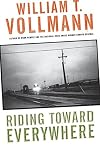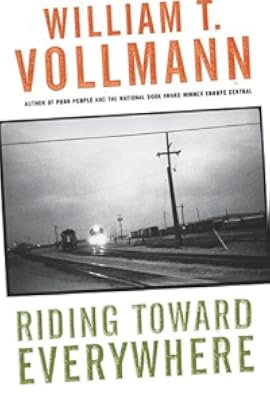
Riding Toward Everywhere
by William T. Vollmann
On This Page
Description
Vollmann is a relentlessly curious, endlessly sensitive, and unequivocally adventurous examiner of human existence. He has investigated the causes and symptoms of humanity's obsession with violence (Rising Up and Rising Down), taken a personal look into the hearts and minds of the world's poorest inhabitants (Poor People), and now turns his attentions to America itself, to our romanticizing of "freedom" and the ways in which we restrict the very freedoms we profess to admire.For Riding show more Toward Everywhere, Vollmann himself takes to the rails. His main accomplice is Steve, a captivating fellow trainhopper who expertly accompanies him through the secretive waters of this particular way of life. Vollmann describes the thrill and terror of lying in a trainyard in the dark, avoiding the flickering flashlights of the railroad bulls; the shockingly, gorgeously wild scenery of the American West as seen from a grainer platform; the complicated considerations involved in trying to hop on and off a moving train. It's a dangerous, thrilling, evocative examination of this underground lifestyle, and it is, without a doubt, one of Vollmann's most hauntingly beautiful narratives.Questioning anything and everything, subjecting both our national romance and our skepticism about hobo life to his finely tuned, analytical eye and the reality of what he actually sees, Vollmann carries on in the tradition of Huckleberry Finn, providing a moving portrait of this strikingly modern vision of the American dream. show lessTags
Recommendations








Member Reviews
https://msarki.tumblr.com/post/164551617213/riding-toward-everywhere-by-william-...
Never been much of a Kerouac or Dean Moriarity fan, but have always been interested in the road, marching to a different beat, and eating off the land. The people Vollmann highlights here do not exactly fit the exacting romance I hold so dear. What William does achieve however is making me listen to him and actually focus on what he has to say. And that is good writing, no matter the subject or obsessions posed on his page. I read this book much as a slow-moving train. The sway and rhythm soothed me, and the certain-to-come rain failed to dampen my days like it might have his. I did feel sodden however with the pain of loss presented through the show more characters he met along the rails and diners and ditches on the way to his own Cold Mountain, the satori Kerouac strove for.
I never could have gotten to Cold Mountain because I lack Cold Mountain’s mind. I love cities as much as solitude, prostitutes as much as trees…But as Vollmann finishes, saying …Sometimes when I ride to Everywhere I believe in Cold Mountain. show less
Never been much of a Kerouac or Dean Moriarity fan, but have always been interested in the road, marching to a different beat, and eating off the land. The people Vollmann highlights here do not exactly fit the exacting romance I hold so dear. What William does achieve however is making me listen to him and actually focus on what he has to say. And that is good writing, no matter the subject or obsessions posed on his page. I read this book much as a slow-moving train. The sway and rhythm soothed me, and the certain-to-come rain failed to dampen my days like it might have his. I did feel sodden however with the pain of loss presented through the show more characters he met along the rails and diners and ditches on the way to his own Cold Mountain, the satori Kerouac strove for.
I never could have gotten to Cold Mountain because I lack Cold Mountain’s mind. I love cities as much as solitude, prostitutes as much as trees…But as Vollmann finishes, saying …Sometimes when I ride to Everywhere I believe in Cold Mountain. show less
Snapshots of a vanishing culture, written in a companionable Vollmann style. No writer is better at observing the world and conveying a perspective that is uniquely his own. But, the rants about airport security are silly and they read like any number of cranky letters to the local newspaper. The freedom Vollmann enjoys going everywhere doesn't have much to do with these impositions at the airport. I get his point, I suppose, but its certainly not the best contrast for the kind of freedom he is writing about. Furthermore, he confuses freedom and transgression. The problem-solving required to catch out, the uncertainty of success and the frisson provided by evading railroad bulls are the most substantial parts of his thrill and they are show more what heighten the rest of the experience. Otherwise, its just riding and looking at scenery. You could do that on the bus. Freedom and transgression are related, but they are also at odds. I'm pretty sure Vollmann wouldn't like a world without bulls any more than he'd like a world without poor people. show less
3.5 stars would be closer, but I'll round up because we need more books like this that value freedom in America over "homeland security." Vollmann's elegy to trainhopping has plenty of sharp commentary and poetic self-reflection--with more meat, either facts or story or sustained characters, this could have been really great. But you won't find too many other middleaged literary geniuses doggedly pursuing the tedium and terror of catching freight trains these days, so my hat's off to him.
Then through a vaginal cut in the red rock, our freight train pulled us up into the sky, with small pines on either side of the tracks, and the entire world was red like Bryce Canyon or Zion.
I am nearly sure I saw WTV and his family, a short while back in Atlanta, as we were preparing to fly to London. I didn't approach him but now I wonder if he was struggling with an interior urgency: I need to get out of here.
Not what I expected. Riding Toward Everywhere is less sociology than travel. Well, it is actually less travel than a memoir. The use of that term has to be inflated in this context, for this is really a long article for a periodical allowed to drift from its own momentum. Despite that, I found and allow what some may regard as show more padding. it is quite good at times. This isn't a history of riding the rails, but a few snapshots of its contemporary configuration larded with oral history a few dozen photographs. show less
I am nearly sure I saw WTV and his family, a short while back in Atlanta, as we were preparing to fly to London. I didn't approach him but now I wonder if he was struggling with an interior urgency: I need to get out of here.
Not what I expected. Riding Toward Everywhere is less sociology than travel. Well, it is actually less travel than a memoir. The use of that term has to be inflated in this context, for this is really a long article for a periodical allowed to drift from its own momentum. Despite that, I found and allow what some may regard as show more padding. it is quite good at times. This isn't a history of riding the rails, but a few snapshots of its contemporary configuration larded with oral history a few dozen photographs. show less
One of the first books about "catching out" that I really didn't enjoy. The author is all over the place in this book and the train riding and hobo interaction is sparse. The author can be considered a joy rider. He travels by whatever means to get to a rail yard and then if not successful heads to the hotel or flies home. I'm sure that his time riding was exciting but he misses the culture that is present in other books such as Rolling Nowhere.
The book was just good enough to keep reading but barely. The second half of the book is better than the first.
The book was just good enough to keep reading but barely. The second half of the book is better than the first.
I'll write more later
This book is about a particular fear and feeling. Vollmann describes an America, shortly after 9/11 and in the grips of George W and his tightened security. Vollmann feels and senses a loss of freedom, and longs to regain it by riding the rails. He quotes from Hemingway, Thomas Wolfe, and Kerouac's On the Road with respect to their own attempts to leave somewhere and reach Everywhere. but where is that? Can you ever attain Everywhere? What is it we are longing for? What does it mean to be free?
The writing is good, especially his lyrical description of riding the trains and seeing the night sky or lying under a eucalyptus.
This book is about a particular fear and feeling. Vollmann describes an America, shortly after 9/11 and in the grips of George W and his tightened security. Vollmann feels and senses a loss of freedom, and longs to regain it by riding the rails. He quotes from Hemingway, Thomas Wolfe, and Kerouac's On the Road with respect to their own attempts to leave somewhere and reach Everywhere. but where is that? Can you ever attain Everywhere? What is it we are longing for? What does it mean to be free?
The writing is good, especially his lyrical description of riding the trains and seeing the night sky or lying under a eucalyptus.
As much as the reader may sense how glorious riding the rails, catching out on a freight train may be to William T. Vollmann, somehow he fails to really ignite the same awe and wonder in us. In me, at any rate. Frankly, the book is a rather ornery mess, sort of like a…..well, like a train wreck. It’s all over the lot, er, yard. Many of the times that Vollmann and his pal Steve hop a train, they don’t know where they’re going - except to the mythical “everywhere”. His writing resembles that lack of destination.
Vollmann is really at his best here, when he’s quoting Kerouac, or Jack London, or Thoreau. That’s not enough to keep a good level of interest. Even the sixty or so black and white photographs that are placed at the show more rear of the book are mostly mediocre. What a disappointment.
It’s clear that Vollmann is deeply troubled about the state and status of personal freedom in America. But we knew that. This book, sadly, adds nothing to our understanding. show less
Vollmann is really at his best here, when he’s quoting Kerouac, or Jack London, or Thoreau. That’s not enough to keep a good level of interest. Even the sixty or so black and white photographs that are placed at the show more rear of the book are mostly mediocre. What a disappointment.
It’s clear that Vollmann is deeply troubled about the state and status of personal freedom in America. But we knew that. This book, sadly, adds nothing to our understanding. show less
Members
- Recently Added By
Author Information

54+ Works 9,858 Members
Journalist and novelist William T. Vollmann was born in 1959 and educated at Cornell University. He worked as a comptuer programmer before becoming a journalist and covering Bosnia, Sarajevo and Afghanistan. He has written extensively since 1987, when his first book, You Bright and Risen Angels, was published. The Atlas (1996) won the PEN Center show more USA West Award for the best novel by a writer living west of the Mississippi. His newest work of Non-Fiction is entitled, Imperial. (Bowker Author Biography) show less
Awards and Honors
Distinctions
Common Knowledge
- Original publication date
- 2008
- People/Characters
- William Vollmann; Cinders; Pretty Polly; Pittsburgh Ed; Steve Jones; Badger (show all 15); Sheldon; Guitar Whitey; Jim Tully; Ira; Jayna; Jake Macwilliamson; Dolores; Montana Blackie; Ukla
- First words
- I am my father's son.
- Quotations
- I am my father's son, which is to say that I am not exactly my father. In some ways I am shyer than he, in others more extreme and bold. My father believes that drugs should be legalized, regulated and taxed. So do I. My fat... (show all)her has never sampled a controlled substance and never will. I've proudly committed every victimless crime that I can think of. My father actively does not want to know which acts I have performed and with whom.
Freight trains remind me of my father's tools, and of those of both grandfathers, the one I've known and the one I hardly knew; both were machinists. My father's tools are heavy. They are more metal than plastic. The power t... (show all)ools sport cords as thick as promises. The tools of my grandfathers, the solid old micrometers and files, do not have anything to do with plastic or electricity. They are solid metal, knurled and dense. As for my father's tools, they are poxed with rust. When I inspect them, I worry that I might have been a bad son.
I was irritated -- I'd come back from the Magnetic Pole, hadn't I? -- and sad for him for worrying so irrelevantly, incidentally increasing my own fears -- and wasn't that one reason I rode the freights, to cut fear down to s... (show all)ize?
Every time I surrender, even necessarily, to authority which disregardingly or contemptuously violates me, so I violate myself. Every time I break an unnecessary law, doing so for my own joy and to the detriment of no other h... (show all)uman being, so I regain myself, and become strong in the parts of me that the security man can never see.
When I ride the rails, I don't wish to go just anywhere; I demand to go Everywhere. I insist on being myself more than would please the neighbours. So I hereby say goodbye to my neighbours.
Where am I? What if I am not here because I am not myself? - Last words
- (Click to show. Warning: May contain spoilers.)The dark-windowed locomotive is sinister, the train seemingly about to explode off the wall, leap through the air, and shatter into a shower of red-hot shrapnel.
Classifications
- Genres
- Travel, Biography & Memoir, Fiction and Literature
- DDC/MDS
- 818.5403 — Literature & rhetoric American literature in English American miscellaneous writings in English 20th Century 1945-1999 Diaries
- LCC
- PS3572 .O395 .Z46 — Language and Literature American literature American literature Individual authors 1961-
- BISAC
Statistics
- Members
- 301
- Popularity
- 106,443
- Reviews
- 13
- Rating
- (3.30)
- Languages
- English, French, German
- Media
- Paper, Ebook
- ISBNs
- 5
- ASINs
- 3