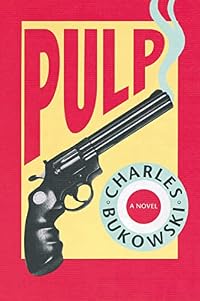
Pulp
by Charles Bukowski
On This Page
Description
Opening with the exotic Lady Death entering the gumshoe-writer's seedy office in pursuit of a writer named Celine, this novel demonstrates Bukowski's own brand of humour and realism, opening up a landscape of seamy Los Angeles.Tags
Recommendations







Member Reviews
"We have come to terms". Sorry, just wanted to start my review with a nicely terminal quote from a relatively obscure show (the fabulous anime The Big O for those interested) before jumping in. Here we have Bukowski's final published novel and for all its various flaws (and there are quite a few don't get me wrong) the work still succeeds through a rare combination of authorial resignation, acceptance, the tragedy of the mortal human condition, and the inverted triumph that results from all this which can all be discerned in the books dedication "To bad writing".
I've mentioned in my past reviews of Bukowski's work that I read him in that period between community college and university, wherein I fantasized about the life he so show more viscerally put to the page. That life was the writing life. Not just any writing life mind you, but Bukowksi's singular interpretation of this, of the lone writer, cast off, mocked and derided by his fellow man, left sadly but ultimately beautifully to his own devices (and vices, of course) to occasionally cobble together a piece of poetry or prose that would rock the literary world..or his small corner of it at least. And all this while he wasn't slowly killing himself with drugs (mostly alcohol) women (mostly the female equivalents of himself) and just plain apathy and lack of output.
I like to think that I've hopefully matured in outlook since then but I can't help but look back on those years and my concomitant reading of Bukowksi during those years with fondness, even affection. I feel like despite his boastful and boisterous (and at times despairing, wrathful, and lachrymose) moods, nobody understood Bukowski better than Bukowski himself. And it's this level of self-cognizance that lends itself so beautifully to the flawed but ultimately fascinating (and hence worth reading) text of Pulp.
I won't spoil anything but suffice it to say the book stands decently on its own but even better if you, like me, have made acquainted yourself with Buk's oeuvre, his tropes and hangups, and yes, even his repeated weaknesses in the craft. But Bukowski, maybe more so than any other writer I've yet read, not only understood his shortcomings, he embraced them and, again unlike most writers I've seen up until now, he actually managed a level of writerly evolution and transcendence that goes beyond what the superficially minded might deride as just 'weak' writing. There's more to this book and Bukowksi as an author than that.
This idea of Bukowski's is I think best represented with an anecdote I've heard about him. It was regarding a review of one of his then recent collections of poetry that a reviewer had written, maybe facetiously, maybe earnestly, that Bukowksi (then in his 60's I think) was finally 'showing improvement'. Bukowski ackowledged this to his laughing audience and herein, I believe, lies his singular status as a writer, even a thinker.
Is it perfect? No. Is it a masterwork? Hell no. And has Bukowski written better work than this? Oh undoubtedly. But where Bukowski succeeds is exactly where few writers, save Kafka, have succeeded, that is, he succeeds in the realm of failure, a realm too few writers and artists are afraid to acknowledge let alone transcend.
On Charles Bukowski's grave it reads "Don't Try" and to that I can only say, write, "Damn, I think you were right,". show less
I've mentioned in my past reviews of Bukowski's work that I read him in that period between community college and university, wherein I fantasized about the life he so show more viscerally put to the page. That life was the writing life. Not just any writing life mind you, but Bukowksi's singular interpretation of this, of the lone writer, cast off, mocked and derided by his fellow man, left sadly but ultimately beautifully to his own devices (and vices, of course) to occasionally cobble together a piece of poetry or prose that would rock the literary world..or his small corner of it at least. And all this while he wasn't slowly killing himself with drugs (mostly alcohol) women (mostly the female equivalents of himself) and just plain apathy and lack of output.
I like to think that I've hopefully matured in outlook since then but I can't help but look back on those years and my concomitant reading of Bukowksi during those years with fondness, even affection. I feel like despite his boastful and boisterous (and at times despairing, wrathful, and lachrymose) moods, nobody understood Bukowski better than Bukowski himself. And it's this level of self-cognizance that lends itself so beautifully to the flawed but ultimately fascinating (and hence worth reading) text of Pulp.
I won't spoil anything but suffice it to say the book stands decently on its own but even better if you, like me, have made acquainted yourself with Buk's oeuvre, his tropes and hangups, and yes, even his repeated weaknesses in the craft. But Bukowski, maybe more so than any other writer I've yet read, not only understood his shortcomings, he embraced them and, again unlike most writers I've seen up until now, he actually managed a level of writerly evolution and transcendence that goes beyond what the superficially minded might deride as just 'weak' writing. There's more to this book and Bukowksi as an author than that.
This idea of Bukowski's is I think best represented with an anecdote I've heard about him. It was regarding a review of one of his then recent collections of poetry that a reviewer had written, maybe facetiously, maybe earnestly, that Bukowksi (then in his 60's I think) was finally 'showing improvement'. Bukowski ackowledged this to his laughing audience and herein, I believe, lies his singular status as a writer, even a thinker.
Is it perfect? No. Is it a masterwork? Hell no. And has Bukowski written better work than this? Oh undoubtedly. But where Bukowski succeeds is exactly where few writers, save Kafka, have succeeded, that is, he succeeds in the realm of failure, a realm too few writers and artists are afraid to acknowledge let alone transcend.
On Charles Bukowski's grave it reads "Don't Try" and to that I can only say, write, "Damn, I think you were right,". show less
Charles Bukowski's final novel, Pulp, is hard to assess. On one level, it's rubbish. It makes no sense, what with its space aliens and red sparrows, and at times it seems like a rough draft that could have used a bit more polish. Bukowski's work has always had that rough-around-the-edges feel, but it didn't feel like that here. It felt incomplete, unfocused - the 'Red Sparrow as metaphor for death' angle was clearly intended, but difficult to reason out. One can see the strands - Lady Death is obviously the Grim Reaper (What a babe. Never let you down." (pg. 142)), and the loan that Nicky Belane, the protagonist, is "suckered into and never saw" a dime of (pg. 170) is clearly a metaphor for life itself. Bukowski is confronting life's show more biggest mystery - death - and so chooses a detective mystery setting; perhaps this novel is the only known instance of 'existential pulp fiction'. It's an idea which never comes fully to fruition, but is intriguing nonetheless.
Yet on another level, Pulp is immensely enjoyable, as Bukowski takes away what few shackles may have influenced his previous writing and just lets rip with gleeful abandon. Pulp shows Bukowski at his most batshit crazy; the book is absurd, and all the more entertaining for being so. Why are there space aliens? Just because. Why are there grapefruits on the floor? "Because I like them like that." (pg. 36). The Buk is clearly enjoying himself; at one point he stops half-way through a pervy description of a beautiful woman with the words: "Don't bother me now. I want to think about it." (pg. 4). There's a lot more identifiable humour than in his previous books; his character of Nicky Belane is essentially Chinaski, the protagonist of his other novels, but with a gun. This, after all, is a private detective whose idea of investigative work is just to walk into a random bar and shout at the baffled patrons: "Has anybody here seen Cindy, Celine or the Red Sparrow?" (pg. 31). He's also a large ham - note his 'choo-choo' speech to Brewster on page 47. All in all, it's just a riot to read, especially when Belane has his camcorder with him.
That said, it's not for apprentice Bukowski-ites. I think the reason I enjoyed Pulp so much is because I was familiar with the author's style, so it helps if readers have read some of his other novels first. As a pulp detective novel, it is rather less than ordinary, but as 'Bukowski-pulp' for ardent Bukowski fans, it's a real treat." show less
Yet on another level, Pulp is immensely enjoyable, as Bukowski takes away what few shackles may have influenced his previous writing and just lets rip with gleeful abandon. Pulp shows Bukowski at his most batshit crazy; the book is absurd, and all the more entertaining for being so. Why are there space aliens? Just because. Why are there grapefruits on the floor? "Because I like them like that." (pg. 36). The Buk is clearly enjoying himself; at one point he stops half-way through a pervy description of a beautiful woman with the words: "Don't bother me now. I want to think about it." (pg. 4). There's a lot more identifiable humour than in his previous books; his character of Nicky Belane is essentially Chinaski, the protagonist of his other novels, but with a gun. This, after all, is a private detective whose idea of investigative work is just to walk into a random bar and shout at the baffled patrons: "Has anybody here seen Cindy, Celine or the Red Sparrow?" (pg. 31). He's also a large ham - note his 'choo-choo' speech to Brewster on page 47. All in all, it's just a riot to read, especially when Belane has his camcorder with him.
That said, it's not for apprentice Bukowski-ites. I think the reason I enjoyed Pulp so much is because I was familiar with the author's style, so it helps if readers have read some of his other novels first. As a pulp detective novel, it is rather less than ordinary, but as 'Bukowski-pulp' for ardent Bukowski fans, it's a real treat." show less
I’m not sure what “good old Bukowski stuff” really is, but Pulp smacks on a couple of good themes for me: a good old fashion noir detective tale (“A dick without a gat is like a tomcat with a rubber”) and the dark undercurrents of Lady Death, Celine (the writer, not the singer) and the fate of the Red Sparrow: “Sometimes I looked at my hands and realized that I could have been a great pianist or something. But what have my hands done? Scratched my balls, written checks, tied shoes, pushed toilet levers, etc. I have wasted my hands. And my mind.”
"Pulp" by Charles Bukowski is a detective story (and a sharp departure from his usual autobiographical fiction). It showcases Bukowski's distinctive voice and dark humor while exploring the conventions of the genre. Set in the gritty underbelly of Los Angeles and delivered through a cynical lens, it’s classic noir with a cast of eccentric characters and seedy environments. Bukowski's prose is raw and unapologetic, filled with sharp observations and exacting wit. He skillfully satirizes the tropes of detective fiction while infusing the narrative with his own brand of existential despair. While "Pulp" may not be as revered as Bukowski's more autobiographical works like "Post Office" or "Ham on Rye," it offers a unique glimpse into his show more versatility as a writer. Fans of Bukowski's gritty realism and dark humor will appreciate this offbeat exploration of the detective genre. show less
Bukowski’s last novel is a fun and ridiculous one. Humorously nihilistic, Pulp tosses around, and even mutates, the standard noir private investigator clichés like candy.
Los Angeles P.I. Nick Belane, horny, drunk and broke, has three cases fall into his lap at once. They involve Lady Death, space aliens and a dead French writer (Celine.) And, of course, beautiful but dangerous women – one of which is Death. Unmistakably a Bukowski novel.
Los Angeles P.I. Nick Belane, horny, drunk and broke, has three cases fall into his lap at once. They involve Lady Death, space aliens and a dead French writer (Celine.) And, of course, beautiful but dangerous women – one of which is Death. Unmistakably a Bukowski novel.
The first two-thirds of this book are pretty much hilarious as Bukowski's down-on-his-luck private eye has to deal with Lady Death, a disgruntled landlord, a mortician, space aliens, annoying bar patrons and staff, various tough guys, and a postman who lives down the hall. The last third sort of fizzles out a bit, and the ending is very weird. I can see how some would be annoyed--but don't read this for the story, which is really irrelevant. Read it for Bukowski's hard-boiled attitudes and off-hand comments. Mostly, it's a pleasure. The audiobook I listened to was read in a suitable hard-boiled, sometimes I don't really care attitude, by Christian Baskous.
Dedicated to bad writing
"Pulp" follows the misadventures of Nicky Belane, the best private eye in LA, who will take any case as long as the client knocks on the door nicely and can afford his fee of 6 bucks an hour.
With Lady Death herself perched on his shoulder, Belane faces dead authors, cheating wives, sadistic cops, vengeful bookies, and space aliens, all in the day's work. While he often looks for answers in any bar in which he is still welcome, what he never does is drop a case. Suffused with flashes of under-the-gallows humour, this book turns the noir genre/detective novel completely on its head.
Bukowski's writing is like a sock you've worn all week that looks all crusted with sweat and dirt, but when you put it near your nose, show more you discover that it smells as fresh as if it'd just come out of the dryer. And I've just realized that I'll probably start every future review of anything by Bukowski with this sentence.
The greatest strength of this book is the fact that it combines all the typical markers of the genre with expertly interwoven development of themes like identity (on several occasions people call Belane the wrong name, and even though he angrily corrects them each time, he privately admits that he can't really blame them), the meaninglessness and absurdity of life and how you can get sent out of the game at any time as easily as swatting a fly (Lady Death is always near, literally and figuratively), and the human endeavour to make our pursuits and our time here matter.
Now with extra pulp. Pulpier than most pulpy things. show less
"Pulp" follows the misadventures of Nicky Belane, the best private eye in LA, who will take any case as long as the client knocks on the door nicely and can afford his fee of 6 bucks an hour.
With Lady Death herself perched on his shoulder, Belane faces dead authors, cheating wives, sadistic cops, vengeful bookies, and space aliens, all in the day's work. While he often looks for answers in any bar in which he is still welcome, what he never does is drop a case. Suffused with flashes of under-the-gallows humour, this book turns the noir genre/detective novel completely on its head.
Bukowski's writing is like a sock you've worn all week that looks all crusted with sweat and dirt, but when you put it near your nose, show more you discover that it smells as fresh as if it'd just come out of the dryer. And I've just realized that I'll probably start every future review of anything by Bukowski with this sentence.
The greatest strength of this book is the fact that it combines all the typical markers of the genre with expertly interwoven development of themes like identity (on several occasions people call Belane the wrong name, and even though he angrily corrects them each time, he privately admits that he can't really blame them), the meaninglessness and absurdity of life and how you can get sent out of the game at any time as easily as swatting a fly (Lady Death is always near, literally and figuratively), and the human endeavour to make our pursuits and our time here matter.
Now with extra pulp. Pulpier than most pulpy things. show less
Members
- Recently Added By
Lists

Books featuring alcoholics
103 works; 17 members

100 Mysteries and Thrillers to Read in a Lifetime
99 works; 22 members

Books Read in 1994
5 works; 1 member
Author Information

544+ Works 52,757 Members
Charles Bukowski was born in Andernach, Germany, on August 16, 1920. He came to the United States with his parents when he was three years old and spent his early years in poverty. As a young man he was a transient, doing odd jobs. He lived most of his live in boarding houses in the Los Angeles area. He attended Los Angeles City College briefly. show more He worked for the United States Postal Service for about ten years. Bukowski was at home with street people and his work contains a brutal realism and graphic imagery. He began publishing short stories in the mid-1940s. Starting with Flower, Fist and Bestial Wail in 1959, he produced poetry collections almost once a year. His following had grown by the time his collection of poetry about down-and-outers titled It Catches My Heart in Its Hands appeared in 1963. His short story collections include Dirty Old Man and Ejaculations, Exhibitions and General Tales of Ordinary Madness. His novels, with an autobiographical character called Henry Chinaski, include Post Office and Factotum. Bukowski wrote the screenplay for the 1987 motion picture Barfly. He later wrote about the filming of Barfly in his novel, Hollywood. Bukowski died in San Pedro, California, on March 9, 1994. (Bowker Author Biography) show less
Some Editions
Series
Belongs to Publisher Series
Common Knowledge
- Canonical title*
- Pulp: una storia del XX secolo
- Original title
- Pulp
- Original publication date
- 1994
- People/Characters
- Nick Belane; Signora Morte; Hal Grovers; Jeannie Nitro; Passero Rosso; Louis-Ferdinand Celine
- Important places
- Los Angeles, California, USA; California, USA
- Dedication
- Dedicated to bad writing
- First words
- I was sitting in my office, my lease had expired and McKelvey was starting eviction proceedings.
- Last words
- (Click to show. Warning: May contain spoilers.)The beak opened wide, the Sparrow’s head moved closer and the blaze and the blare of yellow swept over and enveloped me.
- Original language
- English
*Some information comes from Common Knowledge in other languages. Click "Edit" for more information.
Classifications
Statistics
- Members
- 2,228
- Popularity
- 9,009
- Reviews
- 36
- Rating
- (3.57)
- Languages
- 22 — Basque, Danish, Dutch, English, Estonian, Finnish, French, German, Greek, Italian, Japanese, Lithuanian, Norwegian (Bokmål), Farsi/Persian, Polish, Portuguese, Romanian, Russian, Serbian, Spanish, Swedish, Turkish
- Media
- Paper, Audiobook, Ebook
- ISBNs
- 57
- ASINs
- 13