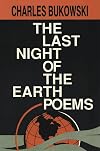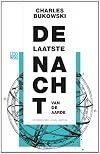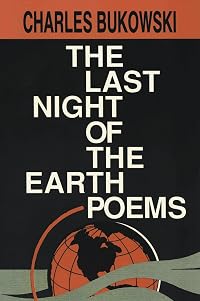
The Last Night of the Earth Poems
by Charles Bukowski
On This Page
Description
Poems deal with writing, death and immortality, literature, city life, illness, war, and the past.Tags
Recommendations





Member Reviews
A great collection of Charles Bukowski's poetry containing some of his best-known poems, including 'The Bluebird', 'Dinosauria, We' and 'Nirvana'. The collection has a certain melancholy about it, yet it is a melancholy mixed with hope, in line with the other stuff he wrote in his twilight years. He is at his best when describing the atmosphere and quiet dignity of bars and cafés and other non-descript rooms, in poems such as 'Bonaparte's Retreat', 'Last Seat at the End' and the afore-mentioned 'Nirvana'.
The thing with Bukowski is that he's always been an honest writer, and now when writing in his old age it is quite affecting. He is looking back on his life honestly, assessing his mistakes as well as his successes, and there is a show more simple dignity in this. This honesty is powerful to behold and quite bittersweet, most notably in 'The Bluebird' and 'Spark'. Bukowski is also a decidedly more likeable and sympathetic person in these later poems than in the novels that made his name. I think you need to delve into both his poetry and his prose to fully appreciate his character, but he allows an unrepentant sentimentality to come through in his poetry that he often suppressed in his somewhat muscular and hard-living prose. In this respect, 'The Bluebird' is the most eloquent and fascinating testament to this conflict within the man. It is rare to find a writer so open, and consequently Bukowski is one to cherish.
Personal favourites include: 'Begging', 'Air and Light and Time and Space', 'Car Wash', 'The Bluebird', 'Confession', 'Spark', 'The Science of Physiognomy', 'We Ain't Got No Money, Honey, But We Got Rain' (which reminds me of something Nick Cave might write), 'Bonaparte's Retreat', 'Dinosauria, We', 'Last Seat at the End', 'Charles the Lion-Hearted' and 'Nirvana' (which has been covered by Tom Waits). show less
The thing with Bukowski is that he's always been an honest writer, and now when writing in his old age it is quite affecting. He is looking back on his life honestly, assessing his mistakes as well as his successes, and there is a show more simple dignity in this. This honesty is powerful to behold and quite bittersweet, most notably in 'The Bluebird' and 'Spark'. Bukowski is also a decidedly more likeable and sympathetic person in these later poems than in the novels that made his name. I think you need to delve into both his poetry and his prose to fully appreciate his character, but he allows an unrepentant sentimentality to come through in his poetry that he often suppressed in his somewhat muscular and hard-living prose. In this respect, 'The Bluebird' is the most eloquent and fascinating testament to this conflict within the man. It is rare to find a writer so open, and consequently Bukowski is one to cherish.
Personal favourites include: 'Begging', 'Air and Light and Time and Space', 'Car Wash', 'The Bluebird', 'Confession', 'Spark', 'The Science of Physiognomy', 'We Ain't Got No Money, Honey, But We Got Rain' (which reminds me of something Nick Cave might write), 'Bonaparte's Retreat', 'Dinosauria, We', 'Last Seat at the End', 'Charles the Lion-Hearted' and 'Nirvana' (which has been covered by Tom Waits). show less
2.5 stars. I didn’t particularly enjoy this book—I found the poems didn’t feel like poetry at all, rather gross and crude stories from Bukowski’s past. However, every now and then there would be a phrase that I found beautiful or resonated with deeply (these have all been highlighted and posted.) I can’t decide if they made the rest of the book worthwhile or not.
Mr. Bukowski has grown as a poet (in spite of some claims to the contrary) and this collection shows it. He seems to be writing at a frenetic pace as his life enters its final stages (published in 1992, Bukowski died in 1994). This collection has some of the very best poems that Charles Bukowski ever wrote. It also has a few poems that aren't quite up to snuff, but that's a small price to pay to see the very best of what a writer would have to offer. I'm not going to go into the highlights here because being surprised is sometimes the best part about coming across a masterwork. I will say, however, that Bukowski's trademark humor and beat-generation writing are still in full force. The Last of the Earth Poems is a highlight in a show more remarkably prolific career. show less
This is the last collection of Bukowski's poetry published during his lifetime. Written at the age of 72, the poems are highly reflective and focus heavily on the nature of old age. Bukowski has not gone soft though; there are plenty of pieces about women, drunkenness, and desperation. However, they are approached from a place of wisdom: the wisdom that comes from a life that only Bukowski could have lived.
Bukowski, honest and full of emotion to the end, touching raw sensitive look at impending death; this is as good as it gets.
This man has a depressing life, but it makes him write some cool words.
Le Tigre had a great song titled Mediocrity Rules. A poet loaned me this book. I don't think he liked Bikini Kill. Sometimes I think about Bono and Sean Penn calling Bukowski and I die a little inside. For a number of reasons.
Members
- Recently Added By
Author Information

546+ Works 52,927 Members
Charles Bukowski was born in Andernach, Germany, on August 16, 1920. He came to the United States with his parents when he was three years old and spent his early years in poverty. As a young man he was a transient, doing odd jobs. He lived most of his live in boarding houses in the Los Angeles area. He attended Los Angeles City College briefly. show more He worked for the United States Postal Service for about ten years. Bukowski was at home with street people and his work contains a brutal realism and graphic imagery. He began publishing short stories in the mid-1940s. Starting with Flower, Fist and Bestial Wail in 1959, he produced poetry collections almost once a year. His following had grown by the time his collection of poetry about down-and-outers titled It Catches My Heart in Its Hands appeared in 1963. His short story collections include Dirty Old Man and Ejaculations, Exhibitions and General Tales of Ordinary Madness. His novels, with an autobiographical character called Henry Chinaski, include Post Office and Factotum. Bukowski wrote the screenplay for the 1987 motion picture Barfly. He later wrote about the filming of Barfly in his novel, Hollywood. Bukowski died in San Pedro, California, on March 9, 1994. (Bowker Author Biography) show less
Common Knowledge
- Canonical title*
- Evita lo specchio e non guardare quando tiri la catena
- Original title
- Last Night on Earth Poems
- Original publication date
- 1992
*Some information comes from Common Knowledge in other languages. Click "Edit" for more information.
Classifications
Statistics
- Members
- 835
- Popularity
- 32,989
- Reviews
- 11
- Rating
- (4.22)
- Languages
- Dutch, English, Italian, Spanish
- Media
- Paper, Ebook
- ISBNs
- 9
- ASINs
- 3