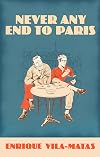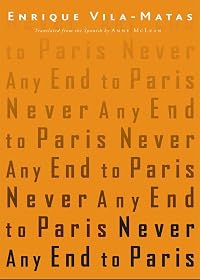
Never Any End to Paris
by Enrique Vila-Matas
On This Page
Description
Trying to be Ernest Hemingway is never easy. After reading A Moveable Feast, aspiring novelist Enrique Vila-Matas moves to Paris to be closer to his literary idol, Ernest Hemingway. Surrounded by the writers, artists and eccentrics of '70s Parisian cafe culture, he dresses in black, buys two pairs of reading glasses, and smokes a pipe like Sartre. Now, in later life, he reflects on his youth while giving a three-day lecture on irony. And he's still convinced he looks like Hemingway. Never show more Any End to Parisis a hilarious, playful novel about literature and the art of writing, and how life never quite goes to plan. show lessTags
Recommendations










Member Reviews
Ostensibly presented as an ironic homage to Ernest Hemingway’s A Moveable Feast, Enrique Vila-Matas’ quixotic Never Any End to Paris flits between an inverted Roman à clef, bildungsroman, situationist non-happening, and self-help manual on how (not) to write a novel. If that sounds jumbled, enervating, or distracting, you’ll probably also think, at times, that there’s just never any end to Never Any End to Paris. But if serious play is the kind of thing that turns your literary crank, then this may be an excellent introduction to the very serious play of Enrique Vila-Matas.
The narrator supposedly has written a lecture that will be presented over three days at a literary festival in which he looks back on the two years he spent show more in Paris as a young man. Why Paris? Because Hemingway’s late rose-tinted memoir described it as the place where he was poor and happy. What could be more enticing for a young wannabe writer? Except that the narrator, looking back on his own time in Paris, describes himself as very poor and very unhappy. It was ever thus as we seek to emulate and overcome our literary forebears (not so much the anxiety of influence, but more the influenza of anxiety).
The narrator’s time in Paris is not entirely wasted. He has connections, after all. He lives in a garret owned by Marguerite Duras (which once hid François Mitterand for two nights during the French Resistance). He parties with Paloma Picasso. He sees Samuel Beckett in the Jardin du Luxembourg. And of course the cafés, of which there definitely seems to be no end in Paris. All the while he is struggling to write his first novel, The Lettered Assassin. (It would take someone more knowledgeable than me to determine whether that is a play on the emergence of situationist theory from lettrism.)
The writing is playful and pointed, sometimes insightful, often repetitive (though presumably to a point), ironic to an almost uncomfortable degree, and at times lovely. Its embrace of and flight from modernism might be considered challenging. But it rewards patience (if not effort). And I’m glad I read it. show less
The narrator supposedly has written a lecture that will be presented over three days at a literary festival in which he looks back on the two years he spent show more in Paris as a young man. Why Paris? Because Hemingway’s late rose-tinted memoir described it as the place where he was poor and happy. What could be more enticing for a young wannabe writer? Except that the narrator, looking back on his own time in Paris, describes himself as very poor and very unhappy. It was ever thus as we seek to emulate and overcome our literary forebears (not so much the anxiety of influence, but more the influenza of anxiety).
The narrator’s time in Paris is not entirely wasted. He has connections, after all. He lives in a garret owned by Marguerite Duras (which once hid François Mitterand for two nights during the French Resistance). He parties with Paloma Picasso. He sees Samuel Beckett in the Jardin du Luxembourg. And of course the cafés, of which there definitely seems to be no end in Paris. All the while he is struggling to write his first novel, The Lettered Assassin. (It would take someone more knowledgeable than me to determine whether that is a play on the emergence of situationist theory from lettrism.)
The writing is playful and pointed, sometimes insightful, often repetitive (though presumably to a point), ironic to an almost uncomfortable degree, and at times lovely. Its embrace of and flight from modernism might be considered challenging. But it rewards patience (if not effort). And I’m glad I read it. show less
In Never Any End to Paris Enrique Vila-Matas has given us a novel about a lecture about his time as a young in Paris trying to write a novel while living in a garret owned by Marguerite Duras. He manages to be at once formally interesting, funny, and penetrating about living in Paris in particular, and living as an expatriate in general, about the Parisian literary and bohemian demimonde, and about what writing is and can be. He is an avant-garde writer for those who like to smile while they are amazed.
It is very well translated, in the sense that it is fluent and one does not feel any obstacle between oneself and the author's thoughts : the style is limpid. Reading Vila-Matas reminds me of when I first plugged earphones into my ears and listened to someone speaking, the voice seemed to exist in my head as if nothing existed between my ears except the words passing through, like a beam of light in the dark.
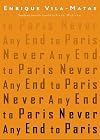
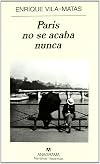
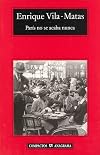
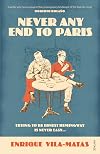
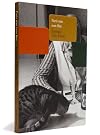
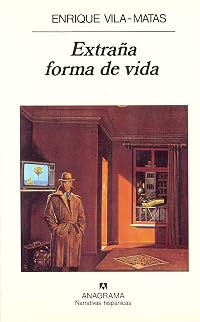
I liked the cover and all that it hints at: this is the second time I've come across a cover by Semadar Megged, and I think she does it intelligently, it is a pleasure to think about what she has done, though I think the translator deserves a bigger font here.
I want to read this book a second time because it is so rich. I want to show more understand as much as possible what is in there. Vila-Matas mentions Hemingways' iceberg theory of the short story: never tell what is most important. He writes ironically about irony, and my feeling is that Hemingway - who is a major figure in the book - Hemingway took himself immensely seriously.
The book contains other strong presences: the city of Paris, with its cafes and grey streets, Marguerite Duras who lets Vila-Matas live in her garret, his best friend Raul Escari, and all the other famous people who lived in the garret before him.
All of this divided into 113 sections in lengths varying from several pages to short paragraphs. Why 113, I wonder? All I know is that it is a prime number the cifers of which can be permutated to form two other prime numbers, 131 and 311... show less
I liked the cover and all that it hints at: this is the second time I've come across a cover by Semadar Megged, and I think she does it intelligently, it is a pleasure to think about what she has done, though I think the translator deserves a bigger font here.
I want to read this book a second time because it is so rich. I want to show more understand as much as possible what is in there. Vila-Matas mentions Hemingways' iceberg theory of the short story: never tell what is most important. He writes ironically about irony, and my feeling is that Hemingway - who is a major figure in the book - Hemingway took himself immensely seriously.
The book contains other strong presences: the city of Paris, with its cafes and grey streets, Marguerite Duras who lets Vila-Matas live in her garret, his best friend Raul Escari, and all the other famous people who lived in the garret before him.
All of this divided into 113 sections in lengths varying from several pages to short paragraphs. Why 113, I wonder? All I know is that it is a prime number the cifers of which can be permutated to form two other prime numbers, 131 and 311... show less
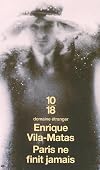
I would have preferred to read this in Spanish, but was very happy to pick up a copy in French. Paris ne finit jamais is a love affair with Paris. It is a wonderful book in which Enrique Vila-Matas looks back on his life in Paris and great authors he met there such as Ernest Hemingwey and Marguerite Duras.
After 120 pages the author didn't say anything new than what he'd say in the first 10 pages, so I dropped the book.
Good for little funny sarcastic remarks, but it had so much quotes it annoyed me. To me, quotes don't show intelligence, they show lack of self steam in one's own thoughts, so one has to quote give credibility to it.
Good for little funny sarcastic remarks, but it had so much quotes it annoyed me. To me, quotes don't show intelligence, they show lack of self steam in one's own thoughts, so one has to quote give credibility to it.
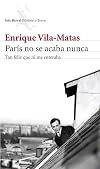
Un paseo por la mítica juventud parisiense, donde evoca a Hemingway, pero no tanto. Ameno.
Enrique Vila-Matas writes:
In those days I had no idea that, as Gide said, the great secret of works with style – the great secret of Stendhal for example – consists of writing on the spot. Gide says of Stendhal that his style, what we might call the malice of his style, consists in his stirring thought being so alive, so freshly colored, like a newly hatched butterfly (the collector is surprised to see it emerge from the chrysalis.) From this comes Stendhal’s vivid, spontaneous, unconventional touch, sudden and naked, that captivates us again and again.
In those days I had no idea that, as Gide said, the great secret of works with style – the great secret of Stendhal for example – consists of writing on the spot. Gide says of Stendhal that his style, what we might call the malice of his style, consists in his stirring thought being so alive, so freshly colored, like a newly hatched butterfly (the collector is surprised to see it emerge from the chrysalis.) From this comes Stendhal’s vivid, spontaneous, unconventional touch, sudden and naked, that captivates us again and again.
Members
- Recently Added By
Lists

España en cien libros
100 works; 1 member
Author Information

93+ Works 4,873 Members
Awards and Honors
Awards
Notable Lists
Spain - 100 Books for 100 Years (2 votes)
Series
Belongs to Publisher Series
Loomingu Raamatukogu 2014 (35-38)
Common Knowledge
- Canonical title
- Never Any End to Paris
- Original title
- París no se acaba nunca; Paris no se acaba nunca
- Original publication date
- 2003
Classifications
Statistics
- Members
- 443
- Popularity
- 69,346
- Reviews
- 14
- Rating
- (3.85)
- Languages
- 14 — Catalan, Danish, Dutch, English, Estonian, French, German, Greek, Italian, Lithuanian, Portuguese, Croatian, Spanish, Swedish
- Media
- Paper, Ebook
- ISBNs
- 27
- ASINs
- 6