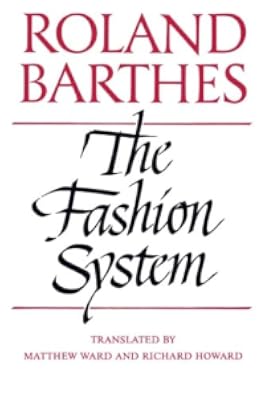
The Fashion System
by Roland Barthes
On This Page
Description
In his consideration of the language of the fashion magazine--the structural analysis of descriptions of women's clothing by writers about fashion--Barthes gives us a brief history of semiology. At the same time, he identifies economics as the underlying reason for the luxuriant prose of the fashion magazine: "Calculating, industrial society is obliged to form consumers who don't calculate; if clothing's producers and consumers had the same consciousness, clothing would be bought (and show more produced) only at the very slow rate of its dilapidation." show lessTags
Recommendations

















































Member Reviews
La moda come testo esemplare, ma anche luogo pericoloso, esposto ai rischi del corpo e delle contaminazioni tra il segno e i suoi dintorni. La moda sorella della morte. In fondo è parlando di lei che Barthes poté permettersi di scrivere che "il semiologo è colui che esprime la sua morte futura nell’istante stesso in cui ha nominato e compreso il mondo". Ma il titolo di questo intervento, che riprende un passaggio della Premessa di Barthes al suo SM, richiama il potere generativo del lavoro sui segni. La "scienza di tutti gli universi immaginati", è infatti la linguistica, nel senso "rinato" in cui la intendeva Barthes.
In his consideration of the language of the fashion magazine-the structural analysis of descriptions of women's clothing by writers about fashion-Barthes gives us a brief history of semiology.
Ratings
Members
- Recently Added By
Lists

Shaking a Leg
111 works; 3 members
Author Information

195+ Works 22,352 Members
Roland Barthes (1915-1980), a French critic and intellectual, was a seminal figure in late twentieth-century literary criticism. Barthes's primary theory is that language is not simply words, but a series of indicators of a given society's assumptions. He derived his critical method from structuralism, which studies the rules behind language, and show more semiotics, which analyzes culture through signs and holds that meaning results from social conventions. Barthes believed that such techniques permit the reader to participate in the work of art under study, rather than merely react to it. Barthes's first books, Writing Degree Zero (1953), and Mythologies (1957), introduced his ideas to a European audience. During the 1960s his work began to appear in the United States in translation and became a strong influence on a generation of American literary critics and theorists. Other important works by Barthes are Elements of Semiology (1968), Critical Essays (1972), The Pleasure of the Text (1973), and The Empire of Signs (1982). The Barthes Reader (1983), edited by Susan Sontag, contains a wide selection of the critic's work in English translation. (Bowker Author Biography) show less
Some Editions
Series
Belongs to Publisher Series
Paperbacks [Einaudi] (18)
Work Relationships
Has as a commentary on the text
Common Knowledge
- Canonical title
- The Fashion System
- Original title
- Système de la mode
- Original publication date
- 1967
- Disambiguation notice
- Please, do not combine "The Fashion System" with "The Language of Fashion" that is a set of essays about fashion.
Classifications
- Genres
- Nonfiction, Art & Design, Philosophy, Literature Studies and Criticism
- DDC/MDS
- 391.0014 — Society, government, & culture Customs, etiquette & folklore Costume and personal appearance Standard subdivisions
- LCC
- GT521 .B313 — Geography, Anthropology and Recreation Manners and customs (General) Manners and customs (General) Costume. Dress. Fashion
- BISAC
Statistics
- Members
- 269
- Popularity
- 120,416
- Reviews
- 2
- Rating
- (3.33)
- Languages
- 10 — English, French, German, Hungarian, Italian, Japanese, Multiple languages, Polish, Portuguese, Spanish
- Media
- Paper, Ebook
- ISBNs
- 18
- ASINs
- 4