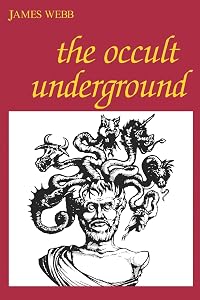
The Occult Underground
by James Webb
On This Page
Description
Covers "such personages as Madame Blavatsky, the Reverend Leadbeater, the Brotherhood of Luxor, Annie Besant, Krishnamurti, Swami Vivekananda, Spiritualists, Rosicrucians, vegetarians, Mithraic cults, and all manner of occult propagandists"--Cover.Tags
Recommendations



































Member Reviews
The Occult Underground is a neglected triumph in the history of ideas. Webb's basic thesis, more than ably fleshed out, is that during the Age of Reason (or the era of the rational), there was a massive, surging welling up of a large section of the populace in 19th century Western Europe and United States into a countercurrent of unreason (or an Age of the Irrational) in direct opposition to the perceived tyrannical straightjacket represented by rational thought. A flamboyant army was arrayed against this secular theocracy in the form of the Theosophists, the Synarchists, the Symbolists, the Spiritualists, the Mesmerists, the Christian Scientists, the Martinists, occult orientated Freemasonic orders of many kinds, and utopian orientated show more millenarian mystics of various persuasions.
They formed a hardly doctrinally unified, yet diffusely ideologically interwoven, sociocultural resistance to (as Webb himself put it) "the Powers That Be." For Webb this irrational counterculture is the expected response due as a result of a "crisis of consciousness," where humanity found itself confronted by the bleak existential tableau conjured by the burgeoning rationalist materialist scientific method and its consequent discoveries. Alone in the frigid blackness of the universe where God is dead and death is the final and true end to all, the multiplicitous occult philosophies offered a panacea to the occult practitioner; and a means to oppose the tide of stark rationalism that so threatened the fragile human psyche.
Webb's prose is lucid and engaging, this historical narrative flows well, enabling the author to build his case and close it by the book's end. The best history of that nebulous beast known as "the occult" that I have read as yet.
Bring on the followup, The Occult Establishment! show less
They formed a hardly doctrinally unified, yet diffusely ideologically interwoven, sociocultural resistance to (as Webb himself put it) "the Powers That Be." For Webb this irrational counterculture is the expected response due as a result of a "crisis of consciousness," where humanity found itself confronted by the bleak existential tableau conjured by the burgeoning rationalist materialist scientific method and its consequent discoveries. Alone in the frigid blackness of the universe where God is dead and death is the final and true end to all, the multiplicitous occult philosophies offered a panacea to the occult practitioner; and a means to oppose the tide of stark rationalism that so threatened the fragile human psyche.
Webb's prose is lucid and engaging, this historical narrative flows well, enabling the author to build his case and close it by the book's end. The best history of that nebulous beast known as "the occult" that I have read as yet.
Bring on the followup, The Occult Establishment! show less
recommended by Celia Rabinovich, I also have a 1974 hardback edition
Ratings
Members
- Recently Added By
Author Information

4 Works 280 Members
Common Knowledge
- Original title
- Flight from Reason
- Alternate titles
- The Occult Underground
- Original publication date
- 1971
Classifications
- Genres
- Nonfiction, Religion & Spirituality, History, General Nonfiction
- DDC/MDS
- 133.09 — Philosophy & psychology Parapsychology & occultism Specific topics in parapsychology and occultism Biography And History
- LCC
- BF1028 .W4 — Philosophy, Psychology and Religion Psychology Parapsychology Psychic research. Psychology of the conscious
Statistics
- Members
- 116
- Popularity
- 281,635
- Reviews
- 2
- Rating
- (4.05)
- Languages
- English, German
- Media
- Paper
- ISBNs
- 4
- ASINs
- 1