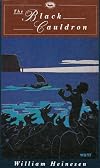
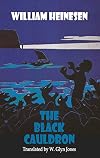
The Black Cauldron
by William Heinesen
On This Page
Description
The Black Cauldron is not a war novel as such, but a work of magic realism which traces a series of boisterous, tragi-comic events in one of the more unusual western European societies. Spanning the tragedy of war, the clash of sectarian interests, the interplay of religion and sex, The Black Cauldron develops into a presentation in mythical form of the conflict between life and death, good and evil.Tags
Recommendations











Member Reviews
A small community in the Faroes during the later stages of the Second World War, with the islands under British military occupation, and an unusual number of outsiders to disturb the even keel of island society. There are huge profits to be made at sea from fishing and cargo carrying, but there are big risks out there as well and many young men have been lost to mines, submarines and aircraft.
Of course, since this is a Heinesen novel, there are political tensions and another disturbing element is the rise of a revivalist religious movement, in this case one led by the local baker Simon — the Bun Sect. Heinesen explores the interesting collisions between capitalist greed, nationalistic and religious fervour, sexual desire, and good show more old-fashioned class prejudice that result. A funny, moving, complex dissection of a small community at a difficult time. show less
Of course, since this is a Heinesen novel, there are political tensions and another disturbing element is the rise of a revivalist religious movement, in this case one led by the local baker Simon — the Bun Sect. Heinesen explores the interesting collisions between capitalist greed, nationalistic and religious fervour, sexual desire, and good show more old-fashioned class prejudice that result. A funny, moving, complex dissection of a small community at a difficult time. show less
Ratings
Members
- Recently Added By
Author Information

49+ Works 484 Members
As a young man in the Faroe Islands, William Heinesen thought of a profession in art or music. His early poetry from the 1920s---he writes in Danish rather than Faroese---demonstrates keen sensitivity to the powerful sensual contrasts of nature in the Atlantic islands. In the 1930s, his elegiac and ecstatic pantheism had a strong effect on show more readers' social awareness. Of novels from this period, Noatun (1938) has appeared in an English translation in Great Britain. In this novel, the reader meets the vital people of a Faroese settlement bravely surviving storms, sickness, and exploitation as they struggle to establish a noatun, or new town. The Faroese people's individualism and sharp beauty are Heinesen's subjects; his strong satire, humor, and imagination have made him one of Denmark's finest prose writers. The Lost Musicians (1950) and The Kingdom of the Earth (1952) share many of the same characters, created by Heinesen to depict fantastic events in Torshavn a generation or so ago. In Heinesen's rich fantasy is an expression of the antinaturalism and antirealism that also mark the writing of the Danes Isak Dinesen and Martin A. Hansen. It is not necessary to have even heard of the Faroes to enjoy the magic of William Heinesen. (Bowker Author Biography) show less
Series
Belongs to Publisher Series
Gyldendals Tranebøger (182)
Work Relationships
Is contained in
Common Knowledge
- Canonical title
- The Black Cauldron
- Original title
- Den Sorte Gryde
- Original publication date
- 1949
Classifications
- Genres
- Fiction and Literature, General Fiction
- DDC/MDS
- 839.8136 — Literature & rhetoric German & related literatures Other Germanic literatures Danish and Norwegian literatures Danish Danish fiction 1800–1900
- LCC
- PT8175 .H367 — Language and Literature German, Dutch and Scandinavian literatures Danish literature Individual authors or works 1900-1960
- BISAC
Statistics
- Members
- 48
- Popularity
- 623,004
- Reviews
- 1
- Rating
- (3.50)
- Languages
- Danish, English, Finnish
- Media
- Paper, Audiobook, Ebook
- ISBNs
- 6
- ASINs
- 2