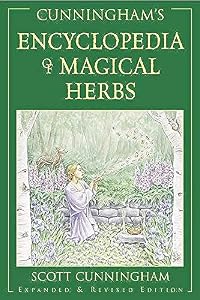
Cunningham's Encyclopedia of Magical Herbs
by Scott Cunningham
On This Page
Description
Expanded and revised, this comprehensive guide features magical uses of over 400 herbs and plants from all parts of the world. With over 400,000 copies in print, this reference book is a must for all who perform natural magic. It features illustrations for easy identification of every herb, in addition to common names, use, and rulership.Tags
Recommendations

Member Reviews
Like many teenagers testing the intriguing new ground of earth-centered spirituality, my introduction to herbalism began more than seven years ago with Scott Cunningham's classic Encyclopedia of Magical Herbs. The very sparseness of this useful reference text might be its greatest asset. Focusing exclusively on magical rather than medicinal properties and uses, the book covers a vast array of plants--herbs, weeds, flowers, trees, nuts, fruits, vegetables, and even seaweeds (the revised, fifteenth anniversary edition includes more than four hundred plants, from all different climates and continents). Short encyclopedic entries on each plant detail elemental and planetary correspondences, magical qualities, common ritual uses and relevant show more folklore; most are also accompanied by a simple illustration to aid in identifying leaf, blossom, fruit and general shape of the plant. Appendices provide a cross reference for less common folknames, as well as tables listing herbs according to gender, planet, element and magical intention. In the four chapters which serve as an introduction to the encyclopedia, Cunningham discusses briefly the general concept of magic and presents a few basic methods for incorporating herbal mixes into simple magical practices.
Some readers--for instance, those more experienced with natural remedies and herbal medicines, or those more sophisticated and nuanced in their studies of magic and meditation--might find Cunningham's Encyclopedia overly simplified, its methods charmingly glossed over and its practical information too scanty to be helpful. As a neophyte to herbalism, however, I remember how this single book sent me stalking the aisles of my neighborhood grocery store, searching out common spices and salad toppings that a sincere blessing and a few moments grinding could transform into a potent magical mixture. I remember wandering the local park, spotting wildflowers and weeds I had known all my life and wondering what latent power in them I had overlooked. Because Cunningham's descriptions of plants and herbs are stripped to the bare essentials and address only their more "metaphysical" qualities, much is left up to the budding herbalist's imagination and personal exploration. What did it mean that daisies are associated with Venus and the element of water, while dandelions relate to Jupiter and the element of air? Did my parents know that the juniper bushes planted outside their front door provided protection against thieves--and if I sat quietly, could I somehow sense that protective power emanating from them? These are the types of questions the Encyclopedia of Magical Herbs sparked in my mind, in addition to the sometimes messy, sometimes very smelly experiments with incenses and sachets. Eventually, however, Cunningham's exclusive interest in the magical properties of herbs can leave much to be desired, and readers must look elsewhere if they are interested in learning more about the physical and chemical properties of plants and their traditional uses for comfort and cure.
Part of a larger review, to read more check out Bond of Druids: Issue 2 (www.mygrove.us/bond_of_druids/index.htm) show less
Some readers--for instance, those more experienced with natural remedies and herbal medicines, or those more sophisticated and nuanced in their studies of magic and meditation--might find Cunningham's Encyclopedia overly simplified, its methods charmingly glossed over and its practical information too scanty to be helpful. As a neophyte to herbalism, however, I remember how this single book sent me stalking the aisles of my neighborhood grocery store, searching out common spices and salad toppings that a sincere blessing and a few moments grinding could transform into a potent magical mixture. I remember wandering the local park, spotting wildflowers and weeds I had known all my life and wondering what latent power in them I had overlooked. Because Cunningham's descriptions of plants and herbs are stripped to the bare essentials and address only their more "metaphysical" qualities, much is left up to the budding herbalist's imagination and personal exploration. What did it mean that daisies are associated with Venus and the element of water, while dandelions relate to Jupiter and the element of air? Did my parents know that the juniper bushes planted outside their front door provided protection against thieves--and if I sat quietly, could I somehow sense that protective power emanating from them? These are the types of questions the Encyclopedia of Magical Herbs sparked in my mind, in addition to the sometimes messy, sometimes very smelly experiments with incenses and sachets. Eventually, however, Cunningham's exclusive interest in the magical properties of herbs can leave much to be desired, and readers must look elsewhere if they are interested in learning more about the physical and chemical properties of plants and their traditional uses for comfort and cure.
Part of a larger review, to read more check out Bond of Druids: Issue 2 (www.mygrove.us/bond_of_druids/index.htm) show less
Hoping to meet that special someone? Wear a sprig of maidenhair fern. Having problems with your cash flow? Burn cloves as incense to attract riches. Want to enhance your psychic abilities? Brew up some dandelion root tea. In days gone by our ancestors lived in harmony with the earth. They knew which plants could heal and which ones could kill. They also knew that plants harbored magical powers, forces that could be harnessed and directed to fulfill a need -- anything from protecting a house to finding true love. Magical herbalism is the use of these powers to create positive changes. This revised and updated fifteenth anniversary edition contains the folklore and magical properties of over 400 herbs. Far from concentrating on esoteric, show more unobtainable plants, many of those mentioned within are old friends. The magical properties of onions, cashews, apples, rice, lettuce -- as well as dill, basil, fennel, garlic, and parsley are described. Extensive tables, a cross-reference of folk names, glossary, and annotated bibliography make this a comprehensive and valuable guide to the practice of magical herbalism. show less
I love this book. I had it years ago in paperback and constantly used it. In a move it was left to one of my children. I have since bought it on my kindle because I missed it so much. I think I prefer the print version better though, ( for the drawings of the herbs). I am putting no date finished on it as I use it all the time. I do not think I will ever officially "finish" this book.
This is a great reference book for those who are interested in herbology. Cunningham's writing is always engaging, and enjoyable and this book is no different. With an extensive listing of herbs, their magical properties, and some folklore attached to them, this book is an indispensable guide for anyone involved in a pagan path.
An excellent reference book. Alphabetical listing of herbs and plants, their histories, warnings, illustrations, and how to use them in spellcraft. Well-indexed and an easy reference book to figure out. The only thing that could make it better would be to include instructions on how to grow these, but that would make this a MUCH thicker book.
An excellent compendium of herbs and their magical properties. My only complaint would be the lack of information on the herb Henna. While it is mentioned there is very little information about it in the book.
Black and white sketches a bit disappointing, but information is very good.
Members
- Recently Added By
Author Information

47 Works 16,999 Members
Scott Cunningham authored more than fifty books, including the bestselling Wicca: A Guide to the Solitary Practitioner. He was a highly respected teacher and one of the most influential members of the modern Craft movement.
Some Editions
Series
Belongs to Publisher Series
Common Knowledge
- Canonical title
- Cunningham's Encyclopedia of Magical Herbs
- Original publication date
- 1987
- Dedication
- For Mom and Dad
- First words
- I was a young man when I began to write what was eventually to become Magical Herbalism.
Classifications
- Genres
- Religion & Spirituality, Nonfiction, General Nonfiction, Reference, Home & Garden
- DDC/MDS
- 133.43 — Philosophy & psychology Parapsychology & occultism Specific topics in parapsychology and occultism Demonology and witchcraft Magic and witchcraft
- LCC
- BF1623 .P5 .C86 — Philosophy, Psychology and Religion Psychology Occult sciences Magic. Hermetics. Necromancy
- BISAC
Statistics
- Members
- 2,070
- Popularity
- 9,957
- Reviews
- 20
- Rating
- (4.07)
- Languages
- 6 — Dutch, English, French, German, Italian, Spanish
- Media
- Paper, Ebook
- ISBNs
- 17
- ASINs
- 10