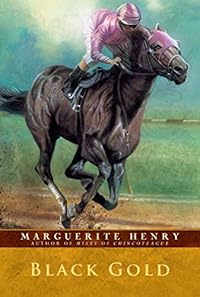
Black Gold
by Marguerite Henry
On This Page
Description
A heroic small-boned horse with a will to win is finally ridden to glory by his devoted jockey.Tags
Recommendations








Member Reviews
Much like how the infamous Misty of Chincoteague, despite its name, was more about Misty's mother, The Phantom, I'm intrigued how a book supposedly about the true story of a 1924 Kentucky Derby winner spent as pages about the mother, U-See-It, and the novel's continuity depends on the people that cared for both.
Black Gold wasn't born until the midpoint of the story. U-See-It also had more character description. She was small, youthful, liked to nuzzle, and was the "Indian Pony" in the races. Most race horses are bred large and from wealthy farms in east of the Mississippi River. U-See-It broke barriers and was a true Oklahoma gal with ties to the Osage tribe. Black Gold never went west of the Mississippi. He was still small for a show more Thoroughbred, but he was bred and raised in Kentucky. The story at this point narrates less from the quirkiness of the horse and its circumstance and read more like a typical sequence of training and races. His character was simply that of a regular race horse.
The point of view bounced between ranch owner Al Hoots, his pal and horse trainer "Old Man" Hanley Webb, and the childhood and jockey career of Jaydee Mooney. I love how Henry depicts Jaydee. I can respect his work ethic and a more intimate, self-less love of race horses. He observes horses closely, he rode Black Gold in a way that made him far more successful than he was with other riders, and Jaydee knew horse 101 and checked a lame horse's hoof! He knew to ask for help and follow the intelligent and considerate path to care for Black Gold's issue. He refused to ride until Black Gold was sound again. This was in the 1920s and animal welfare wasn't at it's highest and I suspect Black Gold would be banned from racing if he ran in modern times.
Hoots was a gambler and made some poor decisions with U-See-It, essentially expecting gentlemanly conduct regarding him and his horse instead of following written rules. Sometimes he gets away with things and sometimes he doesn't--and then he tries again, assuming people will bend the rules because everyone loves his horse enough to overlook his own conduct.
Webb is of a similar nature, though less of a gambler or more of a lonely, stubborn old man. No matter Black Gold's condition, he thought it would be the end of the world to stop racing, even for a season. I can hardly believe how little he thought of Black Gold's well being or basic foresight: treat the injury and rest and then he can continue racing. How could he think otherwise? And for some reason Jaydee is the only one telling him he should know better, while the public simply enjoys what racing Black Gold was able to do and offered condolence when things go wrong. Basic irresponsibility and no reprimands except from Jaydee. It's as if Jaydee is an embodiment of the reader's feelings than a historical figure.
I have one point to add based on other reviews. Is Black Gold too dire for a children's book? I don't think so. It's surprising for sure if you're reading Henry's books for the first time in say, 2017. But some of her most famous stories were written two to three generations ago. This one was first published in 1957. Attitudes regarding what children should be exposed to were different. Original fairy tails were dark and were meant to intimidate children from doing something their parents don't want them to do. This book is mild compared to those. It's also mild compared to most movies from the 90s that involved animals, which are what the parents of today grew up with. The Lion King has more violence.
I still love the book and how it's told. Henry knows how to inject immersion whether it's the Okie lingo and the smell of a rural race track or delve deep into the human psyche without turning the story into 400 pages or setting the mood too serious for children. show less
Black Gold wasn't born until the midpoint of the story. U-See-It also had more character description. She was small, youthful, liked to nuzzle, and was the "Indian Pony" in the races. Most race horses are bred large and from wealthy farms in east of the Mississippi River. U-See-It broke barriers and was a true Oklahoma gal with ties to the Osage tribe. Black Gold never went west of the Mississippi. He was still small for a show more Thoroughbred, but he was bred and raised in Kentucky. The story at this point narrates less from the quirkiness of the horse and its circumstance and read more like a typical sequence of training and races. His character was simply that of a regular race horse.
The point of view bounced between ranch owner Al Hoots, his pal and horse trainer "Old Man" Hanley Webb, and the childhood and jockey career of Jaydee Mooney. I love how Henry depicts Jaydee. I can respect his work ethic and a more intimate, self-less love of race horses. He observes horses closely, he rode Black Gold in a way that made him far more successful than he was with other riders, and Jaydee knew horse 101 and checked a lame horse's hoof! He knew to ask for help and follow the intelligent and considerate path to care for Black Gold's issue. He refused to ride until Black Gold was sound again. This was in the 1920s and animal welfare wasn't at it's highest and I suspect Black Gold would be banned from racing if he ran in modern times.
Hoots was a gambler and made some poor decisions with U-See-It, essentially expecting gentlemanly conduct regarding him and his horse instead of following written rules. Sometimes he gets away with things and sometimes he doesn't--and then he tries again, assuming people will bend the rules because everyone loves his horse enough to overlook his own conduct.
Webb is of a similar nature, though less of a gambler or more of a lonely, stubborn old man. No matter Black Gold's condition, he thought it would be the end of the world to stop racing, even for a season. I can hardly believe how little he thought of Black Gold's well being or basic foresight: treat the injury and rest and then he can continue racing. How could he think otherwise? And for some reason Jaydee is the only one telling him he should know better, while the public simply enjoys what racing Black Gold was able to do and offered condolence when things go wrong. Basic irresponsibility and no reprimands except from Jaydee. It's as if Jaydee is an embodiment of the reader's feelings than a historical figure.
I have one point to add based on other reviews. Is Black Gold too dire for a children's book? I don't think so. It's surprising for sure if you're reading Henry's books for the first time in say, 2017. But some of her most famous stories were written two to three generations ago. This one was first published in 1957. Attitudes regarding what children should be exposed to were different. Original fairy tails were dark and were meant to intimidate children from doing something their parents don't want them to do. This book is mild compared to those. It's also mild compared to most movies from the 90s that involved animals, which are what the parents of today grew up with. The Lion King has more violence.
I still love the book and how it's told. Henry knows how to inject immersion whether it's the Okie lingo and the smell of a rural race track or delve deep into the human psyche without turning the story into 400 pages or setting the mood too serious for children. show less
No one thinks much of Black Gold because he is so small. But Jaydee sees something special in his eyes. He knows Black Gold would be great if he was his rider! Finally, Jaydee gets his wish. And Black Gold grows strong and fast under his careful hands. Soon it would be time for the most important race in America. Did they really have what it takes to win? Black Gold's inspirational story proves that the power of love and dedication can make any dream come true.
Set against the thrilling and colorful world of Thoroughbred horses, "Black Gold" is the true story of this legendary horse and his determined young jockey.
Set against the thrilling and colorful world of Thoroughbred horses, "Black Gold" is the true story of this legendary horse and his determined young jockey.
Like some of the other lesser known Henry books, this story about a Kentucky Derby winner will primarily please an audience of horse lovers. It lacks a significant historical or geographical setting to make it appealing for educational purposes, although the story is well -researched and has a bittersweet, satisfying ending.
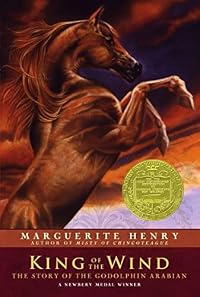
I read all of Henry's horse stories back then. Oddly enough, though, I'd never been within a hundred yards of a horse - I don't think I liked them for the usual reasons. Henry is a good writer for kids who like to actually learn stuff, like history and the purposes of the different breeds of horses. This one is one of my favorites. [b:King of the Wind: The Story of the Godolphin Arabian|423156|King of the Wind The Story of the Godolphin Arabian|Marguerite Henry|http://photo.goodreads.com/books/1174607659s/423156.jpg|2236675] remains the absolute best, though, in my opinion.
Many of Henry's horse stories are based on real horses, such as this one. Black Gold is the remarkable story of a horse that overcomes an unusual handicap to race - he runs with his head up instead of down. I highly recommend all Henry's books.
A story about trust, hope, following your dreams, and not knowing when to stop and listen to the yourself and the experts.
Hardcover, DJ
Members
- Recently Added By
Lists

Favorite Childhood Books
1,646 works; 517 members

Books That Made Me Cry
199 works; 105 members

Best Horse Stories or "Back in the Saddle Again"
82 works; 17 members
Best Books About Animals
143 works; 48 members

Newbery Adjacent
747 works; 3 members
Author Information

94+ Works 45,054 Members
Marguerite Henry was born on April 12, 1902 in Milwaukee, Wisconsin. After high school, she attended the Milwaukee State Teachers College. She became an English teacher. She sold her first published story to a woman's magazine in 1913. Her first book, "Justin Morgan Had a Horse" was named a Newberry Honor Book. This and her other titles to follow show more were written in collaboration with illustrator, Wesley Dennis. They worked together until his death in 1996. Her other works included "King of the Wind," the story of the Godolphin Arabian horse, which won a Newberry Award, "Misty of Chincoteague," which won the Junior Book Award Medal of the Boys' Clubs of America, and "Justin Morgan Had a Horse," which won the Junior Scholastic Gold Seal Award. She was presented the Children's Reading Roundtable Award for her lasting contribution to children's reading in 1961. At the time of her death she had written 58 books. Her works have been translated into eight languages. Marguerite Henry died of complications from a series of strokes on November 26, 1997 in California. show less
All Editions
Awards and Honors
Work Relationships
Is contained in
Common Knowledge
- Canonical title
- Black Gold
- Original title
- Black Gold
- Original publication date
- 1957
- People/Characters
- Black Gold
- Important events
- 1924 Kentucky Derby
- Dedication
- To Sam and Brad Holmes
- First words
- This is the story of a courageous little horse . . . Of a race . . . two races . . . Of a man and a boy who were both reaching for the same goal.
The morning is fair and filled with the smells of spring. - Last words
- (Click to show. Warning: May contain spoilers.)As he walks slowly, alone, into the centerfield, the stands rise up row on row, and in the hushed silence Jaydee gently decorates the grave of one he loved.
- Original language*
- Englisch
*Some information comes from Common Knowledge in other languages. Click "Edit" for more information.
Classifications
- Genres
- Children's Books, Fiction and Literature, Kids
- DDC/MDS
- 813.54 — Literature & rhetoric American literature in English American fiction in English 1900-1999 1945-1999
- LCC
- PZ10.3 .H43 .B — Language and Literature Fiction and juvenile belles lettres Fiction and juvenile belles lettres Juvenile belles lettres
- BISAC
Statistics
- Members
- 1,304
- Popularity
- 18,463
- Reviews
- 8
- Rating
- (4.14)
- Languages
- English, German, Swedish
- Media
- Paper, Ebook
- ISBNs
- 21
- ASINs
- 20