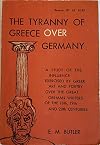
The Tyranny of Greece over Germany: A Study of the Influence Exercised by Greek Art and Poetry over the Great German Writers of the Eighteenth, Nineteenth and Twentieth Centuries
by E. M. Butler
On This Page
Description
Originally published in 1935, this book provides a study of the powerful influence exercised by Ancient Greek culture on German writers from the eighteenth century onwards. The text takes as its starting point Johann Joachim Winckelmann (1717-68), who was of fundamental importance to the introduction of Hellenistic ideas within the German intellectual tradition. This is followed by a chronological discussion of other key figures, such as Goethe, Schiller and Heine, revealing the complicated show more relationship between these ideas and the expression of an explicitly Germanic identity. A detailed index and bibliography are also included, together with illustrative figures. This book will be of value to anyone with an interest in German literature, Ancient Greece and literary criticism. show lessTags
Recommendations






































Member Reviews
A Mournful Paean to German Scholarship on Greece, July 23, 2006
This is a delightful book, first published, I believe, in 1935. It includes chapters on Winckelmann, Lessing and Herder, Goethe, Schiller, Holderlin, Heine and a concluding chapter that includes a section on Nietzsche. A fine examination of the (over) 200 year fascination of Germany with ancient Greece. This wonderfully sentimental and evocative work, that is tinged throughout with the spice of despair, both examines and exhibits said fascination. See especially the chapters on Holderlin and Heine in this regard. I was still quite young (in high school) when I first read this book and it left me yearning for more Greece, and also, I add somewhat sheepishly, a bit of Ms. show more Butler too! Yes, of course it is not really serious scholarship, but rather a romance with and about such scholarship. But nonetheless, it is filled with fine observations. I pick two at (or near) random:
"Goethe and Shakespeare, Homer and Dante, tower above their fellows but stand with them on the earth. Their range is immeasurably wider than Holderlin's, but no one has ever reached the same dizzy heights. [...] Then came the time when this life in poetry gradually changed to a life in prophecy"
"Dionysus, who came late into Greece, came late into Germany too. Heine ushered him in and then left it to Nietzsche..."
Thus the Germans went from admiring the Greek gods to wanting to be them, which would not have been a problem if their conception of the gods did not go from the light of Apollo to the shadows of Dionysus. - With results that even today, in our dumbed-down world, are studied in civics classes throughout the land. 'Whom the gods would destroy they first make mad.' ...It really is such a pity that this bittersweet study is so long out of print. show less
This is a delightful book, first published, I believe, in 1935. It includes chapters on Winckelmann, Lessing and Herder, Goethe, Schiller, Holderlin, Heine and a concluding chapter that includes a section on Nietzsche. A fine examination of the (over) 200 year fascination of Germany with ancient Greece. This wonderfully sentimental and evocative work, that is tinged throughout with the spice of despair, both examines and exhibits said fascination. See especially the chapters on Holderlin and Heine in this regard. I was still quite young (in high school) when I first read this book and it left me yearning for more Greece, and also, I add somewhat sheepishly, a bit of Ms. show more Butler too! Yes, of course it is not really serious scholarship, but rather a romance with and about such scholarship. But nonetheless, it is filled with fine observations. I pick two at (or near) random:
"Goethe and Shakespeare, Homer and Dante, tower above their fellows but stand with them on the earth. Their range is immeasurably wider than Holderlin's, but no one has ever reached the same dizzy heights. [...] Then came the time when this life in poetry gradually changed to a life in prophecy"
"Dionysus, who came late into Greece, came late into Germany too. Heine ushered him in and then left it to Nietzsche..."
Thus the Germans went from admiring the Greek gods to wanting to be them, which would not have been a problem if their conception of the gods did not go from the light of Apollo to the shadows of Dionysus. - With results that even today, in our dumbed-down world, are studied in civics classes throughout the land. 'Whom the gods would destroy they first make mad.' ...It really is such a pity that this bittersweet study is so long out of print. show less
Ratings
Members
- Recently Added By
Lists

Works Cited in The History of White People by Nell Irvin Painter
321 works; 2 members
Author Information

18+ Works 519 Members
Common Knowledge
- Canonical title
- The Tyranny of Greece over Germany: A Study of the Influence Exercised by Greek Art and Poetry over the Great German Writers of the Eighteenth, Nineteenth and Twentieth Centuries
Classifications
- Genres
- Nonfiction, Literature Studies and Criticism, Fiction and Literature
- DDC/MDS
- 830.9 — Literature & rhetoric German & related literatures German literature and literatures of related languages History, description, critical appraisal of works in more than one form
- LCC
- PT117 .B8 — Language and Literature German, Dutch and Scandinavian literatures German literature History of German literature
- BISAC
Statistics
- Members
- 57
- Popularity
- 539,720
- Reviews
- 2
- Rating
- (3.83)
- Languages
- English, German
- Media
- Paper
- ISBNs
- 1
- ASINs
- 3