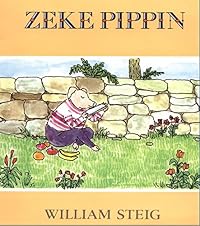
Zeke Pippin
by William Steig
On This Page
Description
After finding a harmonica in the street, a young pig becomes an accomplished musician, but when his loving family falls asleep every time he plays, he runs away in search of a more appreciative audience.Tags
Recommendations








Member Reviews
The picaresque tale of Zeke Pippin is stuffed to the gills with playful, musical lingo, manic plot-turns, and characters whose voices are intuitive and uproarious to read out loud. Read in the spirit in which it's written, kids of any age will dig this rollicking roller-coaster tale - a zeezly, zoozly masterpiece.
You can tell that you're not reading typical children's book fare when on the second page Zeke is cleaning the harmonica that fell out of the garbage truck with his father's schnapps. Zeke is a tale of a pig who finds a magic harmonica when it literally falls at his feet from the garbage truck. Of course he initially regales his family with the prelude to La Traviata! but they fall asleep. He can't believe how rude and insulting his family are and so he runs away from home with his harmonica, and food. This book is very controversial because of the fathers' schnapps and because the mother threatens suicide. Reading this book to students would take serious consideration.
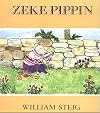
Zeke is a young pig who happens upon a magic harmonica. He plays it very well, but everyone falls asleep as he preforms so he runs away only to discover that it's the harmonica that puts everyone to sleep. Very bright, beautiful illustrations done in ink and paint with lots of variation from an opening page caption picture to double page spreads and panel illustrations. A good runaway story including danger and narrow escapes. Recommended for all readers and any childrens' collection.
Ratings
Members
- Recently Added By
Author Information

72+ Works 31,280 Members
William Steig was born in Brooklyn, New York, on November 14, 1907, and spent his childhood in the Bronx. Steig found an outlet for his talent by creating cartoons for the high school newspaper. After high school graduation, Steig spent two years at City College, three years at the National Academy, and five days at the Yale School of Fine Arts show more before dropping out. During his early days as a free-lance artist, he supplemented his income with work in advertising, although he intensely disliked it. He illustrated for the The New Yorker, beginning in 1930. During the 1940s, Steig's creativity found a more agreeable outlet when he began carving figurines in wood; his sculptures are on display as part of the collection in the historic home of Franklin D. Roosevelt in Hyde Park, New York, and in several museums in New England. In 1967, Bob Kraus, a fellow cartoonist at The New Yorker, was in the process of organizing Windmill Books, an imprint for Harper & Row. Kraus suggested that Steig try writing and illustrating a book for a young audience. The result was Steig's letter-puzzle book entitled C D B!, published in 1968. Roland the Minstrel Pig, was published the same year. With his very next title, Sylvester and the Magic Pebble, he won the Caldecott Medal. The Amazing Bone was also a Caldecott Honor Book.In 1972, Steig published his first children's novel, Dominic, which won the Christopher Award. Abel's Island followed and was a Newberry Honor Book. William Steig died in October 3, 2003 in Boston Massachusettes. (Bowker Author Biography) show less
Awards and Honors
Classifications
Statistics
- Members
- 233
- Popularity
- 139,055
- Reviews
- 3
- Rating
- (3.65)
- Languages
- English, French, German
- Media
- Paper
- ISBNs
- 11
- ASINs
- 2