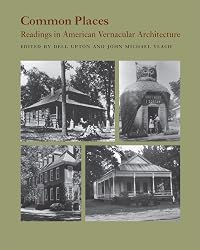
Common Places: Readings in American Vernacular Architecture
by Dell Upton
On This Page
Description
Exploring America's material culture, Common Places reveals the history, culture, and social and class relationships that are the backdrop of the everyday structures and environments of ordinary people. Examining America's houses and cityscapes, its rural outbuildings and landscapes from perspectives including cultural geography, decorative arts, architectural history, and folklore, these articles reflect the variety and vibrancy of the growing field of vernacular architecture. In essays show more that focus on buildings and spaces unique to the U.S. landscape, Clay Lancaster, Edward T. Price, John Michael Vlach, and Warren E. Roberts reconstruct the social and cultural contexts of the modern bungalow, the small-town courthouse square, the shotgun house of the South, and the log buildings of the Midwest. Surveying the buildings of America's settlement, scholars including Henry Glassie, Norman Morrison Isham, Edward A. Chappell, and Theodore H. M. Prudon trace European ethnic influences in the folk structures of Delaware and the houses of Rhode Island, in Virginia's Renish homes, and in the Dutch barn widely repeated in rural America. Ethnic, regional, and class differences have flavored the nation's vernacular architecture. Fraser D. Neiman reveals overt changes in houses and outbuildings indicative of the growing social separation and increasingly rigid relations between seventeenth-century Virginia planters and their servants. Fred B. Kniffen and Fred W. Peterson show how, following the westward expansion of the nineteenth century, the structures of the eastern elite were repeated and often rejected by frontier builders. Moving into the twentieth century, James Borchert tracks the transformation of the alley from an urban home for Washington's blacks in the first half of the century to its new status in the gentrified neighborhoods of the last decade, while Barbara Rubin's discussion of the evolution of the commercial strip counterpoints the goals of city planners and more spontaneous forms of urban expression. The illustrations that accompany each article present the artifacts of America's material past. Photographs of individual buildings, historic maps of the nation's agricultural expanse, and descriptions of the household furnishings of the Victorian middle class, the urban immigrant population, and the rural farmer's homestead complete the volume, rooting vernacular architecture to the American people, their lives, and their everyday creations. show lessTags
Recommendations






















Member Reviews
Several articles on a variety of vernacular architectures. Varying quality.
Ratings
Members
- Recently Added By
Author Information
11+ Works 505 Members
Dell Upton is Distinguished Professor of Architectural History at the University of California, Los Angeles.
Classifications
Statistics
- Members
- 94
- Popularity
- 341,999
- Reviews
- 1
- Rating
- (3.30)
- Languages
- English
- Media
- Paper
- ISBNs
- 2