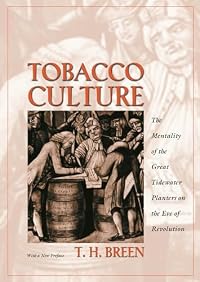
Tobacco Culture: The Mentality of the Great Tidewater Planters on the Eve of Revolution.
by T. H. Breen
On This Page
Description
The great Tidewater planters of mid-eighteenth-century Virginia were fathers of the American Revolution. Perhaps first and foremost, they were also anxious tobacco farmers, harried by a demanding planting cycle, trans-Atlantic shipping risks, and their uneasy relations with English agents. George Washington, Thomas Jefferson, and their contemporaries lived in a world that was dominated by questions of debt from across an ocean but also one that stressed personal autonomy. T. H. Breen's study show more of this tobacco culture focuses on how elite planters gave meaning to existence. He examines the value-laden relationships--found in both the fields and marketplaces--that led from tobacco to politics, from agrarian experience to political protest, and finally to a break with the political and economic system that they believed threatened both personal independence and honor. show lessTags
Recommendations













Member Reviews
This brief but thoughtful book exists midway between history and anthropology, as the author seeks to explore the mindset of Virginia's Tidewater planters in the years leading up to the American Revolution. The agricultural and labor conditions under which tobacco was grown governed the lives of these men: tobacco was a labor-intensive crop to cultivate, required precise conditions to grow, and returned varying degrees of profit as prices fluctuated. These factors directly related to the use of enslaved people to tend to a planter's crops and the increased indebtedness of many planters as they struggled with declining tobacco prices. The cultural picture which emerges helps one to understand why some (but not all) of these men chose to show more take an active role in the American Revolution. I appreciated this insight, although I do feel there is more to be explored than covered in this book and I hope to find other historians have expanded on the topic. show less
Why did the great Tidewater planters of Virginia—the great men of the colony—decide to risk their lives and fortunes in support of Revolution? Dr. Breen, a professor of history at Northwestern University, examines the mentality of these planters, and how that mentality became strained to the extent that revolution became acceptable.
Breen argues that understanding 'tobacco culture' is necessary in order to understand these men and their actions. Tobacco was not just a crop; everything on the plantation revolved around it. Even the calendar they used to mark their days revolved around the planting, cutting, and curing of the tobacco crop (45). It was the nature of tobacco that it took a year to produce a good crop, and, to a large show more extent, the worthiness of the crop depended upon the planter's skill and experience. Indeed, many planters wore (or aspired to wear) the title of 'crop master' as a badge of honor (62).
The Virginians' experience with debt and credit also shaped how they view the world. Within the colony, extending loans or credit to your peers was seen has a duty, something that one had to do to preserve his honor (94-95). This 'debt etiquette' allowed each person—lender and debtor—to preserve his public honor. The planters projected this ritualistic system upon the London merchants with whom they consigned their tobacco. They expected the merchants to sell their tobacco and send them merchandise in return; if the return on their tobacco was not enough to meet their obligations, than the 'gentlemanly' thing to do was to provide credit. The planters imagined these merchants as 'friends' who understood how to provide credit and manage debt in an 'honorable' fashion. Most merchants were ignorant of exactly how the market worked, and when their debts were called in, reacted as if they had been betrayed. (84-86).
As the market for tobacco faltered during the 1760s and 1770s, these merchants were more insistent in calling for repayment of debt, forcing the planter elite to abandon their old concerns for preserving a 'debt etiquette' and call on their peers to repay their local obligations (166). The 'tobacco culture' began to change; merchants were no longer viewed as overseas friends. Debt, viewed casually before, began to be seriously viewed as a real threat to their independence. When Parliament enacted taxes after the French and Indian War, this agrarian discontent was transformed into political protest. From there, many planters easily moved for a complete break with the political and economic system that threatened their independence and their personal honor (202-203).
Breen uses many sources to strengthen his argument—letters, diaries, and court proceedings—that the shifting mentality of the planter class helped push Virginia towards Revolution. He successfully creates for us a window into the mind of the planter elite, and provides us with a sometimes very personal view of history that is sometimes lacking from the more impersonal historical surveys. Breen succeeds admirably in demonstrating the importance of understanding how historical actors think and why they act. Only by understanding these things can we truly understand history. show less
Breen argues that understanding 'tobacco culture' is necessary in order to understand these men and their actions. Tobacco was not just a crop; everything on the plantation revolved around it. Even the calendar they used to mark their days revolved around the planting, cutting, and curing of the tobacco crop (45). It was the nature of tobacco that it took a year to produce a good crop, and, to a large show more extent, the worthiness of the crop depended upon the planter's skill and experience. Indeed, many planters wore (or aspired to wear) the title of 'crop master' as a badge of honor (62).
The Virginians' experience with debt and credit also shaped how they view the world. Within the colony, extending loans or credit to your peers was seen has a duty, something that one had to do to preserve his honor (94-95). This 'debt etiquette' allowed each person—lender and debtor—to preserve his public honor. The planters projected this ritualistic system upon the London merchants with whom they consigned their tobacco. They expected the merchants to sell their tobacco and send them merchandise in return; if the return on their tobacco was not enough to meet their obligations, than the 'gentlemanly' thing to do was to provide credit. The planters imagined these merchants as 'friends' who understood how to provide credit and manage debt in an 'honorable' fashion. Most merchants were ignorant of exactly how the market worked, and when their debts were called in, reacted as if they had been betrayed. (84-86).
As the market for tobacco faltered during the 1760s and 1770s, these merchants were more insistent in calling for repayment of debt, forcing the planter elite to abandon their old concerns for preserving a 'debt etiquette' and call on their peers to repay their local obligations (166). The 'tobacco culture' began to change; merchants were no longer viewed as overseas friends. Debt, viewed casually before, began to be seriously viewed as a real threat to their independence. When Parliament enacted taxes after the French and Indian War, this agrarian discontent was transformed into political protest. From there, many planters easily moved for a complete break with the political and economic system that threatened their independence and their personal honor (202-203).
Breen uses many sources to strengthen his argument—letters, diaries, and court proceedings—that the shifting mentality of the planter class helped push Virginia towards Revolution. He successfully creates for us a window into the mind of the planter elite, and provides us with a sometimes very personal view of history that is sometimes lacking from the more impersonal historical surveys. Breen succeeds admirably in demonstrating the importance of understanding how historical actors think and why they act. Only by understanding these things can we truly understand history. show less
Mostly about how the tobacco mentality and the resulting debt in Colonial Virginia set up the great Gentlemen to accept and embrace revolution. Many examples, though still a bit (inherently) speculative. Still, very informative.
Ratings
Members
- Recently Added By
Lists

Best U.S. History Books (1754-1828)
363 works; 17 members
Author Information

26+ Works 1,687 Members
Award-winning historian T.H. Breen has written extensively on the American Revolution. Recent works include The Marketplace of Revolution and American Insurgents, American Patriots: The Revolution of the People. He is currently the William Smith Mason Professor of American History Emeritus at Northwestern University and the James Marsh show more Professor-at-Large at the University of Vermont. show less
Common Knowledge
- Original publication date
- 1985
- Dedication
- For Susan
- First words
- Tobacco Culture explores the mental world of the great Tidewater planters of mid-eighteenth-century Virginia.
- Last words
- (Click to show. Warning: May contain spoilers.)Jefferson hated debt, was suspicious of the merchant class, and when his colleague in the new federal government, Alexander Hamilton, brought forth schemes for funding a national debt, the Virginia led the agrarians in revolt.
Classifications
Statistics
- Members
- 167
- Popularity
- 195,358
- Reviews
- 3
- Rating
- (4.17)
- Languages
- English
- Media
- Paper, Ebook
- ISBNs
- 4
- ASINs
- 1