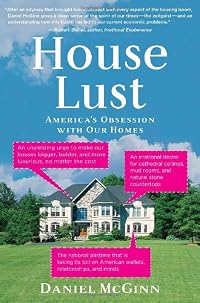
House Lust: America's Obsession With Our Homes
by Daniel McGinn
On This Page
Description
What is it about the rustic beauty of hardwood floors or the luxury of natural stone countertops that turns ordinary people into covetous friends, competitive neighbors, and shameless snoops? In House Lust, Newsweek writer Daniel McGinn takes readers inside the homes---and the psyches---of people all over the country to discover what’s fueling the national fixation on where and how we live today.If eyes are the windows to our souls, then our homes are the windows into our taste, our show more wallets, and, arguably, our very identities. Buying a house or apartment is a rite of passage, so it’s only natural that we spend a lot of time talking about our homes---and our neighbors’ homes. House Lust is filled with stories of what people are not talking about:
---The kitchen designer who in four years saw seven of her twenty clients’ marriages end in divorce
---The woman who took a sledgehammer to her kitchen while her husband was away on a fishing trip to motivate him to start remodeling
---“Zillowing”---using the Web site Zillow.com to find out how much your friends (and enemies) paid for their homes
In a narrative that blends comic social commentary with incisive reporting, McGinn proves what real estate agents have known all along: people are not just buying a house, they’re buying an identity. House Lust is an astute, funny, and sometimes disturbing portrait of contemporary America.
. show less
Tags
Recommendations


Member Reviews
Written before the recent collapse in housing prices -- he does address the beginning of the slide -- this book examines in detail the mad lust for housing makeovers and insatiable desire for people to build better and more upscale with concomitant problems. Fueled by TV shows and channels devoted to peering inside the neighbor's house, it's all about size, number of bathrooms, having something visible that is better than the neighbors. Larger homes mean more space to fill up with stuff and rising equity meant more money to buy stuff -- as long as the value of the house climbs. When it falls....
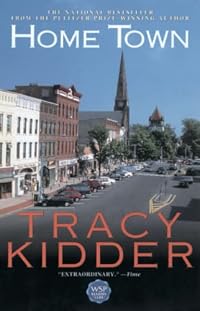
Used homes became less and less desirable. People started building and then the fun really began (although Tracy Kidder in show more [b:House|86697|House|Tracy Kidder|http://photo.goodreads.com/books/1171077379s/86697.jpg|882195] describes in greater detail the travails and conflict involved in actually constructing a house.)
McGinn, himself was not immune to the fever and invested in a rental property through agents that turned out to be less fun and remunerative than he expected. He applied and got a real estate license, so we're treated to an inside view of the profession. The only ones who really enriched themselves were the banks with their fees and the agents who gained more and more commissions as homeowners increasingly saw their homes as investments rather than domiciles.
Therein lies the core of the problem from my perspective. It used to be that Americans bought and built homes to live in; now they buy them as an investment. That inevitably drives the prices up as people move up. It's the classic bubble. Whether this trend will have been brought to a screeching halt by the recent structural failure of the market remains to be seen. I read an article recently that proposed most people should rent rather than buy anyway. A house requires too much maintenance and other expenses to make it worthwhile, reducing flexibility as well.
Lots of fun to read (or listen to - good audiobook.) show less
Used homes became less and less desirable. People started building and then the fun really began (although Tracy Kidder in show more [b:House|86697|House|Tracy Kidder|http://photo.goodreads.com/books/1171077379s/86697.jpg|882195] describes in greater detail the travails and conflict involved in actually constructing a house.)
McGinn, himself was not immune to the fever and invested in a rental property through agents that turned out to be less fun and remunerative than he expected. He applied and got a real estate license, so we're treated to an inside view of the profession. The only ones who really enriched themselves were the banks with their fees and the agents who gained more and more commissions as homeowners increasingly saw their homes as investments rather than domiciles.
Therein lies the core of the problem from my perspective. It used to be that Americans bought and built homes to live in; now they buy them as an investment. That inevitably drives the prices up as people move up. It's the classic bubble. Whether this trend will have been brought to a screeching halt by the recent structural failure of the market remains to be seen. I read an article recently that proposed most people should rent rather than buy anyway. A house requires too much maintenance and other expenses to make it worthwhile, reducing flexibility as well.
Lots of fun to read (or listen to - good audiobook.) show less
An entertaining mix of business and sociology, this book investigates several aspects of Americans' obsession with residential real estate, from renovation to the compulsion to buy a new home, vacation home or time-share. McGinn went so far as to study for and obtain a real estate license and buy a duplex in Pocatello, Idaho (he lives in Massachusetts)in the course of writing the book.
House Lust provides a casual tour through the different aspects of the American obsession with real estate: McMansions; new house fever and its polar opposite, the penchant for fixer-upers; HGTV and other glimpses of house styles of the rich, the famous, and people like you and me; and the appeal of rental properties and second (and sometimes, third and fourth) homes. This is not a rigorous study but instead an entertaining survey of what McGinn eventually concludes is an emotionally driven subject. There are no amazing revelations here, but if you're interested in houses and real estate - even a little - McGinn provides the opportunity to "peak in the window" of areas you might not otherwise have a chance to see. The book is an easy show more read and the chapters flow nicely; and it's a lot better than reruns of Flip This House! show less
I am trying to understand why so many people think bigger is better. As a residential architect, these are not the people I design for, but they are the majority of the home buyers out there.
Entertaining time-newsweek style quick read about American house lust and the media that feed it. File under 21st century material culture and Titanic, plans of--if you read this after 2008.
Beware. This book completely took the fun out of shelter porn. And replaced it with nothing.
A too-long op ed, but with more floor plans.
Members
- Recently Added By
Author Information
6 Works 172 Members
Awards and Honors
Awards
Common Knowledge
- Original publication date
- 2008-01-08
- Blurbers
- Shiller, Robert; Stein, Joel; McLeod, Alex; Gross, Michael; Levy, Steven; Rogers, Alison
Classifications
- Genres
- Nonfiction, General Nonfiction, Sociology, Art & Design
- DDC/MDS
- 155.94 — Philosophy and Psychology Psychology Differential and developmental psychology Environmental psychology Influence of Home, Dwelling, Community
- LCC
- HQ536 .M413 — Social sciences The family. Marriage, Women and Sexuality The Family. Marriage. Women The family. Marriage. Home
- BISAC
Statistics
- Members
- 132
- Popularity
- 246,699
- Reviews
- 7
- Rating
- (3.44)
- Languages
- English
- Media
- Paper, Audiobook, Ebook
- ISBNs
- 6
- ASINs
- 1