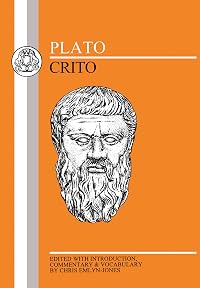
Crito
by Plato
On This Page
Description
Plato's Crito is an investigation of morality and justice. It presents a dialogue which takes place in Socrates' prison cell, where he awaits execution. He is visited by his friend Crito who has made arrangements to smuggle him out of prison. Socrates, however, reasons that this would be the wrong moral choice, and that he should act justly rather than selfishly. This edition of the Crito was first published in 1888, with a second edition published in 1891. It is now on its sixteenth show more printing. The text is given in full, in the original Greek with an introduction and notes. show lessTags
Recommendations











Member Reviews
This short episode that chronologically follows Socrates' apology portrays Crito's attempt to get Socrates out of prison while the powers that be are on a religious pilgrimage in Delos. But Socrates being Socrates, he proves to his friend Crito how this action of breaking the law would not be justified (despite the fact that the law did not carry out justice to Socrates). It is more important to Socrates that he be just in the eyes of the law regardless of his circumstance. It's a great prompt for discussion: Would Socrates be justified for escaping his wrongful death and living in exile?
Taking place after the Apology, this short dialogue is of Socrates in prison, awaiting his death, when Crito, a friend of his comes to ask Socrates if he wishes to be freed, and escape from prison. Socrates argues against Crito's proposal, outlining that if he were to break a law, he would be admitting that he thinks of himself above the law, making him a hypocrite. This is a very brief dialogue, but very effective with how short it is. It explores what is the nature of justice between the citizen and their state. a proto-social-contract theory.
This story could almost be used as a 'trolley problem' question. "If you were imprisoned, would you escape if given the means?" I don't think it is as effective as the trolley problem, because show more the following effects of staying or escaping are not as clear as the trolley problem lays out.
I have been interested in exploring just war theory in relation to revolution, dissent and pacifism. So the Crito is giving me some ideas to chew on and play with as I struggle with a coherent and nonviolent system of justice.
Title: Crito
Series: Socratic Dialogue
Order:
Author/Editor: Plato
Note (Accolades):
Genre/Subject: Philosophy, Greek
Pages: 12
Owned/Platform: PDF
Excitement: 7
Rating: 7
How did I hear about it: Western Philosophical Canon
Finished: Yes
Read over the course of: A Day
Date Finished: Wed, Apr 23, 2025
Reason Finished: Pretty short, Just get your thoughts rolling about justice and government systems
Reason Dropped:
Expectations: Met
Pacing Feel: Too Short
Style: Academic
Worth My Time: Yes show less
This story could almost be used as a 'trolley problem' question. "If you were imprisoned, would you escape if given the means?" I don't think it is as effective as the trolley problem, because show more the following effects of staying or escaping are not as clear as the trolley problem lays out.
I have been interested in exploring just war theory in relation to revolution, dissent and pacifism. So the Crito is giving me some ideas to chew on and play with as I struggle with a coherent and nonviolent system of justice.
Title: Crito
Series: Socratic Dialogue
Order:
Author/Editor: Plato
Note (Accolades):
Genre/Subject: Philosophy, Greek
Pages: 12
Owned/Platform: PDF
Excitement: 7
Rating: 7
How did I hear about it: Western Philosophical Canon
Finished: Yes
Read over the course of: A Day
Date Finished: Wed, Apr 23, 2025
Reason Finished: Pretty short, Just get your thoughts rolling about justice and government systems
Reason Dropped:
Expectations: Met
Pacing Feel: Too Short
Style: Academic
Worth My Time: Yes show less
Na véspera de sua execução, Crito visita Sócrates, oferecendo-lhe meios de escapar. O filósofo recusa, porque é racionalmente mais importante ser ético, e a alma assim ficará em boa forma, mesmo que o corpo pereça. Agora, por que cumprir com suas obrigações perante o estado? É verdade, Sócrates o ama, acima do erro da sentença daqueles que o governam atualmente, e o bom homem com ferro não fere. O senhor As Leis, de todo modo, que dara a vida social, permitindo a boa vida, a Sócrates, e portanto, ele com este senhor deveria mais que para com seus filhos, a se tornarem órfãos. Não é pelo desejo de morte da maioria portanto, que Sócrates aquiesce, pois deve-se sempre escutar os especialistas e não a mera opinião do show more povo ignaro. Entretanto, houve um acordo, imperativamente moral, anterior, para com a dignidade do estado... show less
This love of his city was.. inspiring. I never expected Socrates of all people to be a nationalist
ahora lo lei en la edicion de gredos y me parece fantastico, aun asi no muchas diferencias con respecto a la version de porrua, deberia quiza mirar parrafo por parrafo,
he aqui el bello espiritu de la ley y el contrato social, ademas ¿porque habriamos de hacer caso a lo que diga la muchedumbre?
he aqui el bello espiritu de la ley y el contrato social, ademas ¿porque habriamos de hacer caso a lo que diga la muchedumbre?
Poetic and fervent in nature. It is such a shame that this breaks off in a fragment. Still, short and sweet.
Short, sweet, to the point- Socrates justifies his refusal to escape on potentially philosophically dubious grounds.
Members
- Recently Added By
Lists

100 Books to Read in a Lifetime (That Are Older Than 200 Years)
415 works; 175 members

Política - Clásicos
164 works; 2 members

Favourite Books
1,819 works; 308 members

Books Read in 2018
4,360 works; 110 members

Favourite Greek Books
97 works; 1 member

Books Read in 2019
4,052 works; 108 members

Books I read in high school
52 works; 1 member

Greatest Books, allegedly
484 works; 9 members

ENTENDIENDO LA FILOSOFÍA
16 works; 1 member

Books Read in 2010
631 works; 11 members

New Lifetime Reading Plan by Fadiman and Major
225 works; 5 members

Recommended Reading : 600 Classics Reviewed, Editors of Salem Press, 2015
634 works; 6 members

In Our Time books
4,934 works; 2 members
Author Information

2,731+ Works 100,731 Members
Plato was born c. 427 B.C. in Athens, Greece, to an aristocratic family very much involved in political government. Pericles, famous ruler of Athens during its golden age, was Plato's stepfather. Plato was well educated and studied under Socrates, with whom he developed a close friendship. When Socrates was publically executed in 399 B.C., Plato show more finally distanced himself from a career in Athenian politics, instead becoming one of the greatest philosophers of Western civilization. Plato extended Socrates's inquiries to his students, one of the most famous being Aristotle. Plato's The Republic is an enduring work, discussing justice, the importance of education, and the qualities needed for rulers to succeed. Plato felt governors must be philosophers so they may govern wisely and effectively. Plato founded the Academy, an educational institution dedicated to pursuing philosophic truth. The Academy lasted well into the 6th century A.D., and is the model for all western universities. Its formation is along the lines Plato laid out in The Republic. Many of Plato's essays and writings survive to this day. Plato died in 347 B.C. at the age of 80. (Bowker Author Biography) show less
Some Editions
Series
Belongs to Publisher Series
Work Relationships
Is contained in
Diálogos I by Platón
Four Texts on Socrates: Plato's Euthyphro, Apology, and Crito and Aristophanes' Clouds by Thomas G. West
The Dialogues of Plato: Apology; Crito; Euthyphro; Phædo; Protagoras; Meno; Symposium; Gorgias, Part III by Plato
The Apology, Phaedo and Crito of Plato / The Golden Sayings of Epictetus / The Meditations of Marcus Aurelius by Charles William Eliot (indirect)
Teokset. Ensimmäinen osa : Apologia ; Kriton ; Lakhes ; Hippias (lyhyempi dialogi) ; Ion ; Euthyfron ; Kharmides ; Lysis ; Protagoras / suomentaneet Marja Itkonen-Kaila, Marianna Tyni, Kaarle Hirvonen by Plato
Is abridged in
Has as a study
Has as a student's study guide
Common Knowledge
- Canonical title
- Crito
- Original title
- Κρίτων
- Alternate titles*
- Krito
- Original publication date
- c. 360 B.C.
- People/Characters
- Socrates (c. 470–399 BC); Crito; Plato
- Important places
- Ancient Greece; Athens, Greece; Greece
- Important events
- Classical Antiquity; 4th century BCE
- Disambiguation notice
- Please separate and combine only LT works having substantially the same content. For example, this LT work includes one of Plato's dialogues: Crito. Thank you.
*Some information comes from Common Knowledge in other languages. Click "Edit" for more information.
Classifications
Statistics
- Members
- 494
- Popularity
- 61,074
- Reviews
- 17
- Rating
- (3.72)
- Languages
- 12 — Czech, Dutch, English, Finnish, French, German, Greek (Ancient), Italian, Norwegian (Nynorsk), Polish, Spanish, Turkish
- Media
- Paper, Audiobook, Ebook
- ISBNs
- 52
- ASINs
- 21