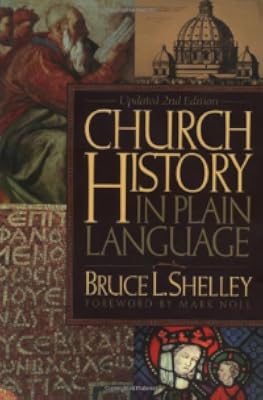
Church History In Plain Language
by Bruce L. Shelley, Bruce Leon Shelley (Author)
Word Books' Plain Language Series
On This Page
Description
Over 330,000 copies sold. This is the story of the church for today's readers. Bruce Shelley's classic history of the church brings the story of global Christianity into the twenty-first century. Like a skilled screenwriter, Shelley begins each chapter with three elements: characters, setting, plot. Taking readers from the early centuries of the church up through the modern era he tells his readers a story of actual people, in a particular situation, taking action or being acted upon, show more provides a window into the circumstances and historical context, and from there develops the story of a major period or theme of Christian history. Covering recent events, this book also: - Details the rapid growth of evangelical and Pentecostal Christianity in the southern hemisphere - Addresses the decline in traditional mainline denominations - Examines the influence of technology on the spread of the gospel - Discusses how Christianity intersects with other religions in countries all over the world For this fifth edition, Marshall Shelley brought together a team of historians, historical theologians, and editors to revise and update this father's classic text. The new edition adds important stories of the development of Christianity in Asia, India, and Africa, both in the early church as well as in the twentieth and twenty-first centuries. It also highlights the stories of women and non-Europeans who significantly influenced the development of Christianity but whose contributions are often overlooked in previous overviews of church history. This concise book provides an easy-to-read guide to church history with intellectual substance. The new edition of Church History in Plain Language promises to set a new standard for readable church history. show lessTags
Recommendations




Member Recommendations

divinepeacelutheran My go-to version of the Bible. No additions or deletions. Easy to read.
Member Reviews
This book is alright, if you don't set much store in things like historical accuracy, thoroughness, or nuanced treatment of subjects. Two stars because at least it was readable. I do not recommend as a serious or accurate source of information, but if all you have time for is a quick and dirty overview of the topic (and if you are already familiar enough with the history to know when it is misrepresented) then I suppose this would do the trick.
While it was highly readable and interesting enough for me to quickly cover the 500 pages, I was disappointed in the author's tone. I felt much more like I was reading the work of a Christian than a historian due to the value judgments that existed between the lines of this supposed work of history. While all historians have their own backgrounds and points of view, I expect historians to do their best to prevent their preexisting ideas and values from interfering with the presentation of facts and analytical, researched arguments. For example, it was jarring whenever Shelley used "we" language. At the end of his chapter on the Crusades, he says, "Unfortunately the popes never held two basic truths that we must never forget..." Here, show more the "we" reads like an assumption on the author's part that his readers share his Christian faith. Throughout the later chapters, the author is also unable to conceal his skepticism or even disdain of secularization and liberalization--again, rather than discussing these social forces from a historian's perspective, he allows his perspective as a Christian (and as a particular kind of Christian, since Christians are not all the same) to creep in.
It was also difficult, in reading the 1996 version, to excuse some of the outdated language. In particular, it was frustrating to read the sections describing "savage" or "brutal" Native American tribes. I would hope that a more recent edition would take into account more recent scholarship, or just sheer appropriateness and human respect, with regard to non-Western groups discussed in the book.
There's also a frustrating lack of women discussed in the book. I was hoping to get Jane Addams thrown in for the Social Gospel chapters, but alas, no mention. Almost more frustrating than the lack of particular women mentioned was the male-centric language in general. For example, in the section about missionaries, the author discusses the role of "missionaries and their wives", as if the women were not also missionaries.
Finally, it was confusing to me that there was not one mention of Mormons. Given that there were whole chapters on Vatican II and the Religious Right, I would have thought that the Mormons would have at least a mention in 500 pages.
Overall, I'm glad I read it. I certainly learned some new information, and was able to contextualize some prior knowledge, and also had the interesting sociological experience of reading what I considered to be a flawed history book, particularly if reviewers elsewhere on the Internet are correct in saying that this book is widely read by students preparing for life in ministry. show less
It was also difficult, in reading the 1996 version, to excuse some of the outdated language. In particular, it was frustrating to read the sections describing "savage" or "brutal" Native American tribes. I would hope that a more recent edition would take into account more recent scholarship, or just sheer appropriateness and human respect, with regard to non-Western groups discussed in the book.
There's also a frustrating lack of women discussed in the book. I was hoping to get Jane Addams thrown in for the Social Gospel chapters, but alas, no mention. Almost more frustrating than the lack of particular women mentioned was the male-centric language in general. For example, in the section about missionaries, the author discusses the role of "missionaries and their wives", as if the women were not also missionaries.
Finally, it was confusing to me that there was not one mention of Mormons. Given that there were whole chapters on Vatican II and the Religious Right, I would have thought that the Mormons would have at least a mention in 500 pages.
Overall, I'm glad I read it. I certainly learned some new information, and was able to contextualize some prior knowledge, and also had the interesting sociological experience of reading what I considered to be a flawed history book, particularly if reviewers elsewhere on the Internet are correct in saying that this book is widely read by students preparing for life in ministry. show less
This is the most readable of all the church history books i've examined. It is thorough and often gives unique insights. It is a relatively easy read as history books go and the accounts will hold your interest. I would recommend this book as a great starting place for a layman wanting to study church history and it has enough depth to still be of value for those conversant in church history.
Here is a good example of a very readable and accessible one-volume church history. The second edition covers the progress -- and regress -- of Christianity from its beginnings to the mid 1990s. Shelley writes in a style that both church history novices and journeymen can appreciate. Of necessity, he uses broad strokes to fit the whole story into a book of only 520 pages. But there is enough detail to make it interesting.
Shelley divides the history of the church into eight chronological parts or "ages":
(1) The Age of Jesus and the Apostles (6 BC - AD 70)
(2) The Age of Catholic Christianity (70-312)
(3) The Age of the Christian Roman Empire (312-590)
(4) The Christian Middle Ages (590-1517)
(5) The Age of the Reformation (1517-1648)
(6) The show more Age of Reason and Revival (1648-1789)
(7) The Age of Progress (1789-1914)
(8) The Age of Ideologies (1914-1996)
Footnotes (actually, end notes in this case) are kept to a minimum--possibly too much of a minimum for the more academically-inclined reader. He includes four or five helpful suggestions for further reading at the conclusion of each chapter, and at the end of the book, following the notes there is a list of Roman Catholic popes, and, following that, separate indexes of people, movements, and events discussed in the book.
Unfortunately, the author completely overlooks my own American religious heritage, the Stone-Campbell Restoration Movement of the 19th century, which resulted in today's Christian Churches/Churches of Christ. I believe that is a significant omission. Nonetheless, I thoroughly enjoyed recently reading the book for the third time (the first two readings were of the first edition) and will likely read it again one day since a third edition is now available.
Every serious Christian should take the time to become familiar with the major events, movements, and people of church history. This book will help them accomplish that. show less
Shelley divides the history of the church into eight chronological parts or "ages":
(1) The Age of Jesus and the Apostles (6 BC - AD 70)
(2) The Age of Catholic Christianity (70-312)
(3) The Age of the Christian Roman Empire (312-590)
(4) The Christian Middle Ages (590-1517)
(5) The Age of the Reformation (1517-1648)
(6) The show more Age of Reason and Revival (1648-1789)
(7) The Age of Progress (1789-1914)
(8) The Age of Ideologies (1914-1996)
Footnotes (actually, end notes in this case) are kept to a minimum--possibly too much of a minimum for the more academically-inclined reader. He includes four or five helpful suggestions for further reading at the conclusion of each chapter, and at the end of the book, following the notes there is a list of Roman Catholic popes, and, following that, separate indexes of people, movements, and events discussed in the book.
Unfortunately, the author completely overlooks my own American religious heritage, the Stone-Campbell Restoration Movement of the 19th century, which resulted in today's Christian Churches/Churches of Christ. I believe that is a significant omission. Nonetheless, I thoroughly enjoyed recently reading the book for the third time (the first two readings were of the first edition) and will likely read it again one day since a third edition is now available.
Every serious Christian should take the time to become familiar with the major events, movements, and people of church history. This book will help them accomplish that. show less
If you're looking for an overview of Christian history, this is great. He has quite a bit of detail (it's 500 pages), but it doesn't go into excessive detail, and it reads more like a novel than a textbook. Anybody could read this book and understand the basics of church history without prior background. One main complaint: he provides chapter notes & references at the end of the book, but they are not numbered; it's things like "the quote from Polycarp came from...." So if you are wondering where he came up with something, you have to look in the back and see if he gave any reference or not. More often than not, he didn't. I know this book is designed to be in an easy reading style rather than "textbook-ish," but he has some very show more interesting stories from church history that I wish he provided sources for somehow. This book was great for giving me a framework that will be useful when I delve into something a little more detailed (probably Pelikan and/or Latourette). show less
I bought my first copy of this book several years ago. I ended up giving it to a friend who was interested in learning about the history of Christianity. I picked up another copy not long after that. This is not an exhaustive history of Christianity. However, it is an exceptionally good starting point for figuring out which aspects of Christian history you want more detail on. He provides just enough info to cover the major points. I would consider this the highly abridged version of church history. The one thing I do wish he would have spent more time on is the modern day church as we know it in the west. Other than that, I recommend this for anyone who wants to know more about the history of Christianity but doesn't know where to start.
I'm not against apologetics books.
I'm not against Church history books written unashamedly from the Christian POV.
I'm not even against shameless mixing of the two.
I like books written in plain language.
I like good books.
This one is not. Neither is in in plain language. This is a bad book, the language is above all boring to death. What the book lacks in style, it has in abundance in bad history and pitiful apologetics. I can't understand how anyone could have read it, even on assignment.
I'm not against Church history books written unashamedly from the Christian POV.
I'm not even against shameless mixing of the two.
I like books written in plain language.
I like good books.
This one is not. Neither is in in plain language. This is a bad book, the language is above all boring to death. What the book lacks in style, it has in abundance in bad history and pitiful apologetics. I can't understand how anyone could have read it, even on assignment.
Members
- Recently Added By
Lists

Develop Your Personal Christian Library
101 works; 15 members

How to Read a Christian Book Three-Year Plan
36 works; 2 members
Trinity Norman Recommended Christian Readings
170 works; 5 members
STR's Recommended Reading List
34 works; 2 members
Recommendations by Stand To Reason
34 works; 1 member
Author Information

37 Works 4,602 Members
Dr. Bruce Shelley was senior professor of Church History and Historical Theology at Denver Theological Seminary. His previous books include The Church: God's People, Evangelism in America, and The Cross and the Flame. Dr. Shelley held the M.Div degree from Fuller Theological Seminary and the Ph.D. from the University of Iowa. Dr. Shelley passed show more away in 2010. R. L. Hatchett is professor of Theology and Philosophy at Houston Baptist University. He contributed to The Holman Bible Dictionary, Ties that Bind: Life Together in the Baptist Vision, and Biblical Hermeneutics. Dr. Hatchett holds the M.Div degree and the Ph.D. from Southwestern Baptist Theological Seminary. show less
Series

Belongs to Publisher Series
Common Knowledge
- Canonical title
- Church History In Plain Language
- Original publication date
- 1982-02-01
- Important events
- Christmas; Easter
- Epigraph
- Christianity's roots go back into Jewish history long before the birth of Jesus Christ. It was Jesus of Nazareth, however, who attacked established Judaism and brought a renewal movement into history's light early in the fir... (show all)st century. After his crucifixion under Pontius Pilate, a Roman official, Jesus' teachings spread throughout the Mediterranean area An apostle named Paul was especially influential. He stressed Go's gift of salvation for all men and thus led in Christianity's emergence from Palestinian Judaism to a position as a universal religion.
- Dedication
- To my students in Church History classes who pressed the question of significance
- First words
- [Foreword] Years ago, as an undergraduate majoring in history I was told about an exciting professor who taught church history at Denver Seminary.
[Prologue] For years I kept a cartoon on my study door.
Christianity is the only major religion to have as its central event the humiliation of its God.
[Epilogue] Today, after 2,000 years, Christianity is the faith, at least nominally, of one-third of the earth's population.
[Foreword - 4th Edition] This book executed a noble purpose: to lead evangelical readers to engage their own story and to encounter the larger Christian world.
[Epilogue - 4th Edition] This book has left a trail of stories that explain who we are. -- R. L. Hatchett - Last words
- (Click to show. Warning: May contain spoilers.)[Foreword] Therefore, let me simply encourage you, the reader, to "taste and see" that it is everything and more that my students and I have always claimed it to be!
(Click to show. Warning: May contain spoilers.)[Prologue] I am deeply grateful for all three.
(Click to show. Warning: May contain spoilers.)The two--evangelical and Roman Catholic--quickly became the moral backbone of the so-called "religious right" so widely evident in American political life at the time.
(Click to show. Warning: May contain spoilers.)[Epilogue] His title may change, but his truth endures for all generations.
(Click to show. Warning: May contain spoilers.)[Foreword - 4th Edition] She contributes to anything I do well.
(Click to show. Warning: May contain spoilers.)[4th Edition] Each has produced believers who give to Christ is their bearing suffering and extending grace.
Classifications
Statistics
- Members
- 3,356
- Popularity
- 5,032
- Reviews
- 17
- Rating
- (3.92)
- Languages
- Chinese, English, Portuguese (Portugal)
- Media
- Paper, Audiobook, Ebook
- ISBNs
- 18
- UPCs
- 2
- ASINs
- 16
