On This Page
Description
Text and black and white illustrations show how the Romans planned and constructed their cities for the people who lived within them.Tags
Recommendations













Member Reviews
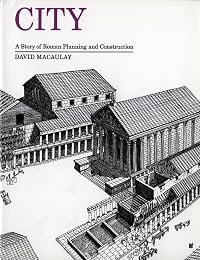
City is David Macaulay's second book. Unlike most of Macaulay's other books in this series, rather than a single building, he draws an entire city. It is interesting and I learned a lot, the Romans were more advanced with basic infrastructure like plumbing and heating than I had imagined. I think Macaulay's subject is too broad though, so he isn't able to get into the hyper-detail that otherwise is the strength of his work that makes it so fascinating. It feels like a book for 14 year olds and not enough for the adults. Still, like all of David Macaulay's books, it is well worth it.
--Review by Stephen Balbach, via CoolReading (c) 2008 cc-by-nd
--Review by Stephen Balbach, via CoolReading (c) 2008 cc-by-nd
Visually impressive and concise, it explains why many of the Roman ruins still stand. You also see how many of their techniques persist today, such as curbs, sewers, and grid-based layouts. It's meant for children, but I think most adults would find it interesting.
This is a Macaulay book about the founding and development of a roman city around the time of the first millennium and the techniques and tools they used to arrange the city and the engineering problems and solutions that were traditionally foreseen and addressed. It doesn’t shy away from traditions and roman cultural touchstones which might have been seen in a frontier city of the roman empire that really helps to immerse the reader in the story, shallow though it is, of this city; which, helps to really highlight the similarities of the technique used by the roman architects and engineers when we see how different their society was.
Amazing little book, if you have kids and this doesn't rock their little world you should probably give them up for adoption. Honestly, makes me cry when I remember what books are used at school to teach kids history.
Nice, easy, somewhat overdue research for the story I'm working on at the moment. It's a great peek into ancient technology and everyday life with a glimpse of politics, too.
Excellent drawings and dense with information. There's no action or excitement, but students who have an interest in classical Roman history will especially appreciate this book. Details of everyday life will surprise students who do not understand the relationship between modern ways and old ones. See other books in this series, but this one is my favorite.
Fascinating! I bought "Castle" for homeschooling this year but haven't read it yet. I read this one just for fun because of my interest in Latin and Rome and whoa! It's incredible. I decided to just buy all of Macaulay's books.
Members
- Recently Added By
Lists

Favorite Childhood Books
1,651 works; 519 members

A Child's Book Tour of Italy
88 works; 3 members

CCE 1000 Good Books List
1,033 works; 12 members

Books Read in 2021
5,361 works; 114 members

Architecture (Michelle TBR)
10 works; 1 member

r/History Recommended Reading List
603 works; 12 members

HOD - Creation to Christ
1 work; 1 member

Beautiful Feet Books
304 works; 7 members

The Story of the World: History for the Classical Child: Activity Book One
291 works; 3 members

Precious People
119 works; 1 member

Read Aloud Revival
108 works; 4 members
Author Information

74+ Works 30,554 Members
David Macaulay was born on December 2, 1946 in Lancashire, England, but moved to Bloomfield, New Jersey when he was 11. He received a bachelor's degree in architecture from the Rhode Island School of Design (RISD). Before becoming an author and illustrator, he worked as an interior designer, a junior high school teacher, and instructor of interior show more design at RISD from 1969 to 1973. His first book, Cathedral: The Story of Its Construction, was published in 1973. His other books include City, Castle, Pyramid, Mill, Underground, Mosque, The Way Things Work, Rome Antics, Shortcut,and How Machines Work. He has received numerous awards including a Caldecott Honor Medal in 1991 for Black and White and the Washington Children's Book Guild Award for a Body of Non-Fiction Work in 1977. He won the Royal Society young people¿s book prize for the best science books for children for his book How Machines Work. (Bowker Author Biography) show less
Awards and Honors
Series

Belongs to Publisher Series
Work Relationships
Has the adaptation
Common Knowledge
- Original publication date
- 1974
- Important places
- Verbonia, Italy; Augusta Verbonia; Northern Italy; Po Valley
- Dedication
- For Janice
and things to come
special thanks to Hardu, Mary,
Sidney, Bill, my parents,
Melanie, Walter, and Vitruvius. - First words
- By 200 B.C. soldiers of the Roman Republic had conquered all of Italy except the Alps.
- Last words
- (Click to show. Warning: May contain spoilers.)With the empire stronger than ever the walls once constructed to keep the enemy out were now serving a more important function--that of keeping the city in.
Classifications
- Genre
- Nonfiction
- DDC/MDS
- 711.40937 — Arts & recreation Area planning & landscape architecture Area planning (Civic art) Local community planning (City planning) History, geographic treatment, biography
- LCC
- TA16 .M33 — Technology Engineering Civil engineering (General). Engineering (General). Civil engineering (General)
- BISAC
Statistics
- Members
- 2,473
- Popularity
- 7,878
- Reviews
- 19
- Rating
- (4.26)
- Languages
- 9 — Dutch, English, Finnish, French, German, Italian, Portuguese, Spanish, Swedish
- Media
- Paper, Ebook
- ISBNs
- 29
- UPCs
- 3
- ASINs
- 15