Minotaur
by Benjamin Tammuz
On This Page
Description
An Israeli secret agent falls hopelessly in love with a young English girl. Using his network of contacts and his professional expertise, he takes control of her life without ever revealing his identity. Minotaur is a complex and utterly original story about a solitary man driven from one side of Europe to the other by his obsession.Tags
Recommendations























Member Reviews
It is difficult to put into words why this novel has remained in my collection for so long. I bought it at a library sale back in the early 90s and haven’t read it since. However I have taken it with me from house to house. It’s one of those enigmatic tales that doesn’t reveal everything, but gives you just enough to fire your imagination and keep you reading.
Here’s the opening paragraph to illustrate what I mean –
“A Man, who was a secret agent, parked his hired car in a rain drenched square and took a bus into town. That day he had turned forty-one, and as he dropped into the first seat he came across , he closed his eyes and fell into a bleak contemplation of his birthday. The bus pulled up at the next stop, jerking him show more back to consciousness, and he watched as two girls sat down on the empty seat in front of him. The girl on the left had hair the color of copper - dark copper with a glint of gold. It was sleek and gathered at the nape of her neck with a black velvet ribbon, tied in a cross-shaped bow. This ribbon, like her hair, radiated a crisp freshness, a pristine freshness to be found in things as yet untouched by a fingering hand. Whoever tied that ribbon with such meticulous care? wondered the man of forty-one. Then he waited for the moment when she would turn her profile to her friend, and when she turned to her friend and he saw her features, his mouth fell open in a stifled cry. Or did it perhaps escape from his mouth? Anyway, the passengers did not react. ”
Now that’s an opener. Mysterious man. Strange goings on (why doesn’t he take the hired car into town?). Instant attraction. Soon our secret agent discovers exactly who this copper-haired beauty is and begins a nearly decade-long campaign of letters. He declares his love and his unfitness for its return. He paints a picture of a man longing for something all his life without knowing what it was. When he finds her he does, but it is too late. His path is already chosen and he cannot deviate from it. At first he does not give her the opportunity to write back. Eventually though, he breaks down and gives her convoluted instructions for reply. Like his other strange requests, she complies exactly and remains intrigued and flattered by her phantom admirer. Tammuz does an excellent job of keeping the story from falling into creepy stalker mode.
Years pass. The letters grow infrequent, but they always arrive. Thea’s life moves along a typical course until her fiancé is killed in a road accident. How much did her admirer have to do with that? She has suspicions, but no outlet for them. When she eventually meets another man, this time the right one for her, she is afraid for him. Will she be allowed to live and love?
Before Tammuz gets to that, he goes into a great deal of detail describing the lives of Thea’s men. First G.R., the doomed bridegroom. Then Nikos, the soul mate. And finally Alex himself, the secret agent. All three men’s lives intersect and not only because of Thea. We’re drawn deeper and deeper into the labyrinth of Alex’s plots and passions. We come to know his reserve and his will. A vortex whirls around him, but we hardly feel its touch. When the violence and unpredictability of his vocation is felt it is fleeting and vague, but has impact. There is nothing hesitant there. All is deliberate and part of a larger picture of which we remain tantalizingly ignorant.
As does Thea. Despite her happiness, she has a gnawing void within her. Wonder and curiosity about her secret admirer plague her almost daily. When a tragedy occurs in the café across the street from where she lives, she is visited by prescience beyond anything else she has ever experienced. Will she have the strength to see it through?
The language is a bit awkward in places, but I believe that’s due to the translation. In part, that very awkwardness helps convey Alex’s state effectively. He is trepidatious and so is Thea. His rule that they shall never meet binds them and adds a doomed romance to the tale that foreshadows a great deal. The locations in Europe and the Middle East are ripe and diverse. Find this one if you can. show less
Here’s the opening paragraph to illustrate what I mean –
“A Man, who was a secret agent, parked his hired car in a rain drenched square and took a bus into town. That day he had turned forty-one, and as he dropped into the first seat he came across , he closed his eyes and fell into a bleak contemplation of his birthday. The bus pulled up at the next stop, jerking him show more back to consciousness, and he watched as two girls sat down on the empty seat in front of him. The girl on the left had hair the color of copper - dark copper with a glint of gold. It was sleek and gathered at the nape of her neck with a black velvet ribbon, tied in a cross-shaped bow. This ribbon, like her hair, radiated a crisp freshness, a pristine freshness to be found in things as yet untouched by a fingering hand. Whoever tied that ribbon with such meticulous care? wondered the man of forty-one. Then he waited for the moment when she would turn her profile to her friend, and when she turned to her friend and he saw her features, his mouth fell open in a stifled cry. Or did it perhaps escape from his mouth? Anyway, the passengers did not react. ”
Now that’s an opener. Mysterious man. Strange goings on (why doesn’t he take the hired car into town?). Instant attraction. Soon our secret agent discovers exactly who this copper-haired beauty is and begins a nearly decade-long campaign of letters. He declares his love and his unfitness for its return. He paints a picture of a man longing for something all his life without knowing what it was. When he finds her he does, but it is too late. His path is already chosen and he cannot deviate from it. At first he does not give her the opportunity to write back. Eventually though, he breaks down and gives her convoluted instructions for reply. Like his other strange requests, she complies exactly and remains intrigued and flattered by her phantom admirer. Tammuz does an excellent job of keeping the story from falling into creepy stalker mode.
Years pass. The letters grow infrequent, but they always arrive. Thea’s life moves along a typical course until her fiancé is killed in a road accident. How much did her admirer have to do with that? She has suspicions, but no outlet for them. When she eventually meets another man, this time the right one for her, she is afraid for him. Will she be allowed to live and love?
Before Tammuz gets to that, he goes into a great deal of detail describing the lives of Thea’s men. First G.R., the doomed bridegroom. Then Nikos, the soul mate. And finally Alex himself, the secret agent. All three men’s lives intersect and not only because of Thea. We’re drawn deeper and deeper into the labyrinth of Alex’s plots and passions. We come to know his reserve and his will. A vortex whirls around him, but we hardly feel its touch. When the violence and unpredictability of his vocation is felt it is fleeting and vague, but has impact. There is nothing hesitant there. All is deliberate and part of a larger picture of which we remain tantalizingly ignorant.
As does Thea. Despite her happiness, she has a gnawing void within her. Wonder and curiosity about her secret admirer plague her almost daily. When a tragedy occurs in the café across the street from where she lives, she is visited by prescience beyond anything else she has ever experienced. Will she have the strength to see it through?
The language is a bit awkward in places, but I believe that’s due to the translation. In part, that very awkwardness helps convey Alex’s state effectively. He is trepidatious and so is Thea. His rule that they shall never meet binds them and adds a doomed romance to the tale that foreshadows a great deal. The locations in Europe and the Middle East are ripe and diverse. Find this one if you can. show less
This is an odd but interesting and fast-paced book. In the first section, the whole story is given – it describes the relationship between a 41-year old Israeli secret agent and a 17-year old girl he sees on a bus. He’s easily able to find out her information and starts sending her anonymous letters telling her he loves her. Being a 17-year old, the girl, Thea, isn’t creeped out and her interest eventually turns into an idealized love. She’s able to write back to him a few times but never sees him. As the years pass, she becomes engaged to a neighbor who dies in a car accident and several years later falls in love with another man, who she at first takes for her pen pal.
The other sections describe the lives of the men who love show more her. All of them share some characteristics – wealthy, at ease all over the world, have difficult relationships with their parents. All three also have particular fixations that come to focus on Thea. Her fiancée develops Oedipal feelings after his father abandons the family and eventually these desires are transferred to the girl across the way. The Spanish lecturer, a Greek who grows up in Egypt and later moves to Europe, has a theory about the rise of the Mediterranean people and he sees Thea as a Mediterranean sort, though she is a British woman. The secret agent’s essential rootlessness and loveless marriage are counterbalanced by his dreams of a perfect woman and he decides that Thea is his dream girl.
The book is a fast read – even though you know the basic outlines of the plot, in every section, key twists or reinterpretations are given. The prose is rather distancing, except for the letters written in the initial section. This certainly moves the plot along and fits with the male characters’ isolation issues. In addition, because everyone is described in a clipped and factual way, Thea – whose life is also given a summary in the same manner – never seems particularly underdeveloped compared with the others, a real possibility given the story. An entertaining but not light read – recommended. show less
The other sections describe the lives of the men who love show more her. All of them share some characteristics – wealthy, at ease all over the world, have difficult relationships with their parents. All three also have particular fixations that come to focus on Thea. Her fiancée develops Oedipal feelings after his father abandons the family and eventually these desires are transferred to the girl across the way. The Spanish lecturer, a Greek who grows up in Egypt and later moves to Europe, has a theory about the rise of the Mediterranean people and he sees Thea as a Mediterranean sort, though she is a British woman. The secret agent’s essential rootlessness and loveless marriage are counterbalanced by his dreams of a perfect woman and he decides that Thea is his dream girl.
The book is a fast read – even though you know the basic outlines of the plot, in every section, key twists or reinterpretations are given. The prose is rather distancing, except for the letters written in the initial section. This certainly moves the plot along and fits with the male characters’ isolation issues. In addition, because everyone is described in a clipped and factual way, Thea – whose life is also given a summary in the same manner – never seems particularly underdeveloped compared with the others, a real possibility given the story. An entertaining but not light read – recommended. show less
There's something to be said for not writing a review as soon as you finish a book. Let it settle, digest what's been taken in and reflect a little. When I closed Minotaur* my initial feeling was one of having been blown away by the taut and refined writing style, the way the plot unwinds gradually, revealing part of the truth, only then to be quickly snapped back like a spring to an earlier scene in the protagonists' stories - revealing more as it went. At least a week has passed and now I find on reflection a sense of depth to the plot that didn't immediately occur to me as I was reading. This is one that I think I'd like to one day return to afresh.
Tammuz' book chiefly involves four main characters - all brilliantly drawn - and the show more book is divided into four extended chapters covering each's story from their particular perspective. There is a lot of overlap, and more than a touch of mischief at play as the author teases the reader with subtle misdirections - almost as the characters in his story will at times play with each other's emotions.
Alexander Abramov is a mid-20th century Israeli secret agent, but he is not really the hero, or even anti-hero of the spy thriller that I was expecting to read. It is his 41st birthday, and he is alone in rain-soaked London, finding himself living in isolation and distanced both physically and metaphorically from his wife and children, his home and his origins. Into his life appears Thea, an unnervingly young beauty with dark copper coloured hair, who he instantly infatuates himself with. At a distance, Abramov observes her going about her life as his obsession grows. The manipulative techniques of his profession allow him to make her existence an inseparable part of his own; an increasingly despairing one that depends on a perpetually out-of-reach and exponentially damaging and unbalanced love affair. But it would be wrong to dismiss Abramov as a creepy stalker. Yes, he can certainly creep with the best of them, but his irregularly frequent letters to Thea - the pair have never met face to face, necessitating an elaborate Le Carresque arrangement via post restante collections - are anticipated by her with a flattered and romantic sensibility that is somewhere between bemused fascination and distracted fantasy.
The years, and letters, pass and we learn of Thea's other suitors, thankfully more conventional than the strange and melancholic Abramov. There is GR - a somewhat preppy and straight contemporary, who is supposedly more suitable, as well as the enigmatic Greek intellectual and academic Nikos Trianda, who also, like his fellow Mediterranean Alexander, falls in love with Thea at first sight. She is entirely convinced that he is in fact her mysterious and "anonymous friend" himself.
The author's spare style, and poetic prose, successfully moves the story along at a fair old pace - it is very well written. By the halfway mark of this slim novel, I was amazed at quite how much ground had been covered by the writing, and the years that had passed in its story.
The final and longest chapter (almost half the book) takes the reader back initially to Alexander's childhood, and his parents' stories of Europe and their self-imposed exiles of sorts in Ottoman/Mandate-era Palestine. The elements of his earlier life that formed his character become ever clearer against a background of isolated privilege, distant parents, nascent Israel, first loves, and existential wars.
Ostensibly a beautifully penned book about obsession and where it might stem from, as well as unfulfilled love, there are many passages that subtly suggest there could be more on Tammuz' mind. I'm not sure, but think that (writing in 1979) he is also saying something about Israel's place in the Levant, and in turn perhaps raises questions of isolation, belonging, and acceptance. I don't know if the last sentence will mean anything to anyone but myself, but Minotaur certainly made me ponder far more than I bargained for when Graham Greene's "The best novel of the year" blurb caught my eye. Have to say also that I kept on thinking what a terrific film this would make in the hands of the right director. Well worth the diversion, and I'll gladly read anything else by Benjamin Tammuz.
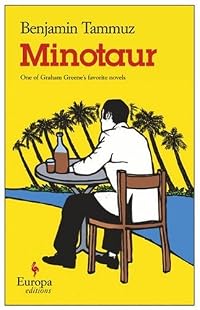
*A post script of praise for the [Europa Editions - World Noir] jacket design with this one - by Emanuele Ragnisco. It is after all both eye-catching and stylish - and deftly drops the very merest hint of the story within: a man sitting alone, in an apparently enticing location, face hidden, somehow lost in thought, possibly unhappy, or both? show less
Tammuz' book chiefly involves four main characters - all brilliantly drawn - and the show more book is divided into four extended chapters covering each's story from their particular perspective. There is a lot of overlap, and more than a touch of mischief at play as the author teases the reader with subtle misdirections - almost as the characters in his story will at times play with each other's emotions.
Alexander Abramov is a mid-20th century Israeli secret agent, but he is not really the hero, or even anti-hero of the spy thriller that I was expecting to read. It is his 41st birthday, and he is alone in rain-soaked London, finding himself living in isolation and distanced both physically and metaphorically from his wife and children, his home and his origins. Into his life appears Thea, an unnervingly young beauty with dark copper coloured hair, who he instantly infatuates himself with. At a distance, Abramov observes her going about her life as his obsession grows. The manipulative techniques of his profession allow him to make her existence an inseparable part of his own; an increasingly despairing one that depends on a perpetually out-of-reach and exponentially damaging and unbalanced love affair. But it would be wrong to dismiss Abramov as a creepy stalker. Yes, he can certainly creep with the best of them, but his irregularly frequent letters to Thea - the pair have never met face to face, necessitating an elaborate Le Carresque arrangement via post restante collections - are anticipated by her with a flattered and romantic sensibility that is somewhere between bemused fascination and distracted fantasy.
The years, and letters, pass and we learn of Thea's other suitors, thankfully more conventional than the strange and melancholic Abramov. There is GR - a somewhat preppy and straight contemporary, who is supposedly more suitable, as well as the enigmatic Greek intellectual and academic Nikos Trianda, who also, like his fellow Mediterranean Alexander, falls in love with Thea at first sight. She is entirely convinced that he is in fact her mysterious and "anonymous friend" himself.
The author's spare style, and poetic prose, successfully moves the story along at a fair old pace - it is very well written. By the halfway mark of this slim novel, I was amazed at quite how much ground had been covered by the writing, and the years that had passed in its story.
The final and longest chapter (almost half the book) takes the reader back initially to Alexander's childhood, and his parents' stories of Europe and their self-imposed exiles of sorts in Ottoman/Mandate-era Palestine. The elements of his earlier life that formed his character become ever clearer against a background of isolated privilege, distant parents, nascent Israel, first loves, and existential wars.
Ostensibly a beautifully penned book about obsession and where it might stem from, as well as unfulfilled love, there are many passages that subtly suggest there could be more on Tammuz' mind. I'm not sure, but think that (writing in 1979) he is also saying something about Israel's place in the Levant, and in turn perhaps raises questions of isolation, belonging, and acceptance. I don't know if the last sentence will mean anything to anyone but myself, but Minotaur certainly made me ponder far more than I bargained for when Graham Greene's "The best novel of the year" blurb caught my eye. Have to say also that I kept on thinking what a terrific film this would make in the hands of the right director. Well worth the diversion, and I'll gladly read anything else by Benjamin Tammuz.
*A post script of praise for the [Europa Editions - World Noir] jacket design with this one - by Emanuele Ragnisco. It is after all both eye-catching and stylish - and deftly drops the very merest hint of the story within: a man sitting alone, in an apparently enticing location, face hidden, somehow lost in thought, possibly unhappy, or both? show less
I first read this book some 30(!) years ago, and I remember picking up pieces of my mind off the wall afterwards... At the time I also read "Tinker Tailor Soldier Spy" and they resonated with each other. Spy books that have nothing to do with espionage.
I've been doing some re-reading lately...
So far (almost done...) the book is everything I remembered it to be. The translation (first read was in Hebrew) stumbles in the first few pages, but caused no long-lasting harm. It soon hits its groove, or you just get used to it and never notice it again.
The book is a story about the obsessive love of a middle-aged spy to a very young girl/woman.
The book is a commentary about how dysfunctional love can be, as all of the relationships described show more in it are deeply flawed. Notice that Tammuz, as the author, is the only one treating Thea as a whole person - he doesn't conform with his protagonists.
Slow moving, relatively little plot, deep characters, just fun to take in at its own pace. The book refers to the middle east conflict, but only as background, not as a central plot theme.
Le Carre's "The last illusion of an illusionless man" applies very well here. show less
I've been doing some re-reading lately...
So far (almost done...) the book is everything I remembered it to be. The translation (first read was in Hebrew) stumbles in the first few pages, but caused no long-lasting harm. It soon hits its groove, or you just get used to it and never notice it again.
The book is a story about the obsessive love of a middle-aged spy to a very young girl/woman.
The book is a commentary about how dysfunctional love can be, as all of the relationships described show more in it are deeply flawed. Notice that Tammuz, as the author, is the only one treating Thea as a whole person - he doesn't conform with his protagonists.
Slow moving, relatively little plot, deep characters, just fun to take in at its own pace. The book refers to the middle east conflict, but only as background, not as a central plot theme.
Le Carre's "The last illusion of an illusionless man" applies very well here. show less
Hmmm. Tales of obsessive &/or stalker-ish "love" aren't really my thing... especially when the stalkee is (naively, stupidly, ...?) flattered by the unwavering love & attention over years of time? Not a comfortable book, imo.
The structure of the book was good. Some of the backstory info was interesting. The ending was not entirely unpredictable. I guess since it's under the "noir" branch of Europa Editions, I should have expected dark; it is dark. No happy people or endings here.
It mostly kept my interest & was a quick read. I can't really say that I liked it very much though.
The structure of the book was good. Some of the backstory info was interesting. The ending was not entirely unpredictable. I guess since it's under the "noir" branch of Europa Editions, I should have expected dark; it is dark. No happy people or endings here.
It mostly kept my interest & was a quick read. I can't really say that I liked it very much though.
Minotaur is the story of obsession and love. It is related from three different male perspectives, but the central character is a ‘spy’ who falls for a teenager called Thea after seeing her on a bus.
Tammuz cleverly details the four respective lives leading to the common theme of obsessive love for the same woman. The spy becomes a central background figure, a stalker, who develops a clandestine relationship of letters, sight unseen, and provides the central relationship. All events lead towards this theme, with the scenarios revisited from each male character to illuminate and illustrate the obsessive love of the spy.
Spy novel does not quite fit the description of this novel, as it has a quiet and contemplative pace, with no great show more twist or reveal at the end. Neither is it a love story, being in the end an unrequited obsession with an ideal. Cleverly constructed, with some beautiful prose, Tammuz poses questions of imagined, unrequited and obsessive love, entering the minds of these three men, for the most part ignoring the physicality of love. It is a very good read. show less
Tammuz cleverly details the four respective lives leading to the common theme of obsessive love for the same woman. The spy becomes a central background figure, a stalker, who develops a clandestine relationship of letters, sight unseen, and provides the central relationship. All events lead towards this theme, with the scenarios revisited from each male character to illuminate and illustrate the obsessive love of the spy.
Spy novel does not quite fit the description of this novel, as it has a quiet and contemplative pace, with no great show more twist or reveal at the end. Neither is it a love story, being in the end an unrequited obsession with an ideal. Cleverly constructed, with some beautiful prose, Tammuz poses questions of imagined, unrequited and obsessive love, entering the minds of these three men, for the most part ignoring the physicality of love. It is a very good read. show less
At 18, beautiful copper haired Thea begins receiving adoring letters from a mysterious stranger. Magnetically drawn to him they settle into an on and off again romantic correspondence well into her twenties even while other men flow through her life. The lives of Thea and three other characters intertwine in this story of obsession, intrigue and displaced love. Set in London, and Tel Aviv, Minotaur is an inventive story of suspense told with creative literary style. Part psychological thriller and part mystery this is a novel accessible to those interested in both. Like most Europa editions, it is a bit dark, but nevertheless, a worthy read. Mesmerizing!
Members
- Recently Added By
Published Reviews
ThingScore 83
With echoes of Kafka and Conrad, Israeli novelist Tammuz (Castle in Spain) has fashioned a provocative, spare, slow-to-unfold mystery of character.
added by Polaris-
If the doomed atmosphere that hovers over the romances in Greene and Le Carré is present in Minotaur, so is a flavor that can only be described as more continental, and prose more sensuous than fits into the schemes of those two writers.
added by Polaris-
A novel about the expectations and compromises that humans create for themselves... Very much in the manner of William Faulkner and Lawrence Durrell.
added by Polaris-
Author Information

30+ Works 363 Members
A native of Kharkov, Russia, Tammuz immigrated to Palestine in 1924. He attended a yeshiva in Tel Aviv while also studying at the Herzlia secondary school. He worked as a laborer in the British army camps and was a member of the Palmah. His work as a journalist involved assignments as a press censor for the Mandatory Government, as a reporter for show more a political party newspaper, and later as the editor of the weekend literary supplement of Ha'aretz. His earliest works were short stories of his childhood, focusing on the roots of Israeli life. His subsequent novels often reflect themes that are critical of modern society. (Bowker Author Biography) show less
Some Editions
Awards and Honors
Awards
Series
Belongs to Publisher Series
Common Knowledge
- Canonical title
- Minotaur
- Original title
- Minotaur; מינוטאור
- Original publication date
- 1980 (original Hebrew) (original Hebrew); 1981 (English translation) (English translation); 1982 (French translation) (French translation); 1997 (Spanish translation) (Spanish translation); 2000 (Turkish translation) (Turkish translation); 2001 (Russian translation) (Russian translation)
- People/Characters
- Thea; Alexander Abramov; G.R.; Nikos Trianda
- Dedication*
- Per Fou Tsong.
- First words*
- Un tale, che era un agente segreto, parcheggiò in una piazza bagnata dalla pioggia la macchina che aveva preso a nolo, e salì sull'autobus per andare in città.
- Last words
- (Click to show. Warning: May contain spoilers.)Quando telefonò l'indomani, attese a lungo ma dall'altra parte non rispose nessuno.
(Click to show. Warning: May contain spoilers.)When he phoned the following day, he listened for a long time to the ringing at the other end, but nobody came to answer the call. - Blurbers
- Greene, Graham
- Original language
- Hebrew
- Disambiguation notice
- Original title: Minoṭaʼur or מינוטאור : רומן
*Some information comes from Common Knowledge in other languages. Click "Edit" for more information.
Classifications
- Genres
- Fiction and Literature, General Fiction
- DDC/MDS
- 892.436 — Literature & rhetoric Asian Literature Afro-Asiatic literatures Jewish, Israeli, and Hebrew Hebrew fiction 1947–2000
- LCC
- PJ5054 .T317 .M4813 — Language and Literature Oriental languages and literatures Oriental philology and literature Hebrew Literature Individual authors and works
- BISAC
Statistics
- Members
- 225
- Popularity
- 144,310
- Reviews
- 12
- Rating
- (3.75)
- Languages
- 9 — English, French, German, Hebrew, Italian, Portuguese, Slovenian, Spanish, Turkish
- Media
- Paper, Ebook
- ISBNs
- 16
- ASINs
- 3