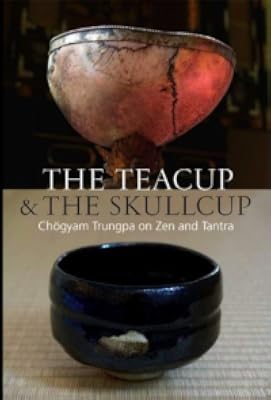
The Teacup & the Skullcup:Chogyam Trungpa on Zen and Tantra
by Chogyam Trungpa
On This Page
Description
The Teacup and the Skullcup is made up of edited transcripts from two seminars that Ch gyam Trungpa gave near the beginning of his North American teaching career in 1974--one in Barnet, Vermont, and one in Boston--called "Zen and Tantra." Although Trungpa Rinpoche belonged to the tantra tradition, he acknowledged the strength and discipline gained from Zen influence. Through these talks you can see his respect for the Zen tradition and how it led to his using certain Zen forms for his public show more meditation hall rituals. He discusses the differences in style, feeling, and emphasis that distinguish the two paths and shows what each one might learn from the other. Also included are Trungpa Rinpoche's commentary on the Ten Oxherding Pictures and an essay he composed in memory of Shunryu Suzuki Roshi, a close friend with whom he continually exchanged ideas for furthering buddhadharma in America. show lessTags
Recommendations











Member Reviews
An exposition of the similarities and differences between Vajrayana Buddhism and Zen, by one of the twentieth century's greatest meditation teachers.
The Teacup and the Skullcup is made up of edited transcripts from two seminars that Chögyam Trungpa gave near the beginning of his North American teaching career in 1974--one in Barnet, Vermont, and one in Boston--called "Zen and Tantra." Although Trungpa Rinpoche belonged to the tantra tradition, he acknowledged the strength and discipline gained from Zen influence. Through these talks you can see his respect for the Zen tradition and how it led to his using certain Zen forms for his public meditation hall rituals. He discusses the differences in style, feeling, and emphasis that show more distinguish the two paths and shows what each one might learn from the other.
Also included are Trungpa Rinpoche's commentary on the Ten Oxherding Pictures and an essay he composed in memory of Shunryu Suzuki Roshi, a close friend with whom he continually exchanged ideas for furthering buddhadharma in America. show less
The Teacup and the Skullcup is made up of edited transcripts from two seminars that Chögyam Trungpa gave near the beginning of his North American teaching career in 1974--one in Barnet, Vermont, and one in Boston--called "Zen and Tantra." Although Trungpa Rinpoche belonged to the tantra tradition, he acknowledged the strength and discipline gained from Zen influence. Through these talks you can see his respect for the Zen tradition and how it led to his using certain Zen forms for his public meditation hall rituals. He discusses the differences in style, feeling, and emphasis that show more distinguish the two paths and shows what each one might learn from the other.
Also included are Trungpa Rinpoche's commentary on the Ten Oxherding Pictures and an essay he composed in memory of Shunryu Suzuki Roshi, a close friend with whom he continually exchanged ideas for furthering buddhadharma in America. show less
The paperback was from my Goodwill stash
Around the year in 52 books challenge notes:
#32. A book related to the 2020 Olympic Summer Games in Japan
Members
- Recently Added By
Author Information

174+ Works 9,492 Members
Chogyam Trungpa (February 29, 1939 -- April 4, 1987) was one of the most visibly active of the Tibetan Buddhist refugees to come to the West and to lay the foundation in Europe and North America for the study of the Tibetan traditions. Born the son of a farmer and considered the eleventh incarnation of Trungpa Tulku, he was given a traditional show more training in religious philosophy but in his teens had to be hidden from the invading Chinese. Fleeing in 1959 when the Communists invaded Tibet, he ultimately moved to Great Britain, where he studied comparative religion at Oxford University and established a Tibetan meditation center in Scotland. He moved to the United States in 1970 and established the Buddhist university, Naropa, in Colorado. Naropa became the center for seminars, many of which he cotaught with prominent American artists, scholars, and scientists. Among his contributions are the translation of numerous Tibetan texts. On September 28, 1986, he suffered cardiac arrest, requiring intensive care at the hospital, then at his home and finally, in mid-March 1987, back at the hospital, where he died on April 4, 1987. (Bowker Author Biography) show less
Classifications
Statistics
- Members
- 51
- Popularity
- 595,786
- Reviews
- 2
- Rating
- (4.00)
- Languages
- English, German
- Media
- Paper, Ebook
- ISBNs
- 4