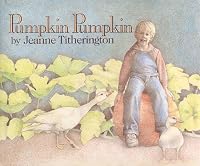
Pumpkin Pumpkin
by Jeanne Titherington
On This Page
Description
Jamie plants a pumpkin seed and, after watching it grow, carves it, and saves some seeds to plant in the spring.Tags
Recommendations
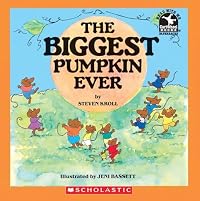
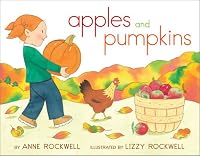








Member Recommendations


Member Reviews
Jamie plants a pumpkin seed in the spring in this seasonal picture book for younger children, watching it grow into a pumpkin plant, then flower, and then produce an actual pumpkin, as summer and then autumn come. When it is Halloween time, he carves the now massive pumpkin into a jack-o-lantern, saving some of the seeds he scooped out of it to plant next year...
Originally published in 1986, Pumpkin, Pumpkin is the first picture book I have read from author/illustrator Jeanne Titherington, whose beautiful colored pencil artwork really enhanced the experience. The text is very simple—no more than a sentence or phrase per two-page spread—describing the seasonal rhythms of a growing pumpkin, while the artwork captures the beauty of the show more natural world (it looks like a farm) in which Jamie lives. I particularly liked the various animals with which Jamie interacts, as he watches his pumpkin grow. Recommended to younger picture book readers and audiences—kindergarten and below, I would say—looking for pumpkin-centered tales for autumn. show less
Originally published in 1986, Pumpkin, Pumpkin is the first picture book I have read from author/illustrator Jeanne Titherington, whose beautiful colored pencil artwork really enhanced the experience. The text is very simple—no more than a sentence or phrase per two-page spread—describing the seasonal rhythms of a growing pumpkin, while the artwork captures the beauty of the show more natural world (it looks like a farm) in which Jamie lives. I particularly liked the various animals with which Jamie interacts, as he watches his pumpkin grow. Recommended to younger picture book readers and audiences—kindergarten and below, I would say—looking for pumpkin-centered tales for autumn. show less
In the spring, Jamie plants a pumpkin seed. He watches all summer as the pumpkin grows and grows. In the fall, it is big enough to make a perfect Halloween jack-o’-lantern. But what will Jamie find inside the pumpkin?
The target audience for this charming picture book is preschool through primary grades, ages four through eight. The exquisite colored pencil illustrations are a highlight of this book. With their childlike innocence, they are sure to delight the young reader. The engaging illustrations are a perfect counterpart to the narrative as they clearly represent the simple science of planting seeds, watching them grow, and deciding when to harvest.
With its simple, repetitive narrative, this picture book is perfect for emerging show more readers. Picture clues help in decoding words while the narrative’s repetition builds confidence as the child reads.
Highly recommended for all young readers, especially emerging readers. Also recommended for autumn storytelling, for an introduction to the science of sowing seeds and growing plants [for which it won a New York Academy of Science Children’s Book Award], or for the beautiful artwork. This is a book that belongs in every primary grade classroom library. show less
The target audience for this charming picture book is preschool through primary grades, ages four through eight. The exquisite colored pencil illustrations are a highlight of this book. With their childlike innocence, they are sure to delight the young reader. The engaging illustrations are a perfect counterpart to the narrative as they clearly represent the simple science of planting seeds, watching them grow, and deciding when to harvest.
With its simple, repetitive narrative, this picture book is perfect for emerging show more readers. Picture clues help in decoding words while the narrative’s repetition builds confidence as the child reads.
Highly recommended for all young readers, especially emerging readers. Also recommended for autumn storytelling, for an introduction to the science of sowing seeds and growing plants [for which it won a New York Academy of Science Children’s Book Award], or for the beautiful artwork. This is a book that belongs in every primary grade classroom library. show less
There are two reasons I liked this book, the first being because of its plot. The plot of this story is simple yet keeps the reader engaged. The story describes the cycle of a pumpkin in a simplistic way that young children can easily comprehend. There are few words on each page, and the author describes the pumpkin growing by stating throughout a few pages that it “grew… and grew… (Next page) and grew… (Next page) until… (Next page).” The author’s choice of spreading out the words onto separate pages builds suspense for the reader and keeps the reader interested. I can imagine reading this book to a child and noting their eagerness to flip the page and find out what the pumpkin develops into after the page that reads, show more “Until…” The second reason I enjoyed this book is due to the author’s illustrations, which were created using soft colored pencils. I liked how the illustrations were soft and simple because they fit perfectly with the author’s simplistic writing. The main idea of this book is to teach children about the life cycle of a pumpkin plant. This book also serves as a great seasonal/holiday book to get children excited for fall. show less
I have mixed feelings about the story, “Pumpkin Pumpkin” by Jeanne Titherington. Although it is an easy-read, informational story, I thought it was kind of boring. The illustrations were precise and depicted the text well, but the colors were very dull. Personally, I would have lost interest in this story when I was a kid. However, the language is simple for beginning readers and gets right to the point. Particularly, “And the pumpkin grew… and grew… and grew, until Jamie picked it.” This sentence was spread out over four pages, allowing beginning readers to decode simpler words while still comprehending the text. Thus, this book would be a good learning tool for younger children. Overall, the big idea of this story was to show more inform kids about planting a pumpkin seed and the stages of how it grows into a pumpkin. show less
I liked this book overall because of the illustrations and how it made learning about how pumpkins grow interesting and relatable. I enjoyed how the illustrations looked to be on a different form of paper and how they aided in helping to understand how a pumpkin grows. Also I noticed in the illustrations that as the pumpkin grows larger there is an animal near the pumpkin. It kind of gives a comparison of how large the pumpkin actually is by comparing it to an animal people know the size of. I also enjoyed how they continued the sentences through multiple pages so when the pumpkin was growing it went “and the pumpkin grew, …. And grew,….. and grew” it made you keep flipping the page because you wanted to know how big the pumpkin show more grew. The overall message of the book is to give a clear understanding of how pumpkins grow and what happens throughout the stages. show less
This book uses simple phrases, about one on every other page, to explain the life cycle of a pumpkin. The story's main character, Jamie, is shown in the illustrations as being the one who plants the seed, watches it grow, etc. This a great book for younger readers who may still be learning about the life cycle of seeds to plants and who are also reading simple sentences. However, it is written too simplistically for older elementary readers. The life cycle of the pumpkin could have also been written in a more interesting story that would have gotten more students excited to learn about pumpkins. However, it seemed like the author was basically writing that a seed was planted by a little boy, he watched it grow, and it turned into a show more pumpkin- too boring for most students and myself to even read aloud in my future classes. show less
I liked this book because I liked how the story went in sequence. By this, the reader can comprehend how a pumpkin seed becomes a fully grown pumpkin. The illustrations of the book help understand the story because it makes it easier for the reader to visually see the process in which a pumpkin seed became a fully grown pumpkin. For visual learners, illustrations like the one used in this book would be effective. Another reason why I liked this book was because of the writing style. The story had a well-organized flow. “Jamie planted a pumpkin seed…and the pumpkin seed grew a pumpkin sprout…and the pumpkin sprout grew a pumpkin plant…” and as you can see, the flow and order in which the book follows keeps the reader engaged to show more see how the pumpkin is finally made, “And the pumpkin grew…and grew…and grew…until Jamie picked it”. The last reason why I liked this book was because of the character used in it. A young reader could relate to the little boy named Jamie because he was also learning about the sequence in which a pumpkin grew. The young reader will remained focused throughout the book because of the relevancy. The purpose of this whole book was to teach young readers how a pumpkin seed becomes a fully grown pumpkin and the cycle behind it. show less
Members
- Recently Added By
Lists

Under The Chinaberry Tree
194 works; 1 member

Youth: Seasonal
55 works; 1 member
Author Information
10+ Works 3,692 Members
Classifications
- Genres
- Picture Books, Children's Books, Nonfiction
- DDC/MDS
- 813.54 — Literature & rhetoric American literature in English American fiction in English 1900-1999 1945-1999
- LCC
- PZ7 .T53 .P — Language and Literature Fiction and juvenile belles lettres Fiction and juvenile belles lettres Juvenile belles lettres
- BISAC
Statistics
- Members
- 3,295
- Popularity
- 5,141
- Reviews
- 38
- Rating
- (3.89)
- Languages
- English, French, Spanish
- Media
- Paper, Audiobook
- ISBNs
- 23
- ASINs
- 4
